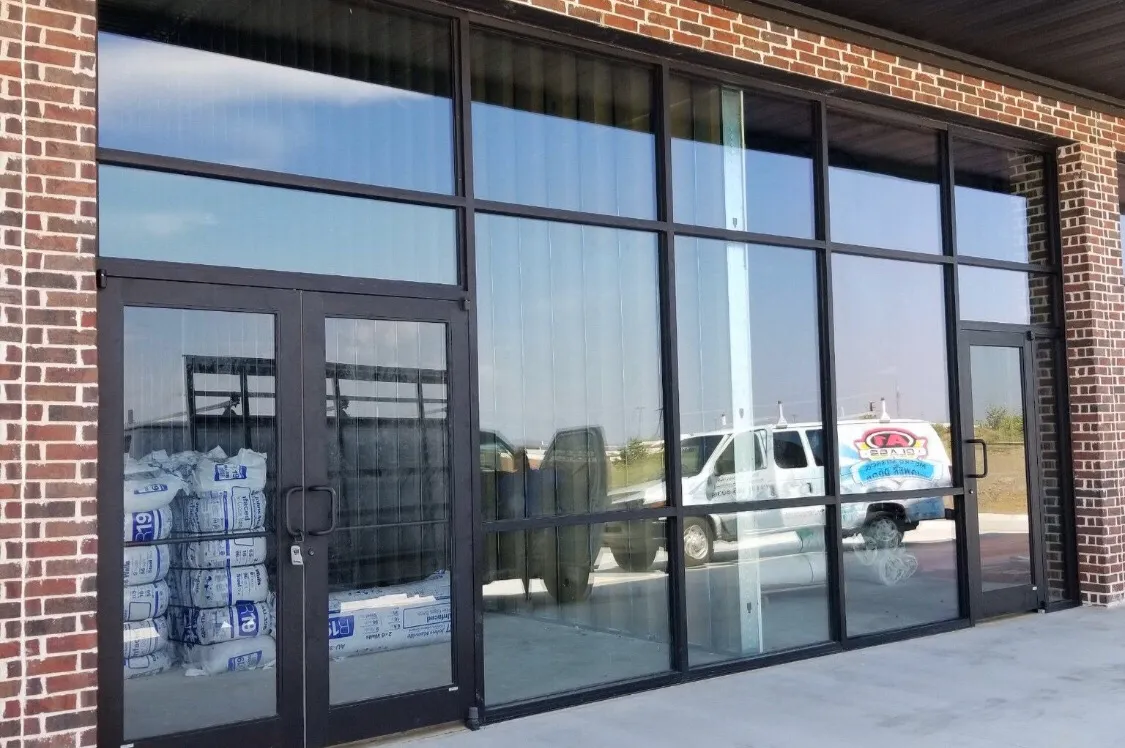
Insulated Storefront Glass
Double-Glazed & Triple-Glazed Insulating Glass Units for Retail Storefronts, Shop Windows & Commercial Entrances – Energy Efficiency, Condensation Control, Thermal Comfort
Insulated storefront glass (also referred to as insulating glass units, IGU, double-glazed shopfront glass or thermal storefront glass) consists of two or more glass panes separated by a hermetically sealed air or gas-filled cavity. The assembly is designed to reduce heat transfer through the storefront, improving building energy efficiency, reducing condensation on interior surfaces, and enhancing occupant comfort near the glazing.
For glazing contractors, facade fabricators, energy consultants, retail developers, architects, and procurement managers supplying the European, North American, Australian and global commercial construction market, insulated storefront glass represents the energy-code-compliant specification for retail glazing – delivering the thermal performance required by modern building regulations while maintaining the visual transparency essential for retail display.
💡 Why insulated glass for storefronts? Retail storefronts are among the largest sources of heat loss in commercial buildings. A single-glazed storefront can lose 5–7 times more heat than an insulated wall. Building energy codes worldwide – including Part L (UK), EnEV (Germany), Title 24 (California), IECC (US), and NCC Section J (Australia) – increasingly mandate minimum thermal performance for commercial glazing. Beyond compliance, insulated storefront glass delivers: (1) lower heating and cooling costs year-round, (2) elimination of interior condensation on the glass surface, (3) improved comfort for staff and customers near the storefront, (4) reduced UV fading of displayed merchandise, and (5) enhanced acoustic insulation from street noise.
1. Insulated Storefront Glass Solutions
Insulated storefront glass is available in multiple configurations to suit different climate zones, energy targets and budget requirements.
1.1 Double-Glazed Storefront Glass (Standard IGU)
- Description: Two glass panes with argon-filled cavity
- Typical U-value: 1.2–1.4 W/m²K (EU) / 0.35–0.45 BTU/h·ft²·°F (US)
- Typical application: Standard retail storefronts meeting current energy codes
- Key benefit: Cost-effective thermal compliance
1.2 Double-Glazed Storefront Glass with Low-E Coating
- Description: Two panes with soft-coat Low-E on inner surface + argon fill
- Typical U-value: 0.8–1.1 W/m²K (EU) / 0.25–0.30 BTU/h·ft²·°F (US)
- Typical application: Energy-conscious retail, cold climate regions
- Key benefit: Significantly improved thermal performance
1.3 Triple-Glazed Storefront Glass
- Description: Three glass panes with two cavities, Low-E coatings, argon/krypton fill
- Typical U-value: 0.5–0.7 W/m²K (EU) / 0.15–0.20 BTU/h·ft²·°F (US)
- Typical application: Passive house retail, extreme climate zones
- Key benefit: Maximum thermal performance
1.4 Solar-Control Insulated Storefront Glass
- Description: Double or triple glazing with solar-control Low-E coating
- Typical SHGC: 0.25–0.40 (depending on coating selection)
- Typical application: Sun-exposed storefronts, hot climate regions
- Key benefit: Reduced cooling load + glare control
1.5 Security Insulated Storefront Glass
- Description: IGU with laminated inner pane for post-breakage retention
- Typical application: High-security retail, ground-floor urban storefronts
- Key benefit: Thermal performance + security in one unit
2. Insulated vs Single-Glazed Storefront Glass
This comparison helps procurement managers understand the value proposition of upgrading to insulated glass
| Feature | Insulated Storefront Glass | Single-Glazed Storefront Glass |
|---|
| U-value (thermal performance) | 0.5–1.4 W/m²K | 5.7 W/m²K (single glass) |
| Energy savings vs single-glazed | 50–80% reduction | Baseline |
| Condensation resistance | ✅ Excellent – minimal interior condensation | ❌ Prone to condensation in cold weather |
| Comfort near glass | ✅ Comfortable – warmer interior surface | ❌ Cold draughts near glazing |
| Acoustic insulation | ✅ Enhanced (32–40 dB) | Poor (~25 dB) |
| UV protection | ✅ Improved (with Low-E coating) | Minimal |
| Weight | Heavier (2–3 panes) | Light (1 pane) |
| Frame depth required | Deeper frame (IGU compatible) | Shallow frame |
| Cost | Higher | Lower |
| Best for | Code-compliant, energy-efficient retail | Budget projects, mild climates |
2.1 When Insulated Is Required vs Single-Glazed
| Application | Recommendation | Reasoning |
|---|
| New-build retail (most jurisdictions) | Insulated glass required | Building energy codes mandate minimum U-value |
| Cold climate region | Insulated glass required | Condensation prevention + energy savings |
| Hot climate region | Insulated glass recommended | Solar control + cooling load reduction |
| Air-conditioned retail | Insulated glass recommended | HVAC operating cost reduction |
| Temporary / pop-up store | Single-glazed acceptable | Short-term use, lower investment |
| Mild climate / unheated display | Single-glazed acceptable | Minimal energy impact |
3. IGU Components & Configurations
3.1 IGU Structure
┌─────────────────────────────────────────┐
│         Outer Pane (Lite 1)             │ ← Street-facing
├─────────────────────────────────────────┤
│      ┌─── Warm-Edge Spacer ───┐         │
│      │    Gas Fill (Ar/Kr)     │         │
│      └─────────────────────────┘         │
├─────────────────────────────────────────┤
│         Inner Pane (Lite 2)             │ ← Interior-facing
└─────────────────────────────────────────┘
3.2 Pane Combinations for Storefront IGUs
| Outer Pane (Street Side) | Inner Pane (Interior Side) | Typical Application |
|---|
| Clear tempered 8mm | Clear tempered 6mm | Standard retail IGU |
| Low-iron tempered 8mm | Clear tempered 6mm | Premium display clarity |
| Tinted tempered 8mm | Clear tempered 6mm | Solar control + aesthetics |
| Clear tempered 8mm | Laminated 6.38mm | Security + thermal performance |
| Silk-screened tempered 8mm | Clear tempered 6mm | Brand identity + thermal |
| Low-iron tempered 10mm | Low-iron laminated 8.38mm | Maximum clarity + security |
3.3 Cavity Options
| Cavity Width | Gas Fill | U-value Improvement |
|---|
| 12mm (1/2″) | Air | Baseline double-glazed |
| 16mm (5/8″) | Argon | ~15% improvement vs air |
| 20mm (3/4″) | Argon | ~20% improvement vs air |
| 16mm (5/8″) | Krypton | ~25% improvement vs air |
| 12mm + 12mm (triple) | Argon/Argon | ~50% improvement vs double |
3.4 Spacer Options
| Spacer Type | Thermal Performance | Cost Level | Best For |
|---|
| Aluminium (standard) | Poor – thermal bridge | Low | Budget projects |
| Stainless steel | Moderate | Moderate | Standard specification |
| Warm-edge (thermoplastic) | Good | Moderate | Energy-code compliance |
| Warm-edge (foam) | Excellent | Higher | Passive house / premium |
4. Thermal Performance Metrics
4.1 U-Value Comparison by Configuration
| Configuration | U-value (EN 673) | U-value (ASHRAE) | Typical Climate Suitability |
|---|
| Single-glazed (reference) | 5.7 W/m²K | 1.10 BTU/h·ft²·°F | Mild only |
| Double-glazed, air fill | 2.7 W/m²K | 0.49 BTU/h·ft²·°F | Temperate |
| Double-glazed, Low-E, Argon | 1.1 W/m²K | 0.28 BTU/h·ft²·°F | Cold / temperate |
| Double-glazed, Low-E, Argon, warm-edge | 1.0 W/m²K | 0.25 BTU/h·ft²·°F | Cold / energy-code |
| Triple-glazed, Low-E, Argon | 0.7 W/m²K | 0.18 BTU/h·ft²·°F | Extreme cold / passive |
| Triple-glazed, Low-E, Krypton | 0.5 W/m²K | 0.15 BTU/h·ft²·°F | Passive house |
4.2 Solar Heat Gain Coefficient (SHGC)
| Coating Type | SHGC | Visible Light Transmittance | Best For |
|---|
| No coating (clear) | ~0.70 | ~80% | Maximum daylight |
| Low-E (passive / hard coat) | ~0.60 | ~75% | Cold climates |
| Low-E (solar control / soft coat) | 0.25–0.40 | 60–70% | Hot climates / sun-exposed |
| Reflective coating | 0.15–0.30 | 20–40% | Extreme solar control |
4.3 Condensation Resistance
| Configuration | Interior Surface Temperature (at -10°C outside, 20°C inside) | Condensation Risk |
|---|
| Single-glazed | ~5°C | Very high |
| Double-glazed, Low-E, Argon | ~14°C | Low |
| Triple-glazed, Low-E, Argon | ~17°C | Very low |
5. Glass Configurations for Insulated Storefront Glass
5.1 Glass Types for IGU Panes
| Glass Type | Position in IGU | Typical Use | Link to Product |
|---|
| Clear Tempered | Outer or inner | Standard storefront IGU | View Tempered Glass → |
| Low-Iron Tempered | Outer (display side) | Premium retail clarity | View Ultra Clear Glass → |
| Tinted Tempered | Outer | Solar control + aesthetics | View Tempered Glass → |
| Laminated | Inner (security side) | Post-breakage retention | View Laminated Glass → |
| Silk-Screened Tempered | Outer | Brand identity, privacy | View Tempered Glass → |
5.2 Common IGU Build-Ups for Storefronts
| IGU Build-Up | Total Thickness | U-value | Best For |
|---|
| 6T + 12Ar + 6T | 24mm | ~2.7 W/m²K | Basic double-glazed |
| 8T + 16Ar + 6T (Low-E) | 30mm | ~1.1 W/m²K | Standard energy-code compliant |
| 8T + 20Ar + 6T (Low-E, warm-edge) | 34mm | ~1.0 W/m²K | Enhanced energy performance |
| 8T + 16Ar + 6.38Lami (Low-E) | 30.38mm | ~1.2 W/m²K | Energy + security |
| 8LI + 16Ar + 6T (Low-E) | 30mm | ~1.1 W/m²K | Premium clarity + energy |
| 6T + 12Ar + 6T + 12Ar + 6T (Low-E) | 36mm | ~0.7 W/m²K | Triple-glazed maximum |
6. Processing & Fabrication for Insulated Storefront Glass
6.1 Manufacturing Sequence
Step 1: Glass Preparation
→ Cut, edgework, drilling for each pane
↓
Step 2: Washing
→ Thorough cleaning of all panes
↓
Step 3: Low-E Coating (if specified)
→ Soft-coat applied to inner surface
↓
Step 4: Spacer Assembly
→ Desiccant-filled spacer applied to inner pane
↓
Step 5: Secondary Seal
→ First seal (PIB) applied to spacer
↓
Step 6: Pressing
→ Outer pane pressed onto spacer assembly
↓
Step 7: Gas Filling
→ Argon/krypton injected through filling ports
↓
Step 8: Final Seal
→ Secondary sealant (silicone/polyurethane) applied
↓
Step 9: Curing
→ Sealant curing period
↓
Step 10: Inspection
→ Dew point test / Gas fill verification / Visual check
↓
Step 11: Packaging
→ Vertical rack packaging for transport
6.2 Processing Services
| Processing Service | Description | IGU Application |
|---|
| Precision cutting | Cut to exact dimensions (±0.5mm) | All panes in IGU |
| CNC drilling | Computer-controlled hole drilling | Hardware mounting (outer pane only) |
| Edge polishing | Smooth, transparent polished edges | Visible edges in frameless IGUs |
| Arris beveling | Slight edge chamfer for safe handling | All panes |
| Ceramic frit printing | Silk-screened pattern on outer pane | Brand identity, privacy bands |
7. Size & Shape Capabilities
7.1 Standard Size Range
| Parameter | Standard Capability | Jumbo Glass Capability |
|---|
| Max Panel Length | 3000 mm (118″) | ≤6000 mm |
| Max Panel Width | 1500 mm (59″) | ≤3300 mm |
| Max Panel Area | ~4.5 m² | ~20 m² |
| Max IGU Thickness | 40mm | ≤60mm |
| Cavity Width | 6–20mm | 6–24mm |
7.2 Shape Capabilities
| Shape | Capability | Typical Application |
|---|
| Rectangle | ✅ Standard | Standard storefront panels |
| Square | ✅ Standard | Individual display windows |
| Trapezoid | ✅ Available | Angled storefront sections |
| Custom polygon | ✅ Available | Irregular storefront layouts |
8. Safety & Standards
8.1 Applicable Standards by Market
| Standard | Market | Scope |
|---|
| EN 1279 | Europe / UK | Primary standard for insulating glass units |
| EN 673 | Europe / UK | Thermal performance calculation |
| EN 12150 | Europe / UK | Thermally toughened safety glass |
| EN 14449 | Europe / UK | Laminated safety glass |
| ASTM E2190 | USA | Standard specification for IGUs |
| ASTM C1048 | USA | Heat-treated flat glass |
| ANSI Z97.1 | USA | Safety glazing materials |
| NFRC 100 | USA | U-factor determination |
| NFRC 200 | USA | SHGC determination |
| AS/NZS 4666 | Australia / NZ | Insulating glass units |
| CE Marking | Europe | European conformity |
8.2 Compliance Statement
Our insulated storefront glass units are manufactured to meet applicable safety, thermal and building code requirements for your target market, including EN 1279 and EN 673 for Europe, ASTM E2190 and NFRC ratings for North America, and AS/NZS 4666 for Australia and New Zealand. Compliance verification should be confirmed with local building authorities for each project.
9. Applications – Insulated Storefront Glass Projects
9.1 Storefront Types Using Insulated Glass
| Application | Description | Recommended IGU |
|---|
| New-build retail storefront | Code-compliant shop window | 8T + 16Ar + 6T (Low-E) |
| Cold-climate retail | Energy-efficient frontage | 8T + 20Ar + 6T (Low-E, warm-edge) |
| Sun-exposed retail | Solar control storefront | 8T + 16Ar + 6T (solar-control Low-E) |
| Flagship brand store | Premium energy + clarity | 8LI + 16Ar + 6T (Low-E) |
| High-security retail | Thermal + security | 8T + 16Ar + 6.38Lami (Low-E) |
| Passive house retail | Maximum efficiency | Triple-glazed, Low-E, Kr |
9.2 Application Environments
| Environment | Recommendation | Notes |
|---|
| Cold climate (heating dominated) | Low-E (passive) + Argon | Maximise solar gain + retain heat |
| Hot climate (cooling dominated) | Solar-control Low-E + Argon | Reduce cooling load |
| Mixed climate | Moderate Low-E + Argon | Balance heating/cooling |
| Sun-exposed west/south façade | Solar-control Low-E | Prevent overheating |
| Shaded north façade | High-transmission Low-E | Maximise daylight |
10. Product Selection – Choosing Your Insulated Storefront Glass
10.1 IGU Selection Matrix
| IGU Configuration | U-value | SHGC | VLT | Security | Cost Level | Best For |
|---|
| Basic double (air) | 2.7 | 0.70 | 80% | No | Moderate | Mild climates |
| Double + Low-E + Ar | 1.1 | 0.40–0.60 | 65–75% | No | Higher | Standard energy-code |
| Double + Solar Low-E + Ar | 1.1 | 0.25–0.35 | 55–65% | No | Higher | Hot climates |
| Double + Low-E + Ar + Lami inner | 1.2 | 0.40–0.55 | 60–70% | ✅ Yes | Highest | Energy + security |
| Triple + Low-E + Ar | 0.7 | 0.35–0.50 | 60–70% | No | Highest | Extreme cold / passive |
| Triple + Low-E + Kr | 0.5 | 0.30–0.45 | 55–65% | No | Highest | Passive house |
10.2 Decision Flow for Procurement Managers
Your Storefront Project Type?
↓
New Build / Renovation / Flagship / Security Upgrade
↓
What Climate Zone?
↓
Cold / Temperate / Hot / Mixed
↓
What is the Local Energy Code Requirement?
↓
Check target U-value (e.g., ≤1.2 W/m²K for EU Part L)
↓
Select IGU Type:
↓
Double-Glazed / Triple-Glazed
↓
Select Coating:
↓
None / Passive Low-E / Solar-Control Low-E
↓
Select Gas Fill:
↓
Air / Argon / Krypton
↓
Select Spacer:
↓
Aluminium / Stainless Steel / Warm-Edge
↓
Select Inner Pane:
↓
Tempered / Laminated (if security required)
↓
Select Outer Pane:
↓
Clear / Low-Iron / Tinted / Silk-Screened
↓
VERIFY COMPLIANCE WITH LOCAL ENERGY CODE
↓
SUBMIT STOREFRONT SPECIFICATIONS FOR QUOTATION
11. Frequently Asked Questions – Insulated Storefront Glass
Q1: What is insulated storefront glass?
Insulated storefront glass consists of two or more glass panes sealed with a gas-filled cavity to reduce heat transfer. It is also called double-glazed or triple-glazed storefront glass, or an insulating glass unit (IGU).
Q2: Do I need insulated glass for my retail storefront?
In most jurisdictions, new-build retail storefronts must meet minimum energy code requirements that mandate insulated glass. Even where not required, insulated glass pays for itself through energy savings and improved comfort.
Q3: What U-value should I specify for my storefront?
Typical energy-code requirements: EU Part L: ≤1.2 W/m²K, US IECC: ≤0.45 BTU/h·ft²·°F (≈2.6 W/m²K for commercial). For optimal performance, specify ≤1.0 W/m²K with Low-E coating and argon fill.
Q4: What is the difference between Low-E and solar-control Low-E?
Passive Low-E maximises heat retention (ideal for cold climates). Solar-control Low-E reduces solar heat gain (ideal for hot climates or sun-exposed façades).
Q5: Can insulated storefront glass provide security?
Yes. By specifying a laminated glass inner pane, the IGU provides both thermal performance and post-breakage retention for security applications.
Q6: Will insulated glass eliminate condensation on my storefront?
Significantly reduce – yes. With Low-E coating and argon fill, the interior surface temperature stays closer to room temperature, greatly reducing condensation risk.
Q7: Can insulated storefront glass be combined with low-iron glass?
Yes. Low-iron glass can be used as the outer pane for premium display clarity while maintaining thermal performance.
Q8: What is the maximum size for insulated storefront glass?
With our jumbo glass capability, we can manufacture IGUs up to 6000mm × 3300mm (~20m²), depending on thickness and configuration.
Q9: How long does it take to produce insulated storefront glass?
Standard double-glazed IGUs: 4–6 weeks. Triple-glazed or custom-configuration IGUs: 6–8 weeks.
Q10: How do I request a quotation for insulated storefront glass?
Please provide: panel dimensions, quantity, required U-value, climate zone, outer pane type, inner pane type, gas fill preference, spacer type, and applicable standard.
12. Request Insulated Storefront Glass Quote
Submit your storefront project specifications for a competitive FOB quotation.
Required Information:
- Customer type: Glazing Contractor / Facade Fabricator / Retail Developer / Architect / Energy Consultant / Other
- Project type: New Build / Renovation / Flagship Store / Shopping Centre / Other
- Number of units: ___
- Panel dimensions: Height × Width (per unit or typical)
- Target U-value: ___ W/m²K (or BTU/h·ft²·°F)
- Climate zone: Cold / Temperate / Hot / Mixed
- IGU type: Double-Glazed / Triple-Glazed / Unsure
- Outer pane: Clear Tempered / Low-Iron Tempered / Tinted Tempered / Silk-Screened / Unsure
- Inner pane: Clear Tempered / Laminated / Unsure
- Security requirement: Yes / No
- Coating: None / Passive Low-E / Solar-Control Low-E / Unsure
- Gas fill: Air / Argon / Krypton / Unsure
- Spacer type: Aluminium / Stainless Steel / Warm-Edge / Unsure
- Cavity width: ___ mm (or let us recommend)
- Applicable standard: EN / ASTM / AS/NZS / Other / Unsure
- Upload drawing: PDF / DWG / DXF
- Quantity per order: ___ units
- Destination port
- Target delivery date
- 📧 Email your specification to: tomron1688@gmail.com
- 🌐 Upload drawings at: www.jumbotemperedglass.com
- Response time: Preliminary feasibility assessment within 24 hours; detailed quotation with thermal performance calculation within 48 hours.
13. Related Pages (Internal Link Cluster)
Within STOREFRONT & RETAIL GLASS Section
Product Pages (Cross‑Links)
Other Applications