




Double Silver vs Triple Silver Low-E: When Does the Extra Silver Pay Off?
Double Silver vs Triple Silver Low-E: When Does the Extra Silver Pay Off?
Choosing between double silver low-e vs triple silver is one of the most consequential calls in a façade or window-wall spec. Both are soft-coat, sputtered Low-E families used inside IGUs — but they solve different problems.
Double silver is the commercial workhorse. Triple silver is the precision instrument. The extra silver layer does not automatically make a building “greener”; it makes the coating more spectrally selective — and that only pays off when climate, orientation and energy targets actually need it.
This guide gives you the decision framework for low-e coating selection without over-specifying.
1. What the silver layers actually do
Low-E coatings work by reflecting infrared radiation while passing visible light. Each added silver layer narrows the spectral window:
- Single silver: basic thermal barrier, high VLT, higher SHGC (~0.40–0.50)
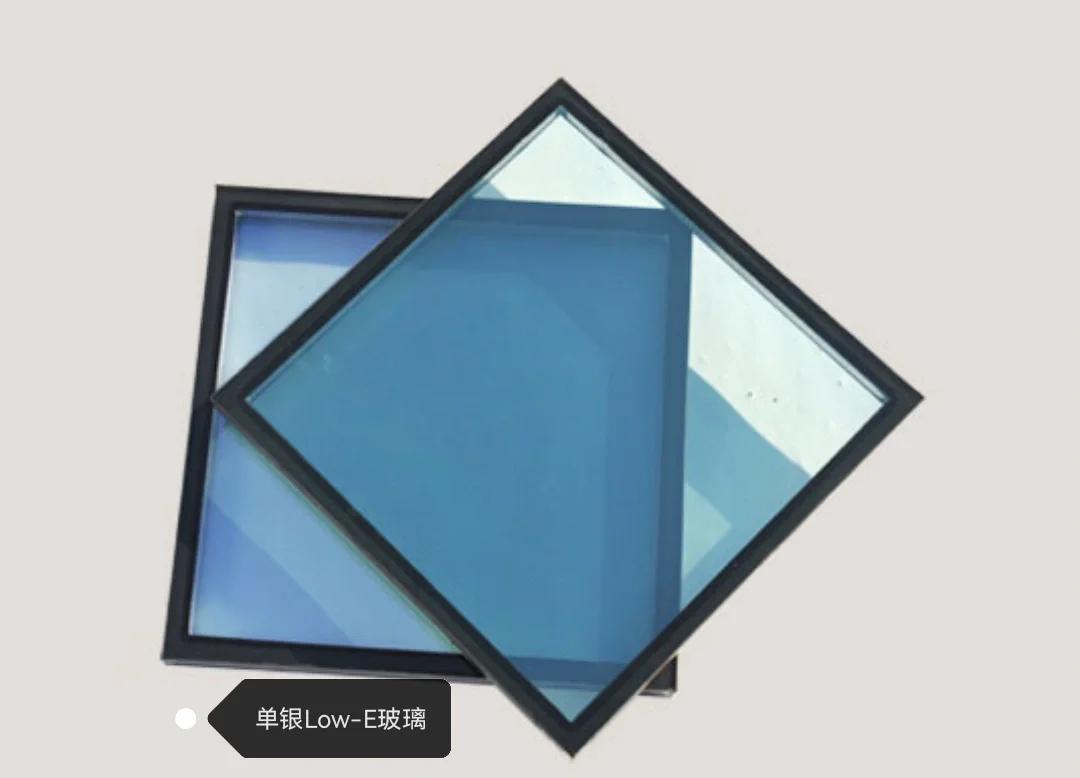
- Double silver: two Ag layers + dielectric stacks → balanced solar control, VLT 60–70%, SHGC ~0.28–0.40
- Triple silver: three Ag layers → sharper NIR rejection, VLT 50–65%, SHGC ~0.20–0.30, U-value lower within the same IGU
- The metric that matters is LSG (Light-to-Solar-Gain ratio) = VLT ÷ SHGC. Double silver typically lands at 1.8–2.0; triple silver pushes past 2.2–2.5. Higher LSG = more daylight per unit of heat admitted.
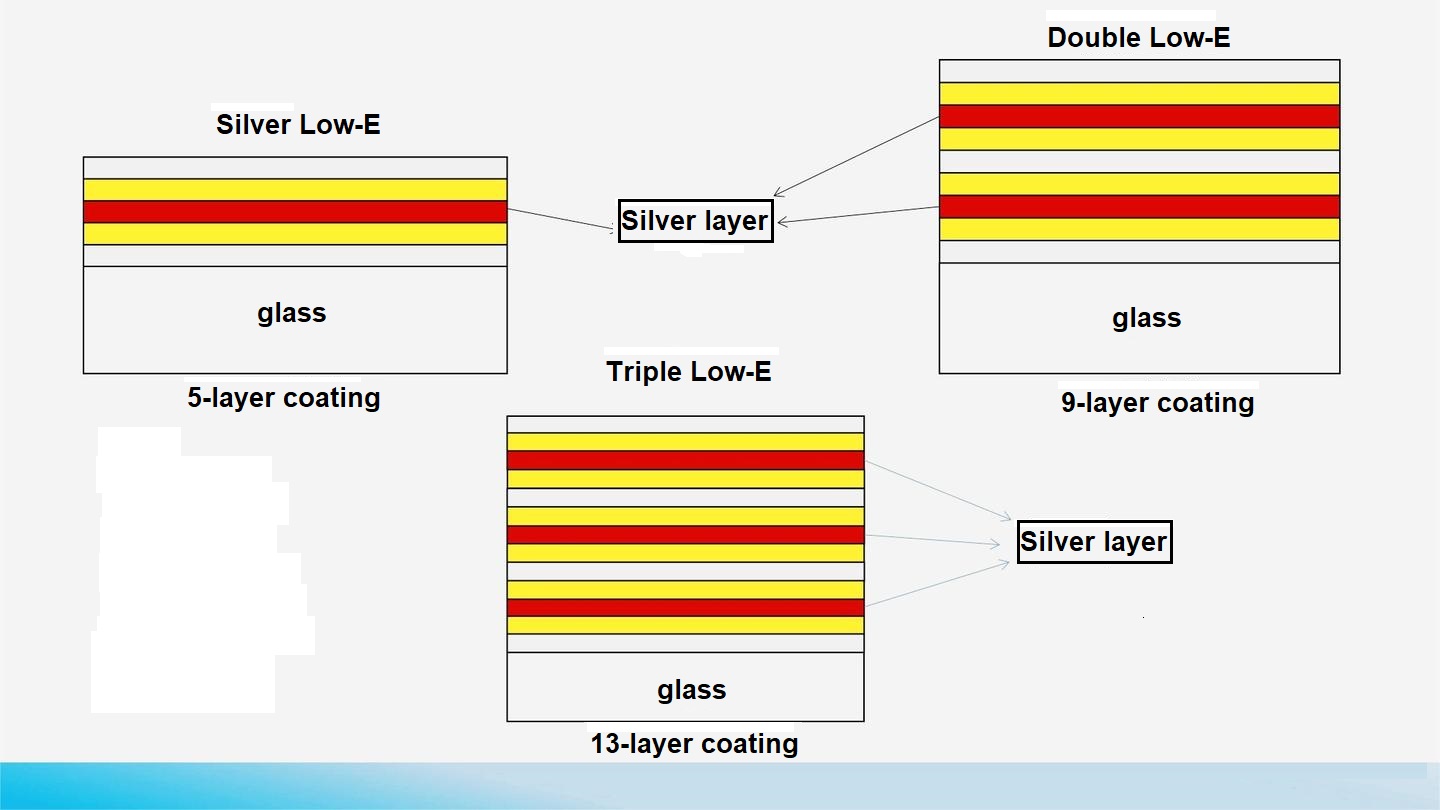
Diagram of the Low-E Glass Coating Structure
2. Performance snapshot (typical 6/8 mm + 16Ar + 6/8 mm IGU)
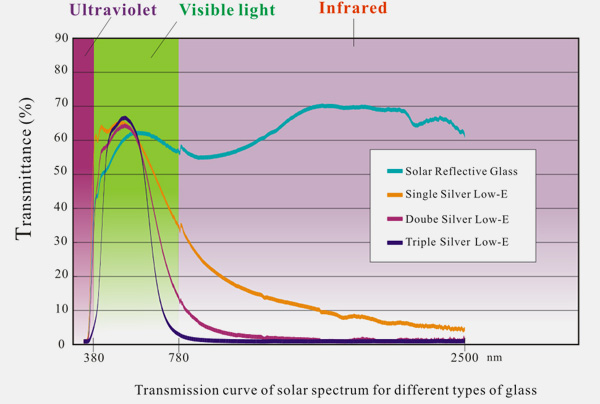
Spectral Curve of Low-E Glass
| Coating | VLT | SHGC | U-value (IGU) | LSG | Relative cost |
|---|---|---|---|---|---|
| Double silver soft-coat | 60–70% | 0.28–0.40 | ~1.1–1.4 W/m²K | 1.8–2.0 | 1.2–1.5× |
| Triple silver soft-coat | 50–65% | 0.20–0.30 | ~0.7–1.2 W/m²K | 2.2–2.5 | 1.8–2.5× |
Values are directional; final numbers depend on substrate, cavity gas, spacer, coating surface (#2 or #3) and IGU build-up. Jumbo Glass Group publishes project-specific IGU calcs, not catalogue averages.
3. When double silver is the right answer
Double silver wins on cost-per-performance in:
- Temperate and mixed climates (Northern Europe, US Midwest/East, China Yangtze, SE Australia)
- Standard office / hotel / school curtain walls where SHGC 0.28–0.33 satisfies code
- Projects where VLT > 60% is a design requirement (atriums, retail, residential towers)
- North / east façades in hot climates (west/south may still need triple)
- Budget-sensitive bids where LEED Silver / BREEAM Excellent is the target, not Platinum
- Rule of thumb: if your energy model passes with SHGC ≈ 0.30 and Uw ≈ 1.2–1.4, double silver is already doing the job. Paying for triple here buys margin you don’t need.
4. When the extra silver pays off
Triple silver earns its premium (typically +25–40% on glass cost) in these cases:
- Hot / cooling-dominated climates — Dubai, Riyadh, Singapore, Miami, Brisbane north/west façades. SHGC ≤ 0.22 cuts chiller sizing materially.
- High window-to-wall ratio (WWR > 60%) — fully glazed towers where every watt of solar gain multiplies across the envelope.
- West and southwest elevations — selective upgrade only. A Riyadh tower case cut chiller capacity 8% by tripling only west/SW, not the whole 22,000 m².
- LEED Platinum / Passive House / net-zero — when the envelope model needs LSG > 2.2 to hit the point threshold.
- Daylight-critical interiors — museums, labs, data centres, luxury retail where you want bright space without heat load.
- Jumbo IGUs — large panes amplify solar gain; triple silver keeps VLT acceptable while dropping SHGC below 0.25.
- Payback logic: on a 10,000 m² Dubai façade, triple silver cost ~$270k more than double but saved ~$180k in HVAC downsizing + ~$40k/yr electricity → <3 year payback. In London or Toronto the same upgrade often never pays back.
4b. Handling, coating position and jumba constraints
- Both families are soft-coat (off-line sputtered) — must be sealed in an IGU, edge-deleted 8–10 mm, never exposed.
- Temper before coating; coat the tempered lite, then assemble IGU.
- Standard position: surface #2 (inner face of outer lite) for double IGU; #3 used in some hot-climate or triple-glazed builds.
- Triple silver is more delicate during bending, lamination and frit firing — confirm your fabricator’s capability before awarding.
- Jumbo IGU cap at Jumbo Glass Group: 13000 × 3000 mm; monolithic/laminated larger, but sealed IGU is the limit.
5. Low-e coating selection checklist (RFQ-ready)
Send this to get a comparable quote:
- Project city + climate zone + façade orientation per elevation
- Target Uw, SHGCw, VLT, LSG from energy model
- IGU build-up: e.g.
8 Low-E #2 + 16Ar + 8, warm-edge spacer, argon ≥90% - Coating family preference: double / triple / mixed by elevation
- Substrate: clear / low-iron / grey / bronze
- Safety: tempered, laminated (PVB/SGP), HST yes/no
- Max panel size and handling limits
- Standard: EN 1279 / IGCC / NFRC / GB-T 8484 as applicable
6. Jumbo Glass Group capability note
We supply both families as soft-coat MSVD on pre-tempered lites, assembled into jumbo IGUs up to 13000×3000 mm:
- Double silver balanced: U ~1.4, SHGC 0.28–0.33, VLT 50–60%
- Triple silver balanced: U ~1.2, SHGC 0.20–0.25, VLT 50–58%
- Triple silver ultra-low: U ~1.2, SHGC 0.15–0.19, VLT 41–50%
- Free IGU thermal calc + BIM load sim on qualified RFQs.
7. Bottom line
- Double silver low-e vs triple silver is not a “better vs worse” question — it is a selectivity vs cost question.
- Default to double silver unless your climate, WWR, orientation or certification target forces SHGC below ~0.25.
- Upgrade to triple silver selectively (west/south, hot zones, passive targets) rather than blanket-specifying the whole envelope.
- Lock low-e coating selection to the energy model, not the sales sheet.
- Over-specifying triple silver in a temperate office is wasted CAPEX. Under-specifying it on a Dubai west façade is wasted OPEX for 30 years.
Climate-Zone Cheat Sheet: Double Silver vs Triple Silver
| Climate zone (Köppen / market) | Example cities | Default pick | Upgrade to triple silver when… | Target SHGC (IGU) | Target U-value | Coating position |
|---|---|---|---|---|---|---|
| Hot & arid (BWh) | Dubai, Riyadh, Doha, Phoenix, Cairo | Double silver (west/SW = triple) | WWR > 60%, west/south elevation, Estidama/ASHRAE 90.1 tight cap | 0.28–0.35 (N/E) · 0.20–0.25 (W/S) | ≤ 1.4 W/m²K | #2 |
| Hot & humid (Am/Aw/Cfa) | Singapore, Bangkok, Miami, Brisbane, Lagos | Triple silver | Year-round cooling, high WWR, glare-sensitive interiors | ≤ 0.25 (equatorial ≤ 0.20) | ≤ 1.2–1.4 W/m²K | #2 |
| Mixed / temperate w/ strong sun (Csa/Cfb) | Madrid, LA, Sydney, Cape Town, Shanghai | Double silver | West façade only, Passive House / net-zero target | 0.30–0.40 (N/E) · 0.25–0.30 (W) | ≤ 1.4 W/m²K | #2 (or #3 in heating months) |
| Cold continental (Dfb/Dwa) | Toronto, Beijing, Berlin, Moscow, Seoul | Single or double silver (higher SHGC) | Triple-pane + warm-edge needed for U, not for SHGC | 0.35–0.50 (want winter gain) | ≤ 1.0–1.2 W/m²K (triple glaze) | #3 |
| Polar / subarctic (E) | Helsinki, Oslo, Anchorage | Single silver + triple pane | Almost never upgrade to triple silver — cooling is rare | 0.45–0.55 | ≤ 0.8 W/m²K (vacuum/triple) | #3 |
| High-altitude / intense UV | Denver, Mexico City, Riyadh outskirts | Double silver | Glare control + low SHGC on south/west | 0.25–0.32 | ≤ 1.3 W/m²K | #2 Reading the table |
- Default = best ROI. Double silver covers ~80% of commercial façades; triple silver is a surgical upgrade, not a blanket spec.
- Orientation beats climate. Even in London, a west-facing all-glass atrium may justify triple silver; in Dubai, a north-facing corridor does not.
- U-value is solved by the IGU, not the silver count. If you need U ≤ 0.8, go triple-glazed / warm-edge / krypton — not necessarily triple-silver coating.
- Coating position flips with climate: hot = #2 (reflect sun before cavity), cold = #3 (keep room heat in).
Procurement one-liner: “Double silver everywhere, triple silver on W/SW in cooling zones or where the energy model demands SHGC < 0.25 — confirm by elevation, not by building.”
FAQ (for JSON-LD)
Q: Is triple silver Low-E always better than double silver?
A: No. Triple silver lowers SHGC and raises LSG, but costs 25–40% more. In temperate climates double silver already meets code; triple only pays back in hot climates, high-WWR towers, west façades or passive/net-zero targets.
Q: What LSG should I expect from double vs triple silver?
A: Double silver typically delivers LSG 1.8–2.0; triple silver 2.2–2.5. Higher LSG means more visible light per unit of solar heat — the real reason to upgrade.
Q: Can I mix double and triple silver on one façade?
A: Yes. Many projects use double silver on north/east and triple silver on west/south elevations to cut cooling load without paying the premium everywhere. Confirm color matching via mock-up.
Internal links (CMS-ready)
- Low-E Glass Selection Guide:
/products/low-e-glass-selection-guide-double-triple-silver-for-fa-ades-windows - Jumbo Low-E / IGU:
/products/jumbo-low-e-glass-jumbo-low-e-igu-oversized-low-emissivity-glass-insulating-glass-units-for-high-performance-facades - 8+16Ar+8 Low-E Curtain Wall:
/products/8-16ar-8-low-e-curtain-wall-glass-heavy-duty-double-silver-low-e-insulated-glass-for-high-rise-super-tall-towers - Related: Low-E vs Vacuum vs Insulated Glass · Meeting Building Energy Codes with Glass
Related Posts