Acoustic PVB Interlayer & Acoustic Laminated Glass Technology
Subheading: The Science of Sound Damping in Laminated Glass – How Viscoelastic Interlayers Control Noise for Office Pods, Partitions & Acoustic Spaces
Key Specs Badge: STC 39–50 | Viscoelastic Damping | Acoustic PVB 0.76–1.52 mm | SGP Option | ISO 10140
CTA Buttons: [Request a Quote] [Download Tech Datasheet]
02 – What Is Acoustic Laminated Glass?
H2: What Is Acoustic Laminated Glass?
Acoustic Laminated Glass is a safety glass composite engineered by bonding two or more layers of tempered or heat-strengthened glass with a specialized acoustic PVB (Polyvinyl Butyral) interlayer. Unlike standard laminated glass—which uses conventional PVB primarily for safety and UV blocking—acoustic laminated glass uses a viscoelastic interlayer formulated to absorb and dissipate sound wave energy across the speech frequency range (500–4000 Hz). The result is a single glass construction that delivers both impact safety (post-breakage retention) and measurable sound transmission loss, without the thickness penalty of solid monolithic glass.
03 – The Role of Acoustic PVB Interlayer
H2: How Acoustic PVB Works – Viscoelastic Damping
The core technology lies in the acoustic PVB interlayer. Standard PVB is a relatively stiff polymer; it bonds glass well but offers limited sound damping. Acoustic PVB is engineered with a higher damping factor (tan δ)—a viscoelastic material that exhibits both viscous (liquid-like) and elastic (solid-like) behavior. When sound waves strike the glass, the interlayer:
- Absorbs vibrational energy – converting sound wave kinetic energy into negligible heat
- Decouples the glass lites – preventing rigid transmission of vibrations from the strike side to the room side
- Extends the coincidence dip – shifting the frequency at which the glass panel resonates away from the critical speech band
- This damping mechanism is why a 12.76 mm acoustic laminated glass (6+1.14PVB+6) can outperform a 12 mm monolithic tempered glass by 5–8 STC points in the 1000–4000 Hz range.
04 – Acoustic Performance Mechanism
H2: Acoustic Performance Mechanism – 6 Levers
Acoustic laminated glass performance is governed by six engineering levers:
| Lever | How It Affects Acoustics |
|---|
| 1. Mass (Thickness) | Heavier glass reflects more sound (Mass Law: +6 dB STC per doubling of mass) |
| 2. Interlayer Damping | Acoustic PVB adds 3–8 STC points via energy dissipation |
| 3. Asymmetric Construction | Different pane thicknesses (e.g., 6+8) break resonance symmetry |
| 4. Interlayer Thickness | 0.76 / 1.14 / 1.52 mm PVB – thicker = higher damping at low frequencies |
| 5. Glass Type | Tempered (flat) vs. Heat-Strengthened (slightly more damping) |
| 6. Edge & Seal | Perimeter gaskets and frame design impact final system STC |
Key Insight for Buyers: The interlayer is the differentiator. Two laminated glasses with identical total thickness but different PVB can have 5+ STC difference. Always ask for the acoustic PVB specification, not just the glass thickness.
05 – Acoustic PVB vs. Standard PVB
H2: Acoustic PVB vs. Standard PVB – What's the Difference?
| Parameter | Standard PVB | Acoustic PVB |
|---|
| Primary Function | Safety, UV block, adhesion | Sound damping + safety |
| Damping Factor (tan δ) | Low (~0.1–0.2) | High (~0.5–0.8) |
| STC Contribution | Baseline (glass mass only) | +3 to +8 STC points |
| Frequency Tuning | None | 500–4000 Hz (speech band) |
| Cost Premium | – | ~15–25% over standard PVB |
| Applications | Windshields, balustrades | Office pods, meeting rooms, recording booths |
Procurement Note: For acoustic applications, never accept "laminated glass" without specifying acoustic-grade PVB. Standard PVB laminated glass will underperform in speech privacy scenarios.
06 – Acoustic PVB vs. SGP Interlayer
H2: Acoustic PVB vs. SGP (Structural Interlayer)
| Parameter | Acoustic PVB | SGP (Ionoplast) |
|---|
| Primary Function | Sound damping | Structural strength, hurricane resistance |
| Damping Factor | High | Moderate |
| Tensile Strength | ~20 MPa | ~34 MPa (higher) |
| Post-Breakage | Retains fragments | Holds heavy loads after breakage |
| Acoustic Performance | Superior (STC 39–50) | Good, but not optimized for sound |
| Cost | Moderate | 2–3× PVB |
| Typical Use | Acoustic pods, partitions | Blast-resistant, hurricane glazing |
Important: SGP is NOT a substitute for acoustic PVB in sound-control applications. If your priority is STC, specify acoustic PVB. SGP should be used only when structural loading (wind, blast, seismic) is the primary concern.
07 – Coincidence Frequency & Asymmetry
H2: Coincidence Frequency & Asymmetric Construction
Every glass panel has a coincidence frequency—the point where the bending wavelength of the glass matches the acoustic wavelength in air, causing a sharp drop in sound insulation (the "coincidence dip"). For monolithic glass, this dip often falls in the 1000–2000 Hz speech band, creating an acoustic weak spot.
How acoustic laminated glass solves this:
- Damping: The viscoelastic interlayer widens and flattens the coincidence dip, reducing its impact
- Asymmetry: Using different thicknesses for the two lites (e.g., 6 mm + 8 mm) creates two different coincidence frequencies, preventing a single deep dip
- This is why acoustic laminated glass with asymmetric construction (6+8 or 8+10) is the preferred choice for high-performance meeting pods and recording booths.
08 – Performance Data & Testing
H2: Acoustic Testing & Standards
- Transmission Loss (TL) Curve: Measured per ASTM E90 / EN ISO 10140, 1/3-octave bands from 100–5000 Hz
- STC Calculation: ASTM E413 (contour fitting to TL data)
- Rw Calculation: ISO 717-1 (with C and Ctr adaptation terms)
- Typical STC Ranges:
- Lab vs. Field: Lab STC is glass-only; field performance depends on frame, seals, and installation. We provide calculation support, not just glass data.
Procurement Tip: Always request the TL curve, not just the STC number. A high STC can hide a coincidence dip in the speech band—the TL curve reveals the true performance.
09 – Integration With Pod & Partition Systems
H2: Integration With Acoustic Systems
Acoustic laminated glass is the default choice for:
- Pod Walls & Doors: Most office pods use 6+1.14PVB+6 for walls and matching door leaf
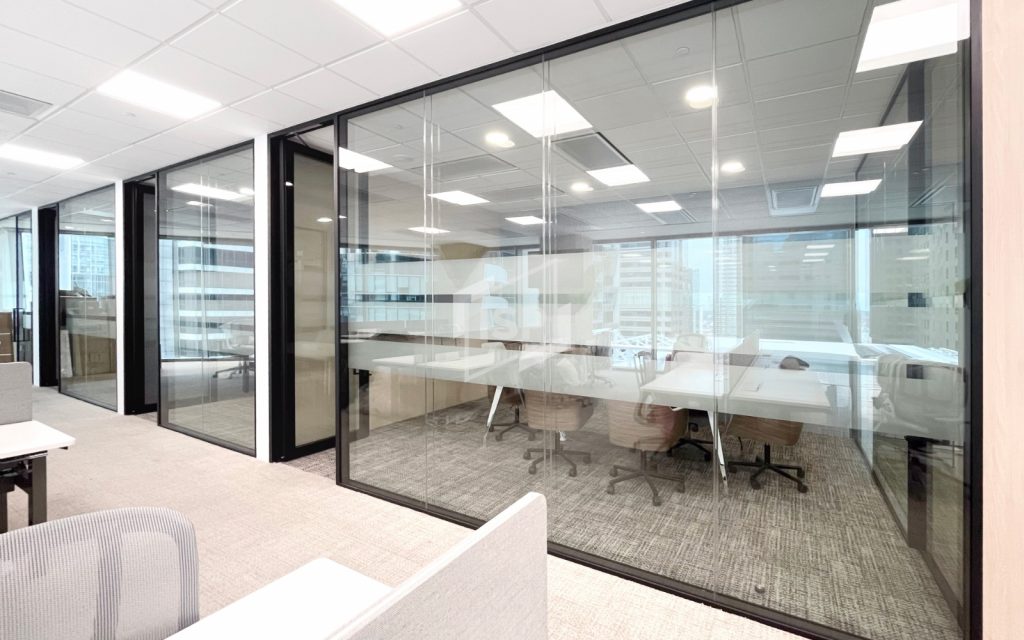
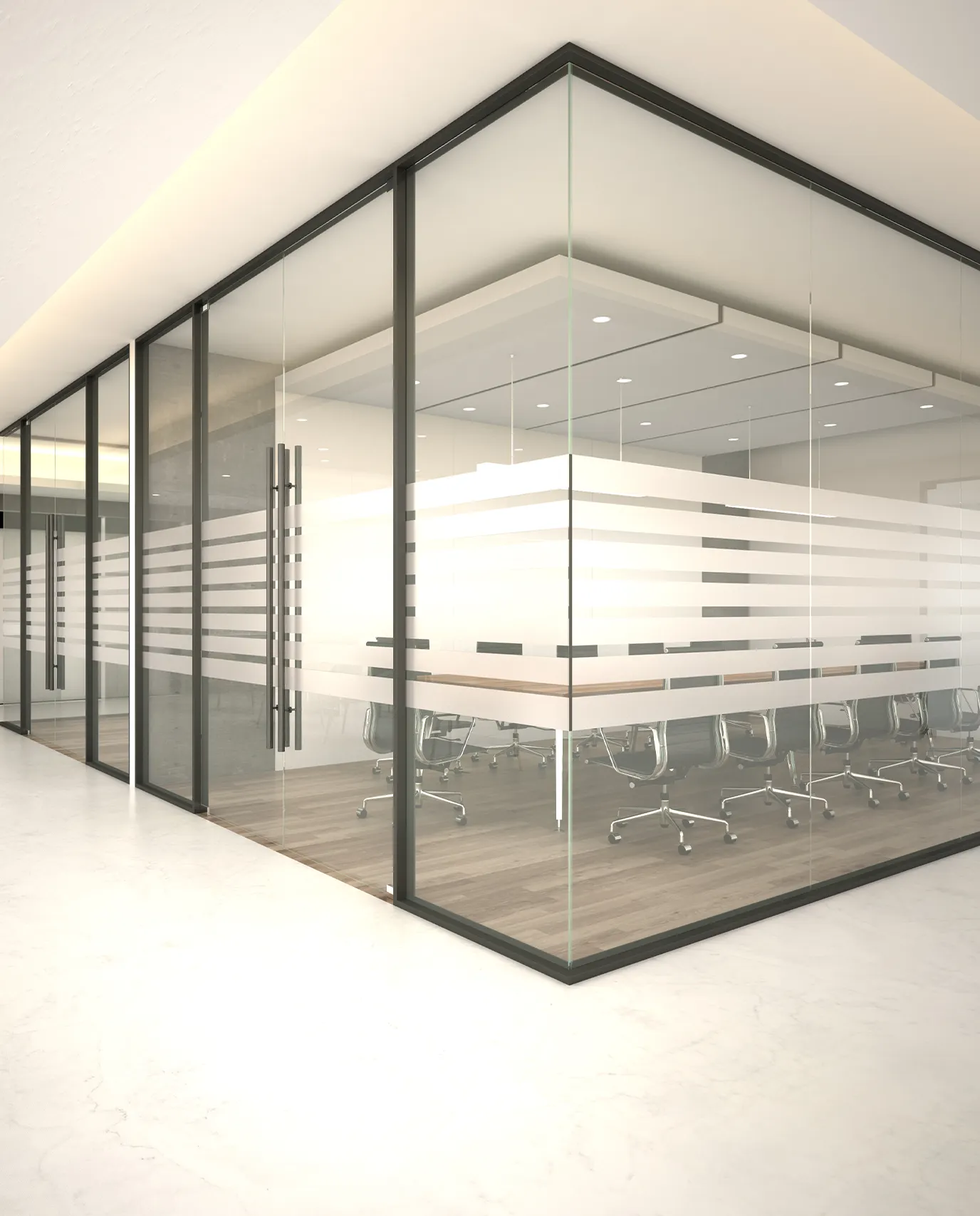
- Partition Walls: Floor-to-ceiling glazing with aluminum framing and EPDM gaskets
- Recording Booths: Asymmetric builds (6+8) for full-frequency control
- Meeting Pods: High-traffic doors with CNC hinge cut-outs and drop seals
- The glass must be specified with polished edges and CNC cut-outs (hinge, lock, closer) to integrate seamlessly with hardware templates (Assa Abloy, Dormakaba, etc.).
10 – Selection Guide for Buyers
H2: How to Specify Acoustic Laminated Glass
| Your Requirement | Recommended Build |
|---|
| Basic speech privacy (phone booth) | 5+0.76PVB+5 |
| Standard office pod (1–2 person) | 6+1.14PVB+6 |
| Meeting pod (2–6 person) | 8+1.52PVB+8 or asymmetric 6+1.14PVB+8 |
| Recording / broadcast | Asymmetric 6+1.14PVB+8 or composite with IGU |
| High-end executive | Composite: 6+PVB+6 + 16Ar + 8
Ask your supplier: |
- What is the damping factor (tan δ) of the PVB?
- Can you provide a TL curve (not just STC)?
- Is the glass tempered or heat-strengthened?
- What is the interlayer thickness and brand?
- Do you offer SGP as an alternative (for structural needs)?
11 – Manufacturing & Quality (JUMBO Glass Group)
H2: Manufactured by JUMBO Glass Group
- 20+ years in laminated glass production
- Dedicated acoustic line – separate PVB laminating room, humidity-controlled
- Jumbo capability – laminated up to 2440 × 5000 mm
- PVB options – acoustic PVB 0.76 / 1.14 / 1.52 mm, SGP on request
- CNC machining – hinge/lock cut-outs, ±0.5 mm tolerance
- QC – 100% spark test, dimensional laser scan
- Certifications – EN 14449, EN 12150, ANSI Z97.1, AS/NZS 2208, ISO 9001:2015
- Export – serving 30+ countries, seaworthy crating
12 – FAQ
H2: Frequently Asked Questions
- What is acoustic PVB?
Acoustic PVB is a specialized polyvinyl butyral interlayer with high damping properties, engineered to absorb sound vibrations in laminated glass. - How much better is acoustic PVB than standard PVB?
Acoustic PVB typically adds 3–8 STC points over standard PVB in the speech frequency range (500–4000 Hz). - Can acoustic laminated glass be tempered?
Yes, both lites are fully tempered (EN 12150 / ANSI Z97.1) for safety. - Is acoustic PVB the same as SGP?
No. SGP is a structural interlayer for strength; acoustic PVB is optimized for sound damping. They serve different purposes. - What thickness of acoustic PVB should I choose?
0.76 mm for basic privacy, 1.14 mm for standard pods, 1.52 mm for high-performance meeting/recording use. - Can I get a TL curve for my glass build?
Yes, we provide lab-tested TL curves per ASTM E90 / ISO 10140 for specific builds. - Does acoustic laminated glass block all noise?
No glass blocks 100%. It reduces sound transmission by a measurable amount (STC 39–50). The complete system (frame, seals) determines final performance. - Can acoustic PVB be combined with Low-E or Low-Iron?
Yes. Low-Iron for clarity, Low-E for thermal control. Both can be integrated without compromising acoustic performance. - What is the lead time?
Samples 10–14 days; bulk 25–35 days FOB. - How do I request a quote?
Send your glass build-up, dimensions, STC target, and hardware requirements to sales@jumbotemperedglass.com.
Final CTA
H2: Need Acoustic Laminated Glass for Your Project?
Send us your drawing or specification. Our engineering team will recommend the optimal acoustic PVB build-up and provide a project-specific quotation.
[Request a Quote] [Download Tech Datasheet] [Send Your Drawing]
- 📩 Email: tomron1688@gmail.com
- [Request a Quote] [Download Datasheet]
🔗 Internal Link Cluster
Related Applications
Acoustic Glass for Office Pods | Office Pod Glass Manufacturer – AcouSpace
Phone Booth Glass | Acoustic Glass for Phone Booths – AcouSpace
Acoustic Glass for Meeting Pods | Meeting Pod Glass Manufacturer – AcouSpace
Acoustic Glass for Work Pods | Work Pod Glass Manufacturer – AcouSpace
Acoustic Glass for Office Privacy Booths | Privacy Booth Glass Manufacturer – AcouSpace
Acoustic Glass for Recording Booths | Recording Booth Glass Manufacturer – AcouSpace
Acoustic Glass for Podcast Booths | Podcast Booth Glass Manufacturer – AcouSpace
Related Product
- [Acoustic Laminated Glass](/acouspace/products/acoustic-glass/acoustic-laminated-glass/)
- [Acoustic Insulated Glass](/acouspace/products/acoustic-glass/acoustic-insulated-glass/)
- [Acoustic Laminated Insulated Glass](/acouspace/products/acoustic-glass/acoustic-laminated-insulated-glass/)
- [Low-E Acoustic Glass](/acouspace/products/acoustic-glass/low-e-acoustic-glass/)
- [Low-Iron Acoustic Glass](/acouspace/products/acoustic-glass/low-iron-acoustic-glass/)
- [Acoustic Glass Doors](/acouspace/products/acoustic-glass/acoustic-glass-doors/)
- [Acoustic Glass Panels](/acouspace/products/acoustic-glass/acoustic-glass-panels/)
- [Custom Acoustic Glass](/acouspace/products/acoustic-glass/custom-acoustic-glass/)
Related Technology supporting
- STC Rating & Rw Rating for Acoustic Glass | STC vs Rw Explained – AcouSpace
- Acoustic PVB Interlayer & Acoustic Laminated Glass Technology – How It Works
- Double Glazing for Acoustics – How IGU Works for Sound Insulation | JUMBO AcouSpace
-Acoustic Laminated Glass vs Double Glazing – Which Is Right for Your Project?
Acoustic Glass Performance – How to Read Acoustic Performance Data | JUMBO AcouSpace
- ISO 23351 for Acoustic Office Pods & Meeting Pods – ASTC, SNR & Classification | JUMBO AcouSpace
Acoustic Glass Testing – How Acoustic Glass Is Tested & How to Read Test Reports | JUMBO AcouSpace