Home / Resources / Glass Selection Guides / Auto Showroom Glass Guide
Auto Showroom Glass Guide
Glass walls, windows and facades for car dealerships, auto galleries and brand flagship showrooms — low-iron for true vehicle colour, reflective coating for daytime privacy and landmark identity, jumbo panels for seamless full-height glazing.
Facade & display wallLow-iron clarityReflective / tinted optionJumbo up to 3300×20000mm
1. What Is an Auto Showroom — and Why the Glass Choice Is Commercial
An auto showroom is the sales floor of a car dealership: a street-facing, fully glazed volume designed to put vehicles on display while projecting the brand. The glass is not a background element — it is the primary sales surface. Every passer-by sees the cars through the glass; the glass therefore controls three commercial outcomes at once:
- Colour fidelity — does the vehicle paint, chrome and interior appear in their true colour, or tinted by the glass?
- Daytime privacy — can the dealership control what is visible from the street without closing blinds?
- Brand identity — does the facade read as a premium, seamless, uninterrupted surface?
For dealership groups, facade engineers, fit-out contractors, architects and procurement managers supplying **dealership networks across Europe, North America, Australia and the Gulf**, the showroom glass decision is therefore a **marketing decision first, a structural decision second**. This guide routes you to the right construction.
Rule one — low-iron is the visual baseline, not an upgrade. Standard clear glass contains iron oxide (typically 0.08–0.12% Fe₂O₃) that produces a visible green tint, most noticeable at the edges and in thicker panels. On a white, silver or red car bonnet this tint changes the perceived colour. Low-iron (ultra-clear) glass at <0.02% Fe₂O₃ removes the tint — so the vehicle is seen as the manufacturer intended. For a showroom this is not optional aesthetics; it is the point of the architecture.
2. The Four Glass Decisions in an Auto Showroom
Unlike a canopy or bridge (where structural load dominates), a showroom brief is solved by answering four questions in order:
| # | Decision | Options | Driver |
|---|
| 1 | Substrate clarity | Clear float / Low-iron (ultra-clear) | Vehicle colour fidelity |
| 2 | Coating & reflectance | None / Neutral reflective / Grey-bronze tinted | Daytime privacy + brand look |
| 3 | Construction | Monolithic tempered / Laminated / IGU (Low-E) | Safety + thermal + acoustics |
| 4 | Format | Standard cut / Jumbo (one uninterrupted panel) | Seamless full-height wall |
Sections 3–6 below address each in turn. Sections 7–9 cover jumbo capability, processing and compliance — the same disciplined rules as the rest of the Jumbo Glass Group range.
3. Low-Iron Glass — True Colour Rendering
Low-iron (ultra-clear) glass is the default choice for the **main display wall** of a showroom. It removes the green cast of standard clear glass so vehicles, branding and interior finishes are rendered in their true colours.
| Property | Standard Clear Glass | Low-Iron (Ultra-Clear) |
|---|
| Iron oxide (Fe₂O₃) | 0.08–0.12% | <0.02% |
| Visible tint | Green — pronounced at edges & thick panels | Virtually none |
| Light transmission | ~89% | ~91–92% |
| Edge appearance | Green glow | Clear / colourless |
| Cost premium | Baseline | +20–35% |
Where low-iron matters most in a dealership
- New-car display frontage — the entire street-facing wall should be low-iron.
- Premium / luxury brand flagships — low-iron is the mandated specification.
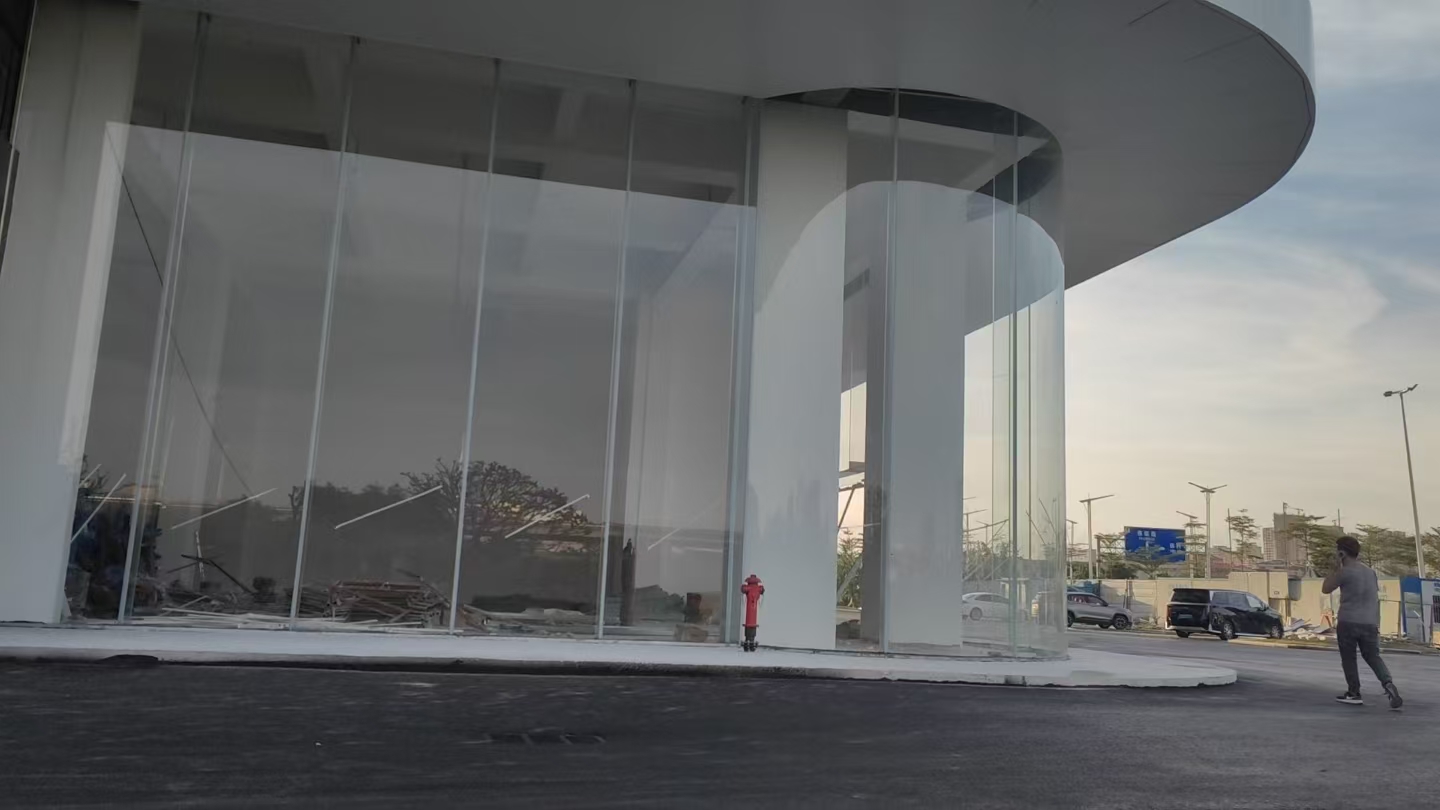
- Full-height glazed corners — edge tint is highly visible without low-iron.
- Interior glazed partitions separating showroom from service — maintains colour continuity.
Edge finish note: because low-iron removes the green edge glow, the polished edge becomes the visual feature of the panel perimeter. Polished edges are strongly recommended to preserve the clean appearance that justifies the investment.
4. Construction Matrix — Which Build for Which Zone
A showroom is not one uniform glass type. It is a set of zones, each with a different requirement:
| Showroom Zone | Recommended Build | Why |
|---|
| Main display wall (street-facing) | Low-iron tempered (8/10/12mm) | True colour + strength + clarity |
| Brand / premium flagship | Low-iron + reflective coating (on surface #2 if IGU) | Colour fidelity + identity + privacy |
| Overhead / canopy / skylight | Low-iron laminated (PVB/SGP) | Post-breakage retention above people & cars |
| High-traffic edge / security zone | Low-iron laminated (PVB 1.52mm+) | Fragment retention + intrusion delay |
| Climate-controlled showroom (sun-exposed) | Low-iron IGU with Low-E + argon | Reduces cooling load, prevents hot spots on vehicles |
| Interior partition / lounge glazing | Low-iron tempered or laminated | Colour continuity + optional acoustic |
Build-up examples
| Build-Up | Overall | Use |
|---|
| 10mm Low-Iron Tempered (monolithic) | 10mm | Standard full-height display wall |
| 12mm Low-Iron Tempered (monolithic) | 12mm | Taller panels, reduced deflection |
| 5LI + 0.76PVB + 5LI (laminated) | 10.76mm | Overhead & security zones |
| 6LI + 16Ar + 6T (Low-E IGU) | ~29mm | Thermal + clarity |
| 6LI + 0.76PVB + 16Ar + 6T (Low-E IGU, laminated inner) | ~29.76mm | Thermal + security + clarity
|
5. Reflective & Tinted — Daytime Privacy and Brand Identity
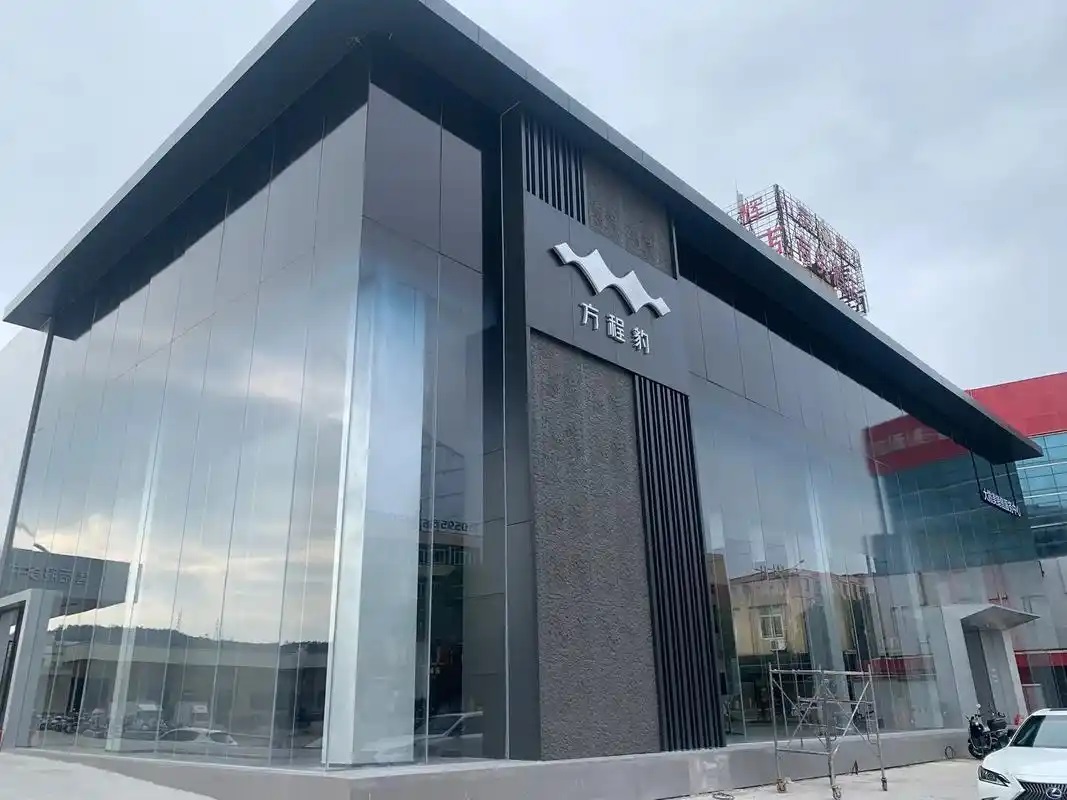
A reflective or tinted coating turns the showroom facade into a **two-way visual surface**: by day, passers-by see a controlled reflection rather than directly into the showroom; at night, with interior lighting, the glass becomes transparent again. This is the classic dealership trick — but it only works if the coating is specified correctly.
Coating options
| Coating | Appearance | Best For |
|---|
| Neutral reflective (silver/grey) | Near-neutral mirror | Premium brands, true-colour requirement |
| Grey tinted | Cool dark grey | Solar control + modern look |
| Bronze tinted | Warm bronze | Heritage / warm-brand aesthetics |
| Blue reflective | Cool blue mirror | Distinctive landmark identity
|
Neutrality matters. A coating that is too cool or too saturated changes the colour of the vehicles behind it — the opposite of the low-iron objective. For brand flagships, specify a neutral reflective coating and approve a sample under both D65 (overcast) and direct sunlight before production. The coating is typically applied to the inner face of the outer lite in an IGU (surface #2), or as a pyrolytic hard coat where field cutting is required.
Combined strategy (most common)
The strongest design combines a **low-iron display zone at eye level** (maximum transparency for window shoppers) with a **reflective upper band** (brand identity + privacy). Both use the same coating family and base tint so the facade reads as one surface — the same vision/spandrel continuity principle used in curtain walls.
6. Thermal & Acoustic — When the Showroom Needs an IGU
A showroom is a large glazed volume in a climate-controlled building. In hot or mixed climates, solar heat gain through a full-height west- or south-facing facade can drive up cooling costs and create hot spots near displayed vehicles. An insulating glass unit (IGU) addresses this without sacrificing clarity.
| Configuration | U-value | SHGC | VLT | Use |
|---|
| Low-iron + 12Ar + clear (single Ag Low-E) | 1.2–1.4 W/m²K | 0.42 | ~72% | Mild climate |
| Low-iron + 16Ar + clear (double Ag Low-E) | 0.9–1.1 W/m²K | 0.32 | ~65% | Standard sun-exposed showroom |
| Low-iron + 16Kr + clear (double Ag) | 0.7–0.9 W/m²K | 0.30 | ~64% | Premium (krypton) |
| Low-iron + 16Ar + laminated inner (double Ag) | 1.0 W/m²K | 0.31 | ~64% | Thermal + security |
Acoustic note
Showrooms on busy roads or near highways benefit from an acoustic PVB interlayer in the laminated inner ply, improving sound insulation by 3–5 dB over standard PVB. This keeps the sales floor quiet without changing the exterior appearance. See the Glass Partition Selection Guide for the STC principles that apply here too.
7. Jumbo Format — Seamless Full-Height Walls
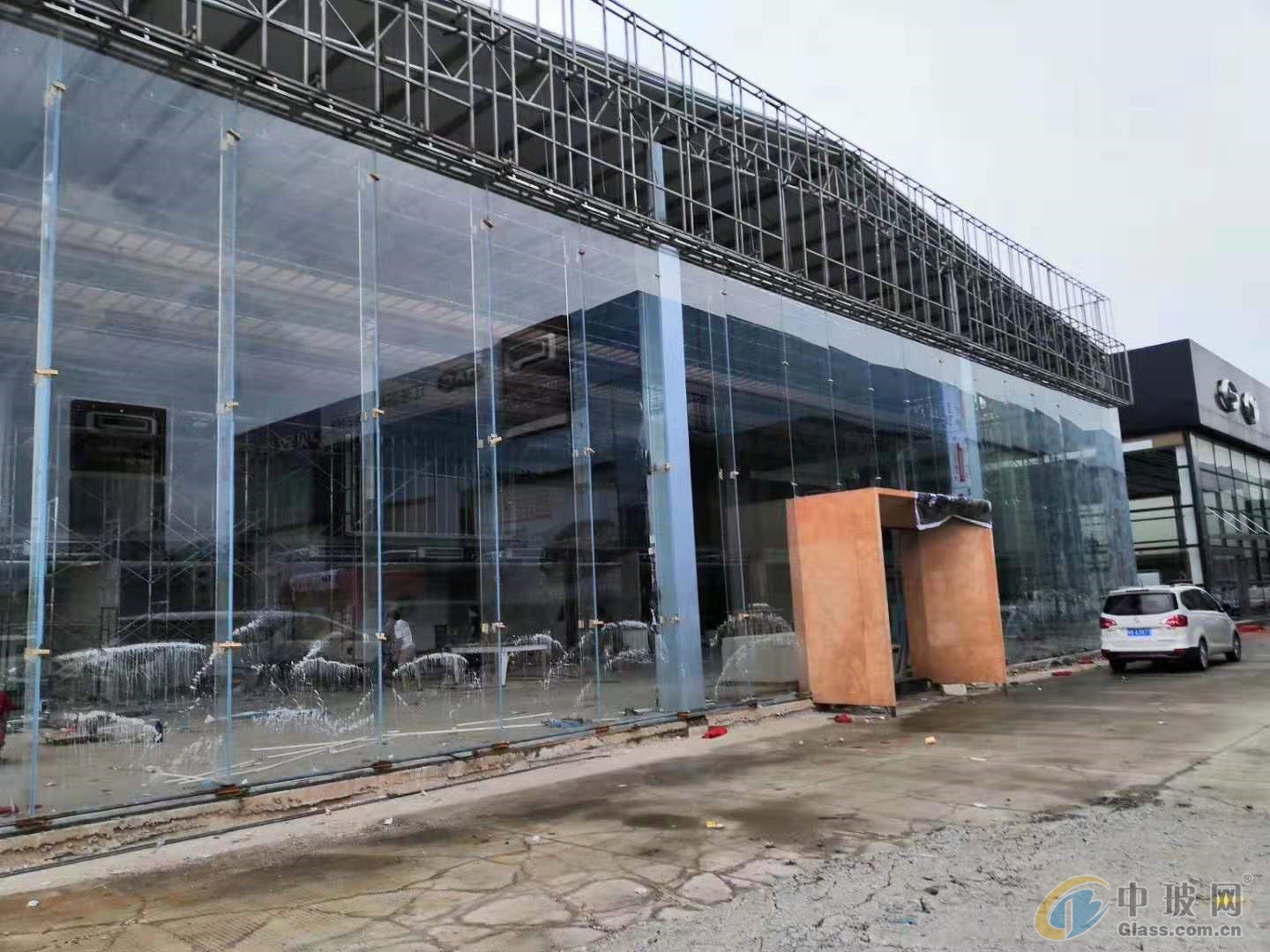
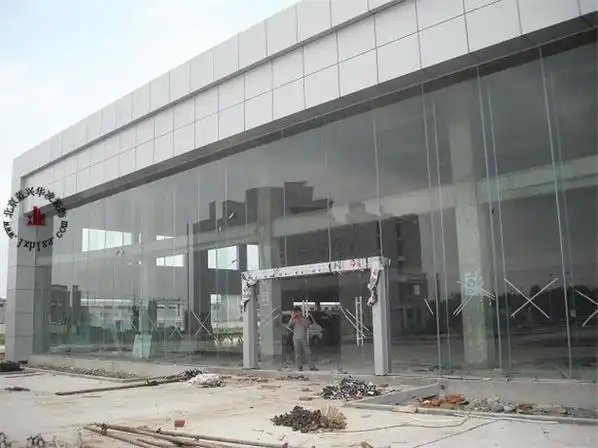
The defining visual of a premium dealership is a **single uninterrupted panel** from floor to soffit, with no horizontal joint cutting across the car silhouette. This is where jumbo format earns its keep.
| Parameter | Standard Capability | Jumbo Glass Group |
|---|
| Max monolithic panel (flat) | 3000 × 1500mm | 3300 × 20000mm (11 × 65.6ft) |
| Max IGU panel | ~3000 × 6000mm | 3300 × 12000mm |
| Thickness range | 6–12mm | 6–25mm |
| Typical showroom panel | — | 8 / 10 / 12mm low-iron tempered
|
Why the difference — 20000mm vs 12000mm. A monolithic (single) tempered or laminated panel can be manufactured and handled up to 3300×20000mm. Once assembled into a sealed IGU, the same glass is limited to 3300×12000mm by handling and long-term seal integrity. For a showroom display wall, monolithic low-iron tempered therefore gives the largest seamless panels; specify an IGU only where thermal performance is required, accepting the 12000mm length limit or using a horizontal mullion break.
Format selection by showroom type
| Showroom Type | Recommended Format | Reason |
|---|
| Single-brand flagship (full height) | Jumbo low-iron tempered, one panel floor-to-soffit | Zero joint across vehicle |
| Standard dealership (3–4m ceiling) | 2500–4500mm tall low-iron tempered panels | Clean wall, manageable handling |
| Climate-controlled / sun-exposed | Jumbo low-iron IGU (up to 3300×12000mm) | Seamless + thermal |
| Showroom with overhead glazing | Jumbo laminated low-iron | Safety over people & cars
|
8. Processing & Fabrication Rules
The same disciplined rules apply to showroom glass as to the rest of the Jumbo Glass Group range. All cutting, drilling and notching must be completed before tempering or lamination — a jumbo panel cannot be re-cut after final heat treatment.
| Process | Capability | Rule for Showroom Glass |
|---|
| Cutting | Bystronic CNC, ±0.01″ | Confirm final dims — no field trimming |
| Edgework | Polished / beveled / arrissed | Polished recommended for low-iron (edges visible) |
| Drilling & notching | CNC holes, cutouts | Before tempering / lamination |
| Tempering | EN 12150 / ASTM C1048 | Surface stress ≥95 MPa |
| Heat soak test (HST) | 554°F (290°C) × 4 hrs | Recommended for overhead & critical panels |
| Lamination | PVB / SGP | For overhead, security & acoustic zones |
| Coating | Reflective / Low-E / frit | Surface placement per IGU design
|
Flatness for seamless walls. Wave distortion is controlled to ≤0.004″/ft (laser interferometry) so that adjacent jumbo panels form a visually continuous surface — critical when a single car spans two or three panels. This is a key differentiator of the Jumbo Glass Group large-format line.
9. Standards & Compliance
Compliance is project- and market-specific. Confirm the target market and applicable building code with the design team.
| Standard | Market | Scope |
|---|
| EN 12150 | EU/UK | Toughened safety glass |
| EN 14449 | EU/UK | Laminated safety glass |
| EN 1279 | EU/UK | Insulating glass units |
| EN 1096 | EU/UK | Coated glass |
| ASTM C1048 | USA | Heat-treated flat glass |
| ASTM C1172 | USA | Laminated architectural glass |
| ASTM C1376 | USA | Coated glass |
| ASTM E2190 | USA | IGU specification |
| ANSI Z97.1 | USA | Safety glazing |
| AS/NZS 2208 | AU/NZ | Safety glazing materials |
Trust package: SGS batch reports, EN 12150 traceability, 20-year breakage insurance, free BIM wind-load and deflection simulation — the Jumbo Glass Group "Triple Guarantee" applied to showroom projects.
10. Decision Flow for Procurement Managers
- Define the zones— display wall / overhead / canopy / partition / service interface
- Substrate— low-iron (default for display) vs clear (budget)
- Coating— none / neutral reflective / grey-bronze tinted / blue reflective
- Construction— tempered / laminated / IGU (Low-E)
- Format— standard cut or jumbo (one seamless panel)
- Thickness— 8 / 10 / 12mm (tempered) or 10.76mm+ (laminated)
- Edge finish— polished (recommended for low-iron)
- Thermal— confirm climate zone & orientation → IGU only if needed
- Safety— specify HST for overhead & critical panels
- Acoustic— acoustic PVB if road noise is a concern
- Submit— facade elevations + panel schedule + coating/frit artwork for quotation
11. Frequently Asked Questions — Auto Showroom Glass
What glass is best for a car dealership showroom?
The strongest combination is low-iron jumbo tempered glass for the main display wall (true vehicle colour, no green tint) plus a reflective or tinted coated layer for daytime privacy and brand identity. High-security or overhead zones use laminated low-iron. The exact build is selected from the matrix in Section 4.
Why use low-iron glass in an auto showroom?
Standard clear glass contains iron oxide that gives a visible green tint, especially at the edges and in thicker panels. On a car bonnet or paint finish this tint distorts colour perception. Low-iron (ultra-clear) glass removes the tint so the vehicle is seen in its true colour — the single most important visual decision in a showroom.
How large can a showroom glass panel be?
Jumbo Glass Group supplies monolithic tempered or laminated showroom panels up to 3300×20000mm (11×65.6ft). Sealed IGUs are limited to 3300×12000mm. Most dealerships use 8–12mm low-iron tempered in 2500–4500mm tall full-height panels, often in a unitized curtain wall system.
Should a showroom facade be reflective or clear?
Reflective coating gives daytime privacy (passers-by do not see straight in) and a strong brand landmark, but the showroom needs controlled interior lighting and the coating choice must preserve colour neutrality. Clear low-iron gives maximum transparency for window shoppers. Many designs combine a reflective upper band with a low-iron display zone.
Is laminated glass needed for a car showroom?
Not for every panel. Laminated low-iron is recommended for overhead glazing, canopies, skylights, high-traffic edge panels and security-sensitive zones because it retains glass fragments after breakage. The main display wall is typically monolithic tempered for clarity and economy, with laminated panels used where fall-out protection is required by code.
Does showroom glass need Low-E or thermal insulation?
Where the showroom is climate-controlled and faces significant sun exposure, an IGU with Low-E and argon (U-value 0.9–1.4 W/m²K) reduces cooling load and prevents hot spots near displayed vehicles. In mild climates or short operating hours, single-glazed low-iron may be sufficient — confirm against the local energy code and orientation.
Request Your Auto Showroom Glass Quote
Submit your facade elevations, panel schedule and coating/frit artwork for a competitive FOB quotation with BIM wind-load and deflection simulation.
Required information:
- Dealership / brand & project type (new build / refurbishment / flagship)
- Zones: display wall / overhead / canopy / partition / service
- Panel dimensions (W × H) & quantity per type
- Substrate: low-iron / clear / tinted (specify colour)
- Coating: none / neutral reflective / grey / bronze / blue (provide frit/coating artwork if any)
- Construction: tempered / laminated / IGU / Low-E IGU
- Thickness: 8 / 10 / 12mm or custom
- Edge finish: polished / beveled / arrissed
- Format: standard / jumbo (seamless full-height)
- Thermal target: U-value / SHGC (if IGU required)
- Acoustic requirement: yes / no (road noise)
- HST: required / not required / unsure
- Standard: EN / ASTM / AS-NZS / other
- Upload: facade elevations / panel schedule / DWG / PDF / coating artwork
- Destination port & incoterm, target delivery dateEmail Your Showroom Specification
13. Continue Reading
Jumbo Glass Family
Related Products
Resources
Back to the full selection-guide index.
Glass Skylight Selection Guide →
Sloped overhead glazing taken to the extreme — atrium & skylight rules.
Glass Bridge / Deck Guide →
When your canopy becomes walkable — concentrated load rules.
Jumbo Laminated Glass →
The product page behind every PVB / SGP canopy build-up.
Jumbo Tempered Glass →
Monolithic tempered plies (pre-lamination) and material spec.
Jumbo Glass / Oversize Glass →
Size definitions, capability and engineering overview.
Jumbo Glass Group — Selection Guides are technical references for design and specification only. Thickness, build-up, acoustic rating, fire rating and compliance must be confirmed by a qualified structural/acoustic designer and the relevant building authority for each project. Published values are typical starting points, not guaranteed design results.