Home › Showerspace › Decorative Shower Glass › Back Painted Shower Glass
Decorative Shower Glass
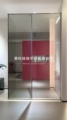
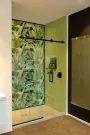
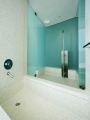
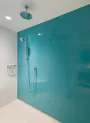
Back Painted Shower Glass Panels — Grout-Free Shower Walls in Any RAL Colour
A colour you can specify precisely, on a surface that has nowhere for mould to grow.
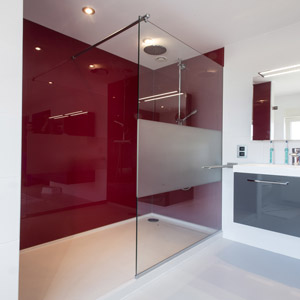
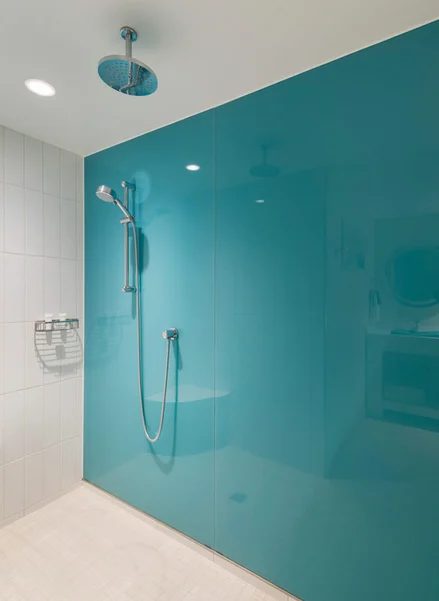
Back painted shower glass is tempered glass with an opaque coating applied to the back face, in any RAL Classic shade. It is used as a shower wall and back wall material — a single continuous surface with no grout lines, bonded to the wall with no visible fixings. Also known as colour coated or lacquered glass.
Request a QuoteWhy No Grout Matters
What Is Back Painted Shower Glass?
An opaque coating is applied to the back face of the glass — the face that sits against the wall — and cured. You see the colour through the full thickness of the glass, which gives it a depth that paint on a wall cannot match. The surface you touch and clean is glass.
The coating sits on the second surface. It never contacts water, soap or cleaning agents, because the glass itself is in the way. That single fact is what separates this product from a film or a painted finish on an exposed face, and it is why the colour does not wear off in service.
The names vary by market. Back painted is the term used across North America and much of the international trade. Colour coated is common in the UK. Lacquered is used in India and parts of Europe. All three describe the same product, and we quote against any of them.
Shower Walls Without Grout
The reason most people choose back painted glass over tile is not the colour. It is the absence of grout.
Grout is porous. In a shower it absorbs water, and what absorbs water in a warm, dark, regularly wet place will eventually grow mould. The maintenance cycle that follows is familiar to anyone who has owned a tiled shower: scrub, re-seal, and eventually re-grout. The tile is rarely what fails — the joints are.
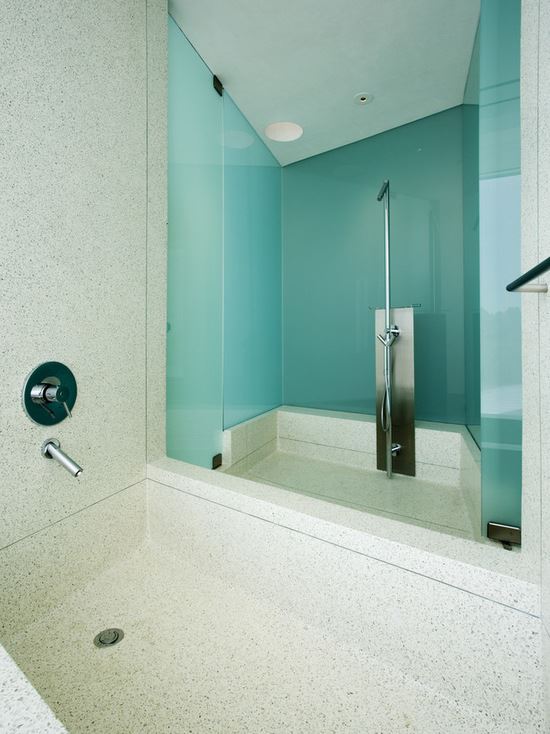
A back painted glass wall panel has no joints across its face. It is a single sheet of non-porous glass, cut to the dimensions of the wall and bonded in place.
| | Back painted glass wall panel | Tiled shower wall |
|---|
| Surface | Single continuous sheet | Tiles with grout joints throughout |
| Porosity | Non-porous glass | Grout absorbs water |
| Mould risk in the surface | No joint for mould to take hold in | Joints are the usual failure point |
| Cleaning | Wipe the glass | Cleaning, then periodic re-sealing of joints |
| Colour | Any RAL shade, consistent across the sheet | Limited to what is stocked |
| Installation | Bonded panels, no visible fixings | Adhesive, spacing, grouting, curing |
| Silicone seams | Perimeter and internal corners only | Perimeter plus every joint line
|
One honest qualification. No shower is entirely seam-free. Where a panel meets another panel, the tray, or the corner, there is a silicone joint. Those seams need the same normal cleaning any silicone joint does. What back painted glass removes is the field of grout lines across the entire wall surface — which is where the maintenance burden actually sits.
Factory Coating or Retrofit Film?
“Painted glass” covers two very different products, and the difference matters more in a shower than anywhere else.
| | Factory back painted glass | Retrofit coloured film |
|---|
| Where the colour sits | Second surface — sealed behind the glass | Exposed face — the surface you touch and scrub |
| How it is bonded | Coating cured onto the glass at the factory | Pressure-sensitive adhesive |
| Edge behaviour | Edges sealed as part of the specification | Edges are where failure typically starts |
| In a wet area | Designed for it — the colour never contacts water | Adhesive breaks down: lifting, clouding, reaction with cleaning chemicals |
| What it is | A finished glazing product | A modification applied to existing glass |
This is worth stating plainly, because it is a fair challenge. Elsewhere in this range we argue that colour applied to glass is less robust than colour that runs through it or is fired into it — and for an exposed face, that argument holds. Back painted glass is not a counter-example. The coating is on the far side of the glass from the water, the cloth and the cleaning spray. Different product, different durability.
Where a genuinely through-body colour is wanted — for instance on a door that may be drilled for hinges and handles — tinted shower glass is the right specification.
Tinted, Printed or Back Painted: Three Kinds of Colour
Three products in this range deliver colour, and they are not variations of each other. Choosing between them is usually quick once the question is framed properly.
| | What it is | Light through it | Specify it when |
|---|
| Tinted | Colour within the glass body — grey, bronze, green, blue | Reduced, not stopped | You need to see through the panel: doors, screens, partitions |
| Printed | Ceramic ink fired onto the surface, in any pattern | Varies with coverage | The colour is a design, graphic or repeat pattern |
| Back painted | Opaque coating on the back face, any RAL shade | None — fully opaque | You want a solid, uniform coloured wall with no grout
|
One-line test: if you need to see through it, choose tinted. If the colour is a pattern or artwork, choose printed. If you want a flat, opaque coloured wall, choose back painted.
Any RAL Shade, Plus Custom Matching
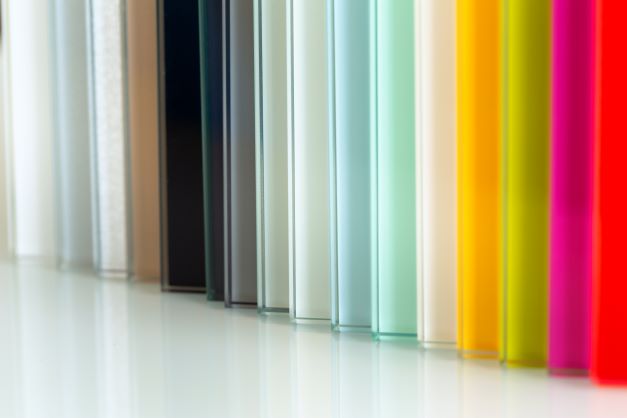
Colour is specified to the RAL Classic standard, which gives a shared reference between designer, specifier and factory — no guessing from a printed chart or a screen.
Zen grey
Deep teal
Midnight blue
Warm taupe
Soft white
Graphite
Beyond the standard chart, colours can be matched to a reference — a brand colour, a tile, a fabric, or an existing panel. Two things are worth being clear about up front:
- Screen colour is not a specification. We work from a physical RAL reference or a supplied sample, not from a photograph or a hex value.
- Exact matching is a process, not an assumption. For colour-critical work we produce a physical strike-off for approval before the full run. It costs a few days and it is the only reliable way to avoid a dispute over a wall that is very slightly the wrong colour.
Gloss, Satin or Matt
Finish is chosen on the same sheet as colour, and it changes how the wall behaves in the room as much as the colour does.
Gloss
Maximum depth and the strongest colour read. Reflects light, which helps a small or windowless bathroom feel larger — but it shows water spots and fingerprints more readily.
Satin
The working middle. Keeps most of the depth while softening reflection, so it is more forgiving between cleans. The usual recommendation for hospitality.
Matt
Flat and non-reflective. The most contemporary read and the best at hiding spotting, with the least colour depth of the three.
Finish is the specification most often left until last, and it is the one that most often causes a rethink after installation. It is worth deciding alongside the colour rather than after it.
Opaque Means Opaque: The Trade-off
A back painted wall panel transmits no light at all. That is the point of it, and it is also the thing to design around.
A tiled or clear-glass shower borrows light from the bathroom. A fully opaque back wall does not. In a bathroom with a window, this is rarely a problem. In a windowless bathroom — an internal en-suite, a basement conversion, a hotel room deep on a floor plate — the shower will need its own lighting, and that lighting should be planned at design stage rather than added afterwards.
There is also a simple optical consequence: an opaque back wall makes the shower read as a solid volume rather than a glazed one. Some schemes want exactly that. Where the brief is to keep the bathroom feeling open, the usual answer is a painted back wall with a clear or tinted glass door on the return, which is covered in the next section.
Pairing Painted Walls with a Glass Door
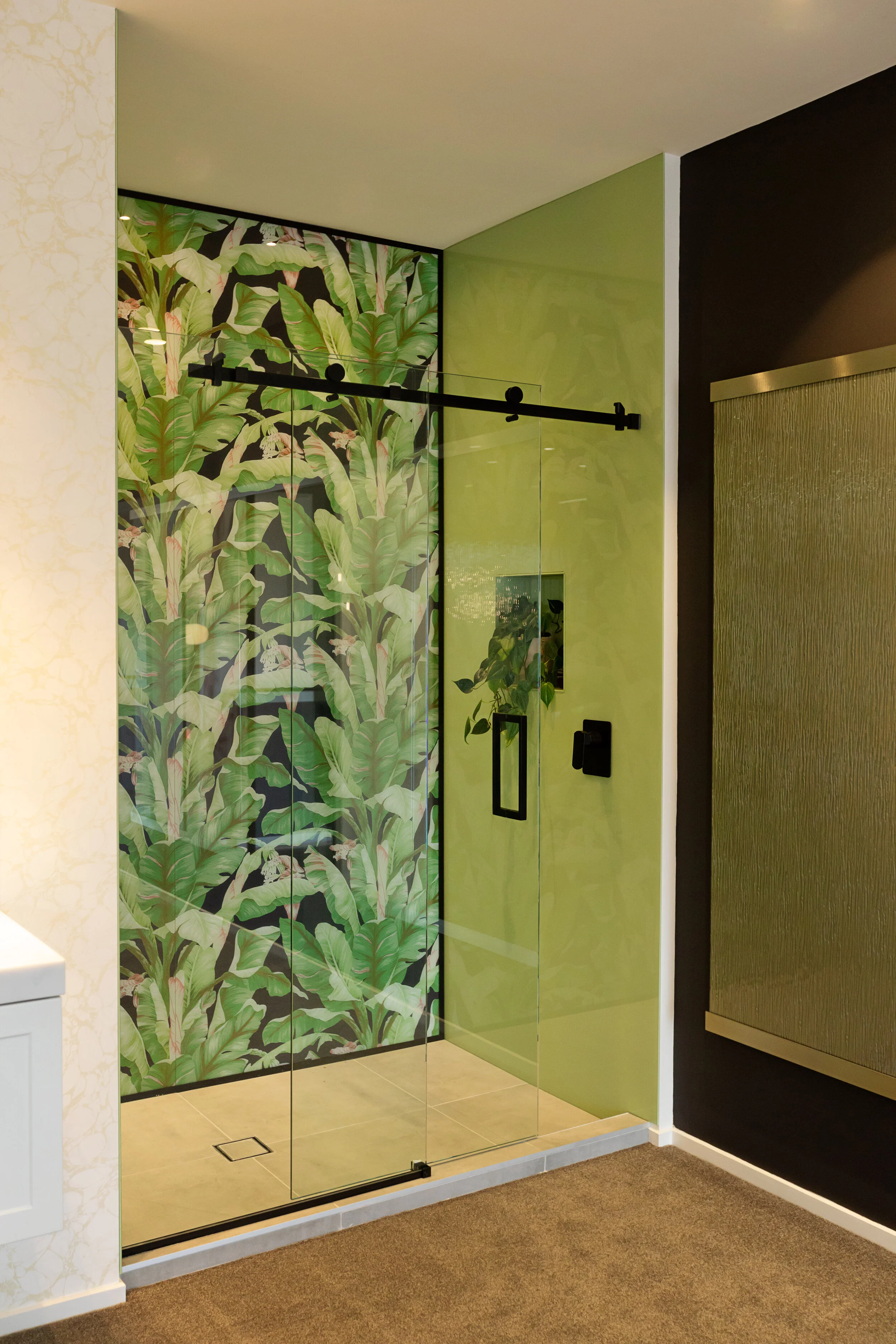
The most common specification is not a fully painted enclosure. It is a painted wall paired with a glazed door — which keeps the room open while giving the shower a solid, coloured anchor.
Painted back wall + clear door
The standard combination. The wall carries the colour, the door keeps the sightline through the room intact.
Painted back wall + tinted door
Adds a second, softer colour note and extra privacy on the door itself, without making the enclosure dark.
Painted side wall only
Used where the back wall is a window or a tiled feature, and only the return needs a maintenance-free surface.
Because Showerspace develops glass, aluminium profiles and stainless steel hardware together, the painted panels and the glazed elements are fabricated as one coordinated package rather than sourced separately and adapted on site. Read about the Showerspace system approach →
How the Panels Are Fitted
Panels are bonded to the wall using a high-strength adhesive, with no visible fixings. The perimeter is closed with a translucent sealant. This is the point at which the product’s practical advantages become concrete.
Almost no drilling
Because the panel is adhered rather than hung, there are no hinge or handle holes through the sheet. Every hole is a place where a coating is interrupted — so avoiding them removes the product’s main vulnerability entirely.
Sealed perimeter
Edges are closed with a translucent sealant as part of a standard detail, rather than being left as an exposed cut edge sitting in standing water.
Single panels, full height
Panels run floor to ceiling where the design allows, removing the horizontal break that collects dirt and makes a low-ceilinged room feel lower.
Cut-outs where needed
Notches for valves, shower heads and recessed niches are cut to drawing and their edges sealed as part of the specification.
Why the drawing has to be final first. The coating is applied after tempering, so cutting, drilling and edge work are all completed before the panel is coated. Nothing can be re-cut, re-drilled or re-edged afterwards. In practice this is a small constraint for a wall panel — dimensions are taken from a finished, tiled-out substrate and do not change — but it does mean measurement happens against a finished wall, not a plan.
Thickness & Size
Back painted shower wall panels are most commonly supplied in 6 mm tempered glass, with 8 mm and 10 mm available for larger panels or where a heavier specification is wanted. [[CONFIRM: recommended thickness by application]]
Panels are cut to size from site dimensions. Maximum panel size depends on thickness, handling, coating equipment capacity and site access, and is confirmed per project. [[CONFIRM: maximum panel size]]
Where a panel is unusually large, or where site access is tight, the wall can be split into two panels with a single sealed vertical joint. That is a deliberate design decision rather than a compromise — and it is much easier to plan for than to discover on installation day.
Processing & Fabrication
Panels are fabricated to drawing and supplied tempered as safety glass.
Cutting
Cut to size and shape from site dimensions or project drawings, before coating.
Edge Polishing
Flat polish and other edge finishes, completed before coating so the finished edge is clean and sealed.
Notches & Cut-outs
CNC notches for valves, shower heads, recessed niches and services, positioned to drawing and sealed after coating.
Holes
Avoided wherever the fixing method allows. Where they are unavoidable, they are cut before coating and sealed as part of the specification.
Coating
Opaque coating applied to the back face and cured. [[CONFIRM: coating system and cure method]]
Tempering
Tempered before coating as safety glass. Requirements for the destination market are agreed before production.,See tempered shower glass.
Processing sequence: cutting → notches and cut-outs → edge work → tempering → coating. Coating last is what protects the colour, and it is why the drawing must be final before fabrication begins.
Enclosure Compatibility
Back painted panels are used within the following configurations. They are specified as walls, which is where they perform best.
Frameless
The configuration that shows fluted glass at its best: minimal framing leaves the texture as the feature. View frameless systems →
Semi-Frameless
Perimeter framing with a frameless door, a common format for mid-market ranges. View semi-frameless →
Framed
Full-profile systems where the glass panel sits within an aluminium frame. View framed systems →
Walk-In
Fixed fluted panels for open, barrier-free layouts, often combined with a clear return panel. View walk-in systems →
Hinged
Swing doors prepared for hinge and handle positions to drawing. View hinged systems →
Sliding
Sliding door panels for apartments and hospitality bathrooms. Texture direction is confirmed against the sightline and handle position. View sliding systems →
Because Showerspace develops glass, aluminium profiles and stainless steel hardware together, panel preparation is matched to the profiles and fittings in your system rather than adapted afterwards. Read about the Showerspace system approach →
Hardware Pairings
A painted wall is a large area of flat colour, so hardware choices read as deliberate rather than incidental.
Deep colours + brushed brass
Teal, midnight blue and graphite against warm metal — the pairing that stops a saturated wall from feeling cold.
Neutrals + matte black
Grey, taupe and soft white with black fittings. Crisp and architectural, and the most specified combination in multi-unit schemes.
Any colour + brushed nickel
The safe pairing where the wall should dominate and the fittings should recede.
View available hardware finishes →
Applications
Residential
Master en-suites and family bathrooms where the enclosure is a design feature and the walls have been newly built or re-lined.
Hotels & Hospitality
Premium room standards, where frameless is part of the specification rather than an upgrade.
Apartments
Higher-tier units within a development, often frameless while the standard units are semi-frameless.
Spa & Wellness
Where the clean, uninterrupted sightline matters and the building is new.
Commercial
Premium fit-outs, showrooms and offices — less often high-traffic changing rooms.
Technical Specifications
| Glass type | Tempered safety glass |
| Thickness | 6 mm / 8 mm / 10 mm — most commonly 6 mm for wall panels |
| Size | Custom, cut to site dimensions; maximum panel size confirmed per project |
| Coating position | Second surface (back face) — protected by the glass, never in contact with water or cleaning agents |
| Coating system | Opaque coating, factory applied and cured |
| Colour | Any RAL Classic shade; custom colour matching available |
| Finish | Gloss, satin or matt |
| Opacity | Fully opaque — no light transmission |
| Privacy | Total |
| Edge | Flat polish and other edge finishes, completed before coating; perimeter sealed with translucent sealant on installation |
| Notches & cut-outs | CNC processed before coating for valves, shower heads and recessed niches; sealed as part of the specification |
| Holes | Avoided by the bonded fixing method; where required, cut before coating and sealed |
| Fixing | High-strength adhesive bond, no visible fixings |
| Processing sequence | Cutting → notches and cut-outs → edge work → tempering → coating |
| Enclosure compatibility | Walk-in, frameless, semi-frameless, framed, hinged, sliding — specified as walls, paired with a glazed door |
| Hardware | Aluminium profiles and stainless steel hardware, selected by configuration and finish |
| Safety glazing | Applicable requirements for the destination market agreed before production. |
| Packaging | Export packaging configured for glass panels, with protection for the coated face |
Specifying Back Painted Glass Without Surprises
Three things prevent almost every problem on these projects.
- Approve a physical sample in the room’s own light. Colour on a screen or a printed chart is not a specification. Look at a real panel under the lighting that will actually be installed — and look at it in the evening, under artificial light.
- Measure off the finished substrate. Panels are cut to site dimensions and then tempered and coated. Nothing can be adjusted afterwards, so measurement waits for a finished, tiled-out wall.
- Plan the lighting. The back wall transmits no daylight. If the bathroom has no window, the shower needs its own lighting and that belongs in the design, not as an afterthought.
Request back painted samples → · Discuss a custom colour →
Related products
Patterned Shower Glass
Fluted Shower Glass
Reeded Shower Glass
Textured Shower Glass
Frosted Shower Glass
Etched Shower Glass
Tinted Shower Glass
Low-Iron Shower Glass
Printed Shower Glass
Back-Painted Shower Glass
Reflective Shower Glass
RelatedTechnical
Shower Glass Thickness
Tempered Shower Glass
Laminated Shower Glass
How to Choose Shower Enclosure Glass
How to Care for Shower Glass
Hardware Finishes
Request a Quote
We use your details to respond to this enquiry only.
Approve the Colour Under the Room’s Own Light
A back painted wall is a large area of flat colour, seen every day. It is worth approving a physical sample in the room it will be installed in — in daylight and again in the evening. We can send a panel in the shade and finish you are considering.
Request a Colour SampleDiscuss Your Project
© Jumbo Glass Group · Showerspace — decorative shower glass and custom shower enclosure systems