Curtain Wall Spandrel Glass
Opaque Insulated Glass Panels for Concealing Floor Slabs, Structure & Insulation Behind Curtain Wall Facades – Colour-Matched to Vision Glass, Ceramic Frit / Back-Painted, Thermally Broken
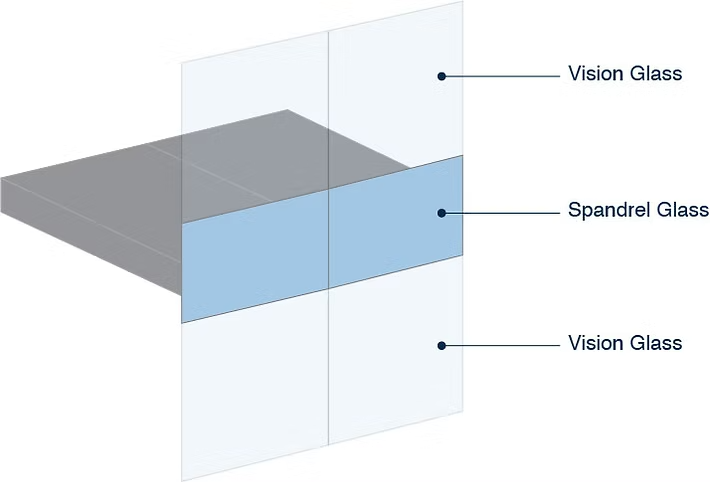
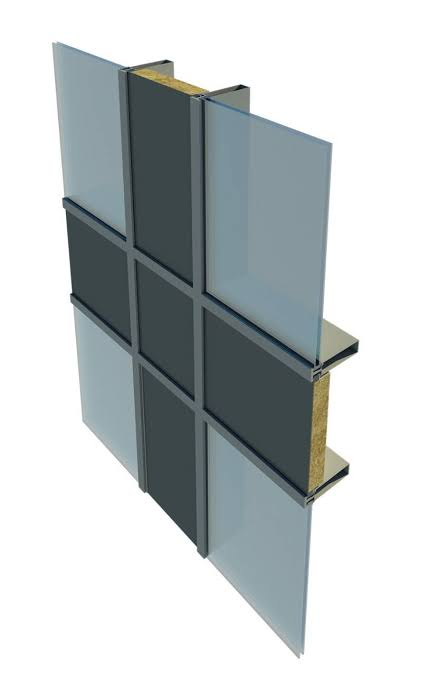
Curtain Wall Spandrel Glass is the non-transparent panel located between vision bands of a curtain wall façade, positioned at each floor level to hide the concrete slab edge, firestop, structural steel, ductwork, insulation and mechanical equipment behind the glass skin. Unlike vision glass which must transmit light, spandrel glass is engineered to be opaque or highly translucent while matching the vision glass in colour, reflectance and gloss so the entire façade reads as one uninterrupted surface.
For facade engineers, curtain wall fabricators, glazing contractors, architects and procurement managers supplying commercial high-rises, mixed-use towers, hotel façades, government buildings and unitized curtain wall packages in Europe, North America, Australia and the Gulf, spandrel glass is not an afterthought – it is a thermally critical, visually demanding, code-regulated component that must be specified with the same rigour as vision glass.
💡 Why spandrel glass requires its own dedicated page: Most glass suppliers treat spandrel as "just opaque glass". But in real curtain wall engineering, spandrel panels must (1) achieve the same U-value as adjacent vision glass to avoid thermal bridging and condensation, (2) match vision glass colour exactly across all lighting conditions, (3) withstand higher internal cavity temperatures due to absorbed solar radiation, and (4) comply with fire-rated spandrel requirements in many jurisdictions. A procurement manager sourcing spandrel glass asks different questions than when sourcing vision glass – this page answers those questions.
1. Quick Specification (Typical Flagship Make-Up)
| Item | Specification |
|---|
| Configuration | 6 mm Tempered Ceramic Frit + 16 mm Argon + 6 mm Clear Tempered |
| Overall Thickness | 28 mm |
| Outer Lite | 6 mm clear tempered, full ceramic frit coating on surface #2 (interior face) |
| Cavity | 16 mm, Argon 90% |
| Inner Lite | 6 mm clear tempered |
| Opacity | Full (no light transmission) |
| Spacer | Warm-edge aluminium or TSS |
| U-value (EN 673) | 1.0 W/m²K (matched to adjacent vision glass) |
| SHGC | 0.45–0.65 (higher than vision due to absorbed heat) |
| VLT | 0% (fully opaque) |
| Max Size (Jumbo) | 6000 × 3300 mm |
| Standards | EN 12150, EN 1279, ASTM C1048, ASTM C1376 |
2. What Is Curtain Wall Spandrel Glass (vs Vision Glass)
| Aspect | Spandrel Glass | Vision Glass |
|---|
| Position in façade | Between floor slabs – horizontal band | Eye-level sightline zone |
| Function | Conceal structure, insulation, MEP | Provide view, daylight |
| Light transmission | 0% (fully opaque) or <10% translucent | 40–75% VLT |
| Backing | Ceramic frit, back-painted, opacified laminate, or metal backing pan | None (transparent) |
| Thermal requirement | Must match vision U-value to avoid cold-bridge | Primary thermal barrier |
| Heat buildup | Higher internal temperature due to absorbed solar radiation | Lower internal temp |
| Fire rating | Often required (EI 30/60/90) | Rarely fire-rated |
| Visual requirement | Match vision colour, gloss & reflectance exactly | Natural appearance
Industry references from Guardian, Viracon and Oldcastle confirm that spandrel and vision must be specified as a matched pair – same coating family, same base glass tint, same frit colour code – to avoid "read-through" where the spandrel band becomes visible as a darker strip on overcast days. |
3. Why Spandrel Glass Matters for Curtain Walls
- Visual continuity – Poorly matched spandrel creates a "patchwork" façade visible from street level.
- Thermal performance – If spandrel U-value is higher than vision, condensation forms at slab edges.
- Condensation control – Warm-edge spacer + Low-E coating on spandrel IGU prevents interior condensation above ceilings.
- Fire safety – Many codes require spandrel panels to provide EI 30/60 fire resistance at slab edges.
- Heat management – Opaque spandrel absorbs more solar heat than vision; proper venting or heat-soaked glass prevents thermal stress breakage.
- Acoustic isolation – Spandrel IGU contributes to inter-floor sound attenuation.
- Large-format efficiency – Jumbo spandrel panels reduce number of joints per floor band.
4. Spandrel Glass Types & Opacification Methods
| Method | Description | Typical Use | Opacity |
|---|
| Full Ceramic Frit | Silk-screen enamel fired onto glass surface | Most common – durable, colour-matched | 100% |
| Back-Painted | Liquid paint applied to interior face | Smaller projects, custom colours | 100% |
| Opacified Laminate | White/black PVB interlayer between two glass plies | Fire-rated spandrel, fall-out protection | 95–100% |
| Metal Backing Pan | Aluminium or galvanised steel pan behind monolithic glass | Retrofit, budget projects | 100% |
| Translucent Frit | Partial dot/hash pattern frit (30–70% coverage) | Semi-opaque aesthetic spandrel | 30–70%
Recommendation for most curtain wall projects: Full ceramic frit on surface #2 (inside face of outer lite) with a clear tempered inner lite – gives best durability, colour consistency and thermal performance. |
5. Colour Matching – Spandrel to Vision Glass
Per your attachment's guidance: colour is important for spandrel, but it follows configuration. The most common spandrel colours by market demand:
| Colour Family | Typical Frit Code | Matches To |
|---|
| Neutral / Light Grey | RAL 7040 / 7035 | Clear Low-E vision glass |
| Dark Grey / Charcoal | RAL 7016 / 7021 | Grey tinted vision glass |
| Black | RAL 9005 | Dark reflective vision, deep façades |
| White / Off-White | RAL 9010 / 9003 | Light-coloured building frames |
| Bronze | RAL 8004 / 8023 | Bronze tinted vision glass |
| Blue-Grey | Custom | Blue reflective vision glass |
| Silver / Metallic | Custom metallic frit | Silver reflective vision glass |
Critical rule: Spandrel frit colour must be tested against actual vision glass sample under D65 (overcast sky) and direct sun before production approval. A colour match that looks perfect in the showroom can fail on site.
6. Common Spandrel Glass Configurations
| Make-Up | Overall | U-value | Opacity | Use Case |
|---|
| 6 mm CF + 12Ar + 6 mm | 24 mm | 1.2 W/m²K | 100% | Budget commercial, mild climate |
| 6 mm CF + 16Ar + 6 mm | 28 mm | 1.0 W/m²K | 100% | Standard unitized tower |
| 8 mm CF + 16Ar + 8 mm | 32 mm | 1.0 W/m²K | 100% | High wind-load, larger modules |
| 6 mm CF + 1.52PVB + 16Ar + 6 mm | 29.52 mm | 1.0 W/m²K | 100% | Fire-rated spandrel, fall-out protection |
| 6 mm CF + 16Ar + 6 mm Low-E | 28 mm | 0.8 W/m²K | 100% | Passive house / LEED façade |
| 6 mm CF + 16Ar + 6 mm + 16Ar + 6 mm (Triple) | 56 mm | 0.5 W/m²K | 100% | Nordic / extreme cold climates |
Note: Where spandrel U-value must match vision U-value, the spandrel IGU typically uses the same Low-E coating (on surface #2 or #3) plus the same gas fill and spacer as the adjacent vision IGU. The only difference is the ceramic frit opacification.
7. Thermal Performance – Spandrel vs Vision
| Metric | Vision IGU (6+16Ar+6 Low-E) | Spandrel IGU (6CF+16Ar+6 Low-E) |
|---|
| U-value | 1.0 W/m²K | 1.0 W/m²K (must match) |
| SHGC | 0.32 | 0.55–0.65 (higher due to dark frit absorbing heat) |
| VLT | 62% | 0% |
| Internal cavity temp (summer) | ~45°C | ~65–80°C (heat absorbed by frit) |
| Risk | Low | Thermal stress breakage if not heat-soaked
Important: Because spandrel glass absorbs more solar radiation than vision glass, the outer lite must be fully tempered (EN 12150 / ASTM C1048) and heat-soak tested (EN 14179) to minimise nickel sulphide inclusion risk. Annealed spandrel glass has a history of spontaneous breakage in dark-coloured spandrel applications. |
8. Fire-Rated Spandrel Glass
Many building codes require spandrel panels at slab edges to provide EI 30, EI 60 or EI 90 fire resistance (Europe) or comply with ASTM E119 / UL 263 (North America).
| Fire Rating | Typical Construction | Application |
|---|
| EI 30 | 6 mm CF + 1.52PVB (fire-grade) + 16Ar + 6 mm | Standard spandrel fire stop |
| EI 60 | 6 mm CF + 2.28PVB (fire-grade) + 16Ar + 8 mm | Higher fire risk zones |
| EI 90 | 8 mm CF + 3.04PVB (fire-grade) + 16Ar + 8 mm | Stairwell spandrel, shaft walls
Fire-rated spandrel glass must be certified by an accredited testing laboratory (e.g. CSTB, IFI, UL) and installed in a fire-rated framing system. |
9. Thickness, Size & Jumbo Capability
| Parameter | Standard CW Supplier | Jumbo Glass |
|---|
| Outer lite thickness | 6 mm | 6–12 mm |
| Inner lite thickness | 6 mm | 6–12 mm |
| Max panel width | 1500 mm | 3300 mm |
| Max panel height | 2500 mm | 6000 mm |
| Max IGU overall | 32 mm | 48 mm |
| Min spandrel height | 600 mm (slab depth) | Any
Jumbo spandrel panels allow fewer horizontal joints per floor band, faster unitized module assembly and cleaner façade lines – especially valuable in hotel and residential tower applications where spandrel bands are often 1200–1800 mm tall. |
10. Processing & Fabrication Rules for Spandrel Glass
| Process | Rule |
|---|
| Ceramic frit application | Applied by silk-screen or digital print on surface #2 (inside face of outer lite) before tempering |
| Frit firing | Fired at 620–680°C during tempering process – becomes permanent enamel |
| Tempering | Both lites fully tempered (EN 12150 / ASTM C1048); outer lite heat-soak tested |
| Colour matching | Production samples approved against reference standard before batch production |
| Edge deletion | Frit removed 8–10 mm from edge for secondary seal adhesion |
| Drilling/notching | Done on monolithic glass before tempering and frit application |
| IGU assembly | Same line as vision IGU – identical spacer, gas fill, sealant |
| Packaging | Interleaving paper between frit surfaces to prevent abrasion |
11. Standards & Compliance
| Standard | Market | Scope |
|---|
| EN 12150 | EU/UK | Tempered safety glass |
| EN 14179 | EU/UK | Heat-soaked tempered glass |
| EN 1279 | EU/UK | Insulating glass units |
| EN 673 | EU/UK | U-value calculation |
| EN 13501-1 | EU/UK | Fire classification |
| EN 1364-4 | EU/UK | Fire resistance of curtain wall spandrel |
| ASTM C1048 | USA | Heat-treated glass |
| ASTM C1376 | USA | Coated glass |
| ASTM E119 | USA | Fire tests of building construction |
| ASTM E2188 | USA | IGU performance |
| AS/NZS 4666 | AU/NZ | Insulating glass units |
12. Selection Matrix – Spandrel Glass by Project Driver
| Project Driver | Recommended Make-Up | Key Consideration |
|---|
| Budget commercial (mild climate) | 6CF + 12Ar + 6 | Lowest cost, adequate thermal |
| Standard unitized tower | 6CF + 16Ar + 6 Low-E | Match vision U-value 1.0 |
| High wind load / large modules | 8CF + 16Ar + 8 Low-E | Stiffer lites, same thermal |
| Fire-rated spandrel | 6CF + 1.52PVB-Fire + 16Ar + 6 | EI 30–60 certification |
| Passive house / LEED | 6CF + 16Ar + 6 Triple-Silver Low-E | U-value 0.8 |
| Nordic climate | 6CF + 16Ar + 6 + 16Ar + 6 Triple | U-value 0.5 |
| Premium hotel façade | 6CF (custom colour) + 16Ar + 6 Low-E | Colour match to vision critical |
13. FAQ – Curtain Wall Spandrel Glass
Q1: What is spandrel glass in a curtain wall?
Spandrel glass is the opaque panel located at each floor level, hiding the slab edge, firestop, insulation and mechanical services behind the façade.
Q2: Does spandrel glass need to match vision glass?
Yes – critically. The colour, reflectance and gloss of spandrel glass must match the adjacent vision glass to avoid a visible striped effect on the building exterior.
Q3: What is the most common way to make spandrel glass opaque?
Full ceramic frit – a vitreous enamel screen-printed onto the interior face of the outer glass lite and fired during tempering.
Q4: Can spandrel glass be the same thickness as vision glass?
Yes – and it should be. Using the same overall IGU thickness ensures consistent frame engagement and thermal performance across the façade.
Q5: Does spandrel glass need Low-E coating?
If the adjacent vision glass has Low-E, then yes – the spandrel IGU should use the same coating to maintain equal U-value and avoid thermal bridging at the slab edge.
Q6: Is spandrel glass more expensive than vision glass?
The base IGU cost is similar; the added cost comes from ceramic frit application (+10–20%) and colour matching quality control.
Q7: What causes spandrel glass to break?
Thermal stress – dark frit absorbs solar heat, raising glass temperature significantly. Solution: fully tempered + heat-soak tested outer lite.
Q8: Can spandrel glass be fire-rated?
Yes – using fire-resistant PVB interlayers and tested IGU constructions (EI 30/60/90).
Q9: How do I ensure colour match between spandrel and vision?
Provide a vision glass sample to the frit supplier; produce spandrel samples under production conditions; approve under D65 and direct sunlight before mass production.
Q10: Can I get jumbo-sized spandrel panels?
Yes – Jumbo Glass produces spandrel IGU up to 6000 × 3300 mm, reducing joints per floor band.
14. Indicative Price (FOB China, per m²)
| Make-Up | Indicative FOB |
|---|
| 6CF + 12Ar + 6 (clear, no Low-E) | US$ XX–XX /m² |
| 6CF + 16Ar + 6 Low-E (standard) | US$ XX–XX /m² |
| 8CF + 16Ar + 8 Low-E | US$ XX–XX /m² |
| 6CF + 1.52PVB-Fire + 16Ar + 6 | US$ XX–XX /m² |
| Triple glazed spandrel | US$ XX–XX /m²
Final price varies with: frit colour complexity, coating grade, jumbo size yield, fire-rated interlayer, quantity, packaging, incoterm. |
15. Request Curtain Wall Spandrel Glass Quote
Send your glass schedule / elevation / spandrel zone drawings:
- Project location & climate zone
- System type – stick / unitized / semi-unitized
- Spandrel make-up (e.g. 6CF + 16Ar + 6 Low-E surface #2)
- Frit colour code (RAL / Pantone / custom reference)
- Vision glass match sample (if available)
- Fire rating required – EI 30 / 60 / 90 / none
- Coating spec – same as vision / different
- Spacer & gas – aluminium / warm-edge, argon / krypton
- Max panel size & quantity per type
- Heat soak test required – yes / no
- Standards – EN / ASTM / AS+NZS
- Upload: PDF / DWG / Glass Schedule / Elevation
- Incoterm & destination port
- 📧 tomron1688@gmail.com | 🌐 Upload at www.jumbotemperedglass.com
- Response: feasibility + U-value/SHGC calc + colour match plan within 48 h.
16. Internal Link Cluster
Within Curtain Wall Glass (Applications → Curtain Wall Glass)
- Curtain Wall Glass & Glazing Solutions (hub)
- Curtain Wall Vision Glass
- Low-E Insulated Curtain Wall Glass
- 6+16Ar+6 Low-E Curtain Wall Glass
- 8+16Ar+8 Low-E Curtain Wall Glass
- Laminated Insulated Curtain Wall Glass
- Blue Reflective Curtain Wall Glass
- Grey Reflective Curtain Wall Glass
- Product cross-links
- Jumbo Tempered Glass | Jumbo Laminated Glass | Ultra Clear Tempered Glass | Jumbo Reflective Glass
- Adjacent applications
- Storefront & Retail Glass | Window & Door Glass | Structural Glass