Home › Showerspace › Custom Design › Custom Printed Shower Glass
Custom Design
Custom Printed Shower Glass — Digital or Screen, and Which One Your Design Needs
Your artwork goes on in ceramic ink, and is fired into the glass. Choose the method by what the design needs, not by habit.
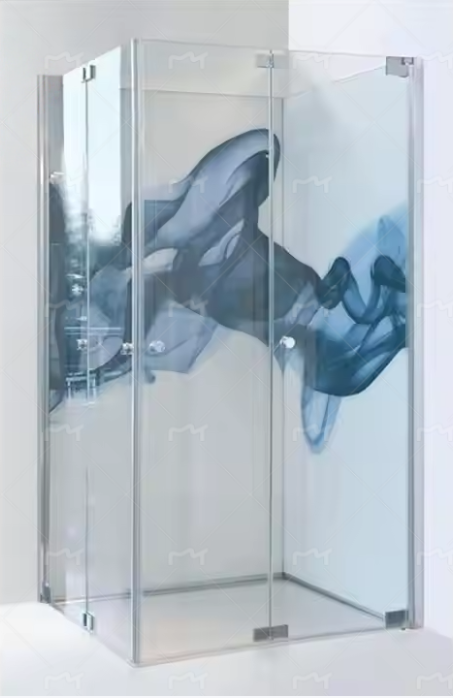
Printing is the one part of shower glass that is genuinely developed rather than selected. Body tints and rolled patterns come from the ranges the original glass manufacturers make; printed artwork comes from your drawing. There are two ways to put it on — digital and screen — and they are not interchangeable. Which one suits the job depends on the design, the quantity, and whether the design will be used again.
Digital or ScreenArtwork Requirements
Why Printing Is Different
Every other decorative option in this range arrives as something that already exists. A rolled pattern is already on the roller. A body tint is already in the manufacturer's range. Printing is the exception: the artwork is yours, and it is produced for the first time when you order it.
Developed, not selected
The design comes from your drawing. There is no catalogue to choose from, because the catalogue is whatever you bring.
The ink is fired in
Ceramic ink is applied to the glass and then fused into the surface during tempering. It is not a film, and it is not a coating applied afterwards.
It happens before tempering
Printing is always before tempering, never after. The furnace is what fixes the ink. A design printed onto tempered glass would simply sit on the surface.
One consequence worth knowing
Because the ink is fused into the glass, the panel can be cut and drilled before tempering like any other — but the artwork has to be positioned for the final panel size, not adjusted afterwards.
This is the same reason printed shower glass in the standard range behaves as it does; the custom difference is that the artwork is yours and the run is dedicated to it.
Digital or Screen: How to Choose
The two methods are not better and worse versions of the same thing. They solve different problems, and choosing by habit is the most common way to end up with the wrong one.
| | Digital printing | Screen printing |
|---|
| What it does best | Anything — continuous tone, gradients, photography, fine detail | Flat single colours, solid coverage, crisp edges |
| Multi-colour | Natural. Full colour in one pass | A problem. Registration across colours degrades, and cost rises with each colour |
| Minimum | None — no screen to amortise, so a single panel is viable | 300 m² |
| Cost behaviour | Roughly flat per unit — the tenth panel costs about what the first did | Falls with quantity. The screen is a fixed cost spread across the run |
| Repeat orders | No screen to store; reprints are straightforward | The screen can be held for reorders, which suits repeat programmes |
| Choose it when | The design is complex, the quantity is small, or every panel is different | The design is one or two flat colours and the quantity clears 300 m² |
Three questions settle it
- Is the design one colour or many? One or two flat colours → screen is viable. Continuous tone, gradient or photography → digital only.
- Is the quantity above 300 m²? Below that, screen is not available however simple the design.
- Will the same design be used again? If it will, the screen cost spreads across projects — and screen can win on cost even on a modest first order.
A practical note on screen registration. Screen printing applies one colour at a time, each through its own screen, and each has to land in exactly the same place. Multi-colour work is where this becomes visible: the more colours, the more chances for the layers to sit slightly apart. It is not a defect in the process — it is what the process does. For multi-colour designs, digital is usually the right answer on quality as well as quantity.
Why the Fired Colour Is Not the Printed Colour
This is the part that most often surprises people, and it is worth reading before designing artwork.
Ceramic ink is not paint. It goes onto the glass as one colour and comes out of the furnace as another, because the heat that fuses it into the surface also develops the pigment. The shift is real, it varies by colour, and it cannot be read off the artwork file.
- No exact Pantone match is promised. Not because the process is imprecise, but because the fired result is the only true reference — and it is only known after firing.
- The approval standard is a fired sample. Not a screen rendering, not a paper proof, not a colour swatch. A piece of glass that has been through the furnace.
- Brand-critical schemes should budget for sampling. If the colour has to be right for a brand, plan for a sampling round. It is a genuine step in the process, not a formality to be skipped.
What this means in practice. Send the artwork and the colour intent, expect a fired sample, compare it under the lighting the bathroom will have, and approve that. The alternative — approving from a rendering and discovering the difference on delivery — is the argument this process is designed to avoid.
What the Artwork Needs to Be
Printing reproduces what it is given. Three things determine whether the result matches what was imagined, and all three are settled before production starts.
Vector where possible
Vector artwork — AI, EPS, SVG or a PDF with live vectors — scales to panel size without losing edge quality. This matters most for logos, type and geometric work.
Fonts converted to outlines
A font that has not been converted may substitute on another system. Converting to outlines removes the risk entirely.
Resolution for raster work
Where the artwork is photographic, supply it at 300 dpi at the final printed size. An image that looks sharp on screen is often far below this.
Repeat and scale declared
A repeating design needs its repeat size stated, and the panel size it is designed for. A pattern scaled up to fill a 2 m panel looks very different from the tile it was drawn at.
Colour intent, not just colour values
Give the target colour, but expect to approve against a fired sample rather than against a number. The two are not the same reference.
Rights confirmed
The buyer must hold the rights to the artwork supplied. This is asked on every order, and it protects both sides.
One more thing that is easy to miss: the artwork is positioned for the final panel size. Because the ink is fired in before tempering, and because nothing can be cut or drilled afterwards, the design has to be laid out for the panel as it will be delivered — including any holes for hinges or clamps.
Where Printed Glass Works, and Where It Does Not
Printing is the most flexible option in the range, which makes it easy to over-specify. Two honest limits.
It does not obscure by itself
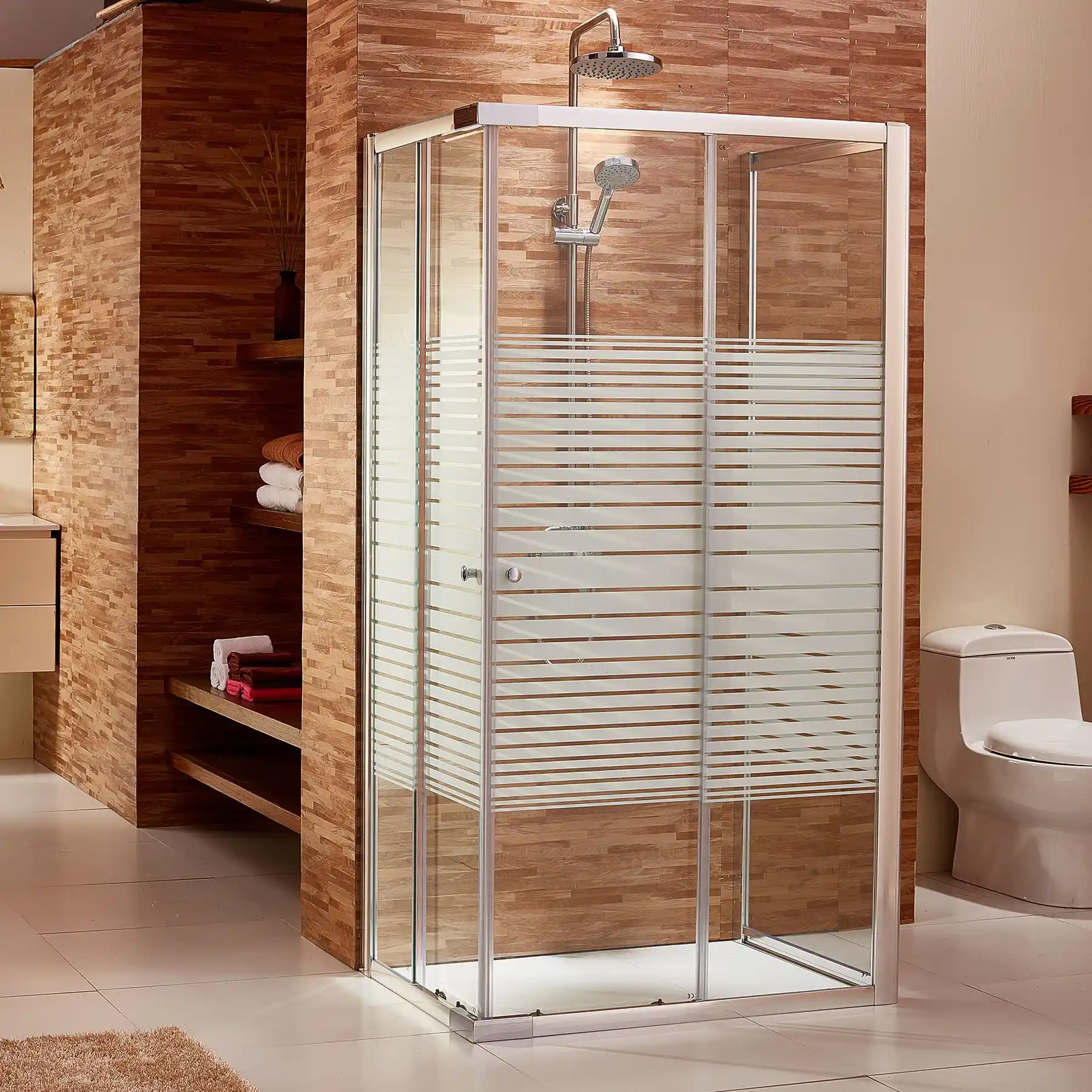
Print is opaque where it is applied and clear where it is not. A sparse design leaves most of the panel transparent. Where obscuring is the requirement, the answer is a dense pattern, or a frosted or etched base underneath.
Dense coverage changes the room
A fully printed panel transmits very little light. On a large panel in a bathroom with one window, this is the difference between a bright shower and a dim one. Worth checking before specifying full coverage.
The second face is visible
Print is viewed from both sides. A design that reads correctly from outside reads in reverse from inside — which matters for anything with text or a directional motif.
Backlit changes everything
Daylight, a window behind the panel, or a lit shower all change how printed colour reads. Approve the sample under the lighting that will actually be there.
Read the full technical detail on printed shower glass →
How a Printed Order Runs
- Artwork and method. The design is reviewed, and the method is chosen from the three questions above. For screen work, the design has to be final before the screen is made.
- Fired sample. A sample is produced through the full process, including the furnace — not a proof. This is what gets approved.
- Approval. Checked under the lighting the bathroom will have, and against the panel thickness and any substrate combination being used.
- Print, then temper. The approved artwork is printed and the panels are tempered. The furnace fuses the ink and gives the panel its safety properties in the same pass.
The step that costs the most when rushed is the second. Artwork signed off late, or a sample approved from a rendering instead of a fired piece, is where printed orders go wrong — and both are entirely avoidable.
Technical Specifications
| Artwork | Developed to your drawing. No catalogue — the design is produced for the first time when ordered |
| Ink | Ceramic, applied to the glass and fused into the surface during tempering. Not a film, not a post-applied coating |
| Sequence | Print before temper, never after. The furnace fixes the ink and gives the panel its safety properties in the same pass |
| Digital printing | Any artwork — continuous tone, gradients, photography, fine detail. No minimum; cost roughly flat per unit |
| Screen printing | Flat single colours and solid coverage. 300 m² minimum; unit cost falls as quantity rises. Multi-colour registration degrades |
| Method selection | By number of colours, quantity against the 300 m² threshold, and whether the design will repeat |
| Colour matching | No exact Pantone match is promised. Ceramic ink shifts in the furnace. Approval is against a fired sample |
| Artwork files | Vector preferred — AI, EPS, SVG or vector PDF. Fonts converted to outlines. Raster work at 300 dpi at final size |
| Rights | The buyer confirms they hold the rights to the artwork supplied |
| Obscuring | Print is opaque only where applied. Where obscuring is required, use a dense design or a frosted or etched base |
| Glass processing | Tempered as safety glass; cut, drilled and edge-worked before tempering, positioned for the final panel size |
| Samples | Fired samples produced through the full process. [[CONFIRM: whether standard on every new design]] |
Request printed samples →
Request Custom Printed Shower Glass
Tell us what the design is and how much of it you need. Those two answers decide the method before anything else.
Name
Business email
Company
Preferred method
Please select…
Digital printing
Screen printing
Not sure — please advise
Chosen by number of colours, quantity against 300 m², and whether the design repeats.
How many colours in the design?
Please select…
One flat colour
Two or three flat colours
Full colour / continuous tone
Gradient
Photographic
Not decided — please advise
Multi-colour work usually points to digital — screen registration degrades with colour count.
Quantity
Screen printing carries a 300 m² minimum. Digital has none.
Is the artwork final?
Please select…
Yes — final and signed off
Close — minor changes possible
Still being designed
No artwork yet — we need design support
For screen work, the design must be final before the screen is made.
Will this design be used again?
Please select…
One-off for this project
Likely to repeat across projects
Part of a rolling programme
Not sure
Repeat designs can justify a screen even on a modest first order.
Panel size
Destination country
Artwork upload
AI, EPS, SVG, vector PDF, PSD, TIFF, JPG or PNG. Vector preferred; fonts converted to outlines; raster at 300 dpi at final size.
Artwork rights
Please select…
We hold the rights to this artwork
We have written permission from the rights holder
The artwork is in the public domain
Not sure — please advise
Required on every order. It protects both parties.
Project notesRequest a Quote
We use your details to respond to this enquiry only. See our privacy policy.
Approve a Fired Sample, Not a Rendering
Ceramic ink changes colour in the furnace. The only reliable reference is a piece of glass that has been through it — checked under the lighting the bathroom will actually have.
Request Printed SamplesBrowse Decorative Glass
© Jumbo Glass Group · Showerspace — decorative shower glass and custom shower enclosure systems