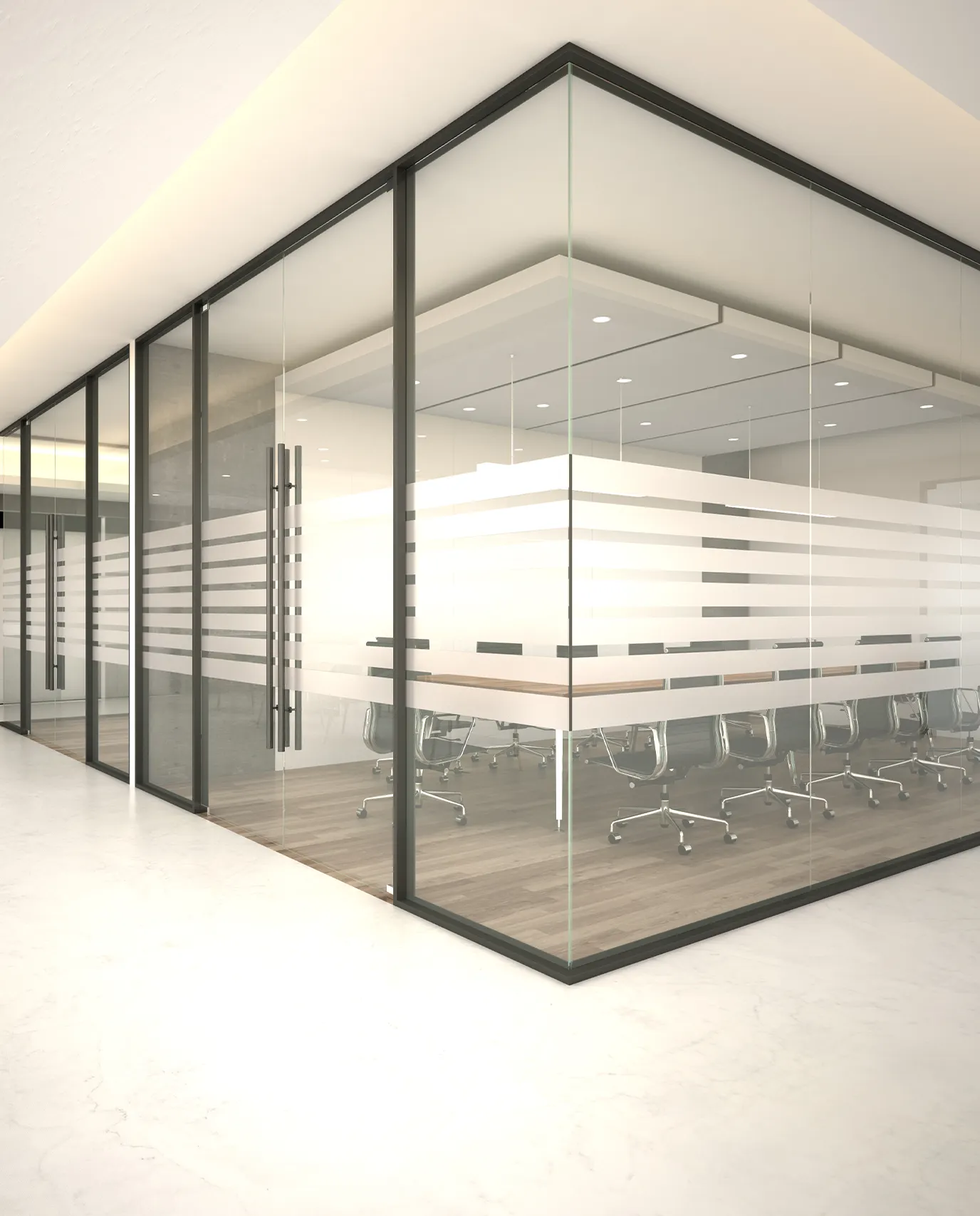
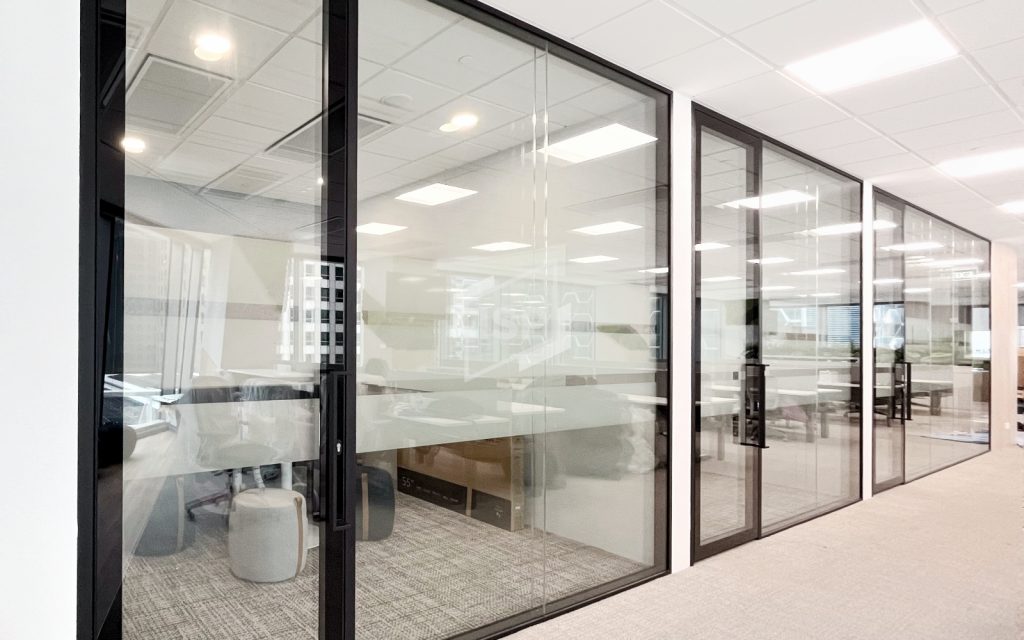
Double Glazing for Acoustics – How IGU Works for Sound Insulation
Subheading: The Science of Insulating Glass Units for Noise Control – Cavity Design, Gas Fill, Asymmetry & Warm-Edge Spacer for Office Pods, Partitions & Acoustic Spaces
Key Specs Badge: STC 43–50 | Cavity 12–20 mm | Argon 90% | Asymmetric Panes | EN 1279 / ASTM E2190
CTA Buttons: [Request a Quote] [Download IGU Tech Datasheet]
02 – What Is Double Glazing for Acoustics?
H2: What Is an Acoustic Insulating Glass Unit (IGU)?
An Acoustic Insulating Glass Unit (IGU) is a sealed double-glazed assembly consisting of two lites of glass separated by a spacer and an air or gas cavity. Unlike monolithic glass or standard laminated glass, the IGU introduces a discontinuity in the sound transmission path—the cavity acts as a spring-damper system that dissipates acoustic energy. In acoustic applications, the IGU is engineered not just for thermal insulation (U-value) but specifically for sound transmission loss (STL) across the speech frequency range (500–4000 Hz).
03 – The Physics of Double Glazing
H2: How Double Glazing Reduces Noise – Mass-Spring-Mass System
The fundamental principle of an IGU is the mass-spring-mass model:
- First mass: Outer glass lite (e.g., 6 mm tempered)
- Spring: Air or gas cavity (12–20 mm)
- Second mass: Inner glass lite (e.g., 8 mm tempered)
- When sound waves strike the outer lite, it vibrates. The cavity (spring) absorbs and delays the vibration before it reaches the inner lite. The resonance frequency (fo) of this system is determined by the mass of the glass and the stiffness of the cavity:
fo = 1 / (2π) × √(ρ·c² / (m·d))
Where:
- ρ = density of gas (air or argon)
- c = speed of sound in gas
- m = mass per unit area of glass
- d = cavity depth
- Key insight: The lower the resonance frequency, the better the low-frequency insulation. To push fo below the speech band (< 500 Hz), increase cavity depth and glass mass.
04 – Cavity Width – The Critical Factor
H2: Cavity Width & Acoustic Performance
Cavity width is the single most important acoustic parameter in an IGU. The relationship is non-linear:
| Cavity Width | Acoustic Effect | Typical STC Gain* |
|---|
| 6 mm | Minimal spring effect | +1–2 vs. monolithic |
| 9 mm | Noticeable improvement | +3–4 |
| 12 mm | Standard acoustic IGU | +5–7 |
| 16 mm | Optimal for speech (500–4000 Hz) | +7–10 |
| 20 mm | Extended low-frequency control | +9–12 |
| >20 mm | Diminishing returns; convection noise | +10–13
*Gain vs. a single monolithic glass of equal total thickness. Actual STC depends on glass type, interlayer, and frame.
Procurement Note: For office pods and meeting rooms, 16 mm argon-filled cavity is the sweet spot—it balances acoustic performance, unit thickness, and cost. Narrower cavities (<12 mm) offer little acoustic advantage over laminated glass. |
05 – Gas Fill – Air vs. Argon
H2: Air vs. Argon Fill – Does Gas Affect Sound?
| Parameter | Air | Argon (90%+) |
|---|
| Density | 1.2 kg/m³ | 1.78 kg/m³ |
| Speed of Sound | 343 m/s | 323 m/s |
| Acoustic Impedance | Baseline | ~30% higher |
| Thermal Conductivity | 0.024 W/m·K | 0.016 W/m·K |
| Acoustic Benefit | – | Slight improvement in STC (1–2 points) |
| Cost Premium | – | ~5–10%
Key Finding: Argon fill primarily improves thermal performance (U-value drops by ~10–15%). Its acoustic contribution is modest—the higher density and lower speed of sound slightly improve impedance mismatch, adding 1–2 STC points. For purely acoustic applications, air cavity is acceptable; for combined thermal-acoustic requirements (e.g., perimeter offices with HVAC noise), argon is recommended. |
06 – Asymmetric Panes – Breaking Resonance
H2: Asymmetric Pane Configuration
Using different thicknesses for the two lites (e.g., 6 mm outer + 8 mm inner) is a critical acoustic strategy:
- Different coincidence frequencies – Each pane thickness has its own coincidence dip; asymmetry prevents a single deep dip in the speech band
- Decoupled resonance – The mass-spring-mass system has a less pronounced resonance peak when masses are unequal
- Typical asymmetric builds:
Rule of thumb: Always specify asymmetric panes for IGU in acoustic applications. Symmetric IGU (e.g., 6+6) is only acceptable for thermal-only glazing.
07 – Warm-Edge Spacer & Sealing
H2: Warm-Edge Spacer & Acoustic Integrity
The spacer is not just a thermal component—it affects acoustics:
- Rigid aluminum spacer: Good thermal break but can transmit vibrations (acoustic bridge)
- Warm-edge spacer (TPS, SWIGGLE, foam): Flexible, reduces vibration transmission, improves STC by 1–2 points
- Seal integrity: A broken seal allows cavity gas to escape, reducing both thermal and acoustic performance. EN 1279 / ASTM E2190 certified IGUs maintain seal for 20+ years.
- JUMBO Glass Group uses warm-edge spacers as standard for acoustic IGUs, with dual-seal (butyl + polysulfide/silicone) for long-term durability.
08 –Double vs. Triple Glazing for Acoustics
H2: Double vs. Triple Glazing – Which Is Better for Sound?
| Parameter | Double Glazing (IGU) | Triple Glazing |
|---|
| Glass Lites | 2 | 3 |
| Cavities | 1 | 2 |
| Typical STC | 43–50 | 47–55 |
| Thickness | 24–38 mm | 36–55 mm |
| Weight | Moderate | Heavy (+40%) |
| Cost | Baseline | +30–50% |
| When to Use | Most acoustic pods & partitions | Recording studios, extreme noise control
Critical Note: Triple glazing is not always better than double. If the cavity widths are too narrow (< 10 mm each), the spring effect is compromised and performance may be worse than a well-designed double IGU. Triple glazing should only be specified when: |
- STC > 50 is required
- Low-frequency control (< 250 Hz) is critical
- Space and weight are not constraints
- For 90% of office pod and partition applications, asymmetric double glazing with 16 mm argon cavity is the optimal choice
09 – Integration With Pod & Partition Systems
H2: IGU in Acoustic Applications
- Office Pods / Meeting Pods: 6+16Ar+8 asymmetric IGU, STC 45–48
- Recording Booths: Composite (laminated + IGU) for STC 50+
- Partitions: 6+16Ar+8 or 8+16Ar+10, floor-to-ceiling jumbo panels
- Phone Booths: Laminated preferred (thinner); IGU only if HVAC noise is high
- Engineering Tip: IGU performs best when the frame and seals are designed for the thicker unit (24–38 mm). Retrofitting IGU into a frame designed for 12 mm laminated glass will compromise the seal and reduce STC
10 – Selection Guide for Buyers
H2: How to Specify Acoustic IGU
| Your Requirement | Recommended Build |
|---|
| Standard office pod | 6+16Ar+8, warm-edge, STC 45–47 |
| High-privacy meeting | 8+16Ar+10, asymmetric, STC 47–49 |
| Recording / broadcast | Composite: 6+PVB+6 + 16Ar + 8, STC 50+ |
| Thermal + acoustic (perimeter office) | 6 Low-E + 16Ar + 8, STC 44–46 |
| Budget acoustic | 6+12Air+6, STC 42–44
Ask your supplier: |
- What is the cavity width and gas fill?
- Are panes asymmetric? If not, why?
- What spacer type is used? (Warm-edge recommended)
- Can you provide TL curve for the IGU build?
- What is the seal warranty? (20-year standard for JUMBO)
11 – Manufacturing & Quality (JUMBO Glass Group)
H2: Manufactured by JUMBO Glass Group
- Jumbo IGU line: Up to 3300 × 13000 mm (130" × 512")
- Cavity options: 6–20 mm, argon 90%+
- Spacer: Warm-edge TPS / foam, dual-seal
- Certifications: EN 1279-1~5, ASTM E2190, IGCC
- QC: Argon retention test, dew point test, sealant adhesion test
- Production bases: 3 facilities, 30,000 m²+ workshop
- Export: 100+ countries, seaworthy crating
12 – FAQ
H2: Frequently Asked Questions
- How does double glazing reduce noise?
By creating a mass-spring-mass system where the cavity dissipates sound energy between two glass lites. - What is the best cavity width for acoustics?
16 mm argon-filled cavity is the optimal balance for speech frequency control (STC 45–48). - Does argon fill improve soundproofing?
Slightly—argon adds 1–2 STC points via higher density and impedance mismatch. Its main benefit is thermal. - Why use asymmetric panes?
Asymmetry prevents a single coincidence dip in the speech band, improving STC by 2–4 points over symmetric builds. - Can IGU be combined with acoustic PVB?
Yes—composite builds (laminated + IGU) achieve STC 50+. See Acoustic PVB & Laminated Glass Technology. - Double or triple glazing for my pod?
For most office pods, double glazing with 16 mm argon is optimal. Triple only if STC > 50 or low-frequency control is critical. - What spacer should I use?
Warm-edge spacer reduces vibration transmission and improves STC by 1–2 points vs. rigid aluminum. - How long does IGU last?
EN 1279 / ASTM E2190 certified units with dual-seal maintain performance for 20+ years. - Can IGU be tempered?
Yes, both lites are fully tempered for safety (EN 12150 / ANSI Z97.1). - How do I request a quote?
Send your IGU build (pane thickness, cavity, gas), dimensions, and STC target to sales@jumbotemperedglass.com.
Final CTA
H2: Need Acoustic IGU for Your Project?
Send us your specification or drawing. Our engineering team will recommend the optimal cavity width, gas fill, and pane configuration for your STC target.
[Request a Quote] [Download IGU Datasheet] [Send Your Drawing]
- 📩 Email: tomron1688@gmail.com
- [Request a Quote] [Download Datasheet]
🔗 Internal Link Cluster
Related Applications
Acoustic Glass for Office Pods | Office Pod Glass Manufacturer – AcouSpace
Phone Booth Glass | Acoustic Glass for Phone Booths – AcouSpace
Acoustic Glass for Meeting Pods | Meeting Pod Glass Manufacturer – AcouSpace
Acoustic Glass for Work Pods | Work Pod Glass Manufacturer – AcouSpace
Acoustic Glass for Office Privacy Booths | Privacy Booth Glass Manufacturer – AcouSpace
Acoustic Glass for Recording Booths | Recording Booth Glass Manufacturer – AcouSpace
Acoustic Glass for Podcast Booths | Podcast Booth Glass Manufacturer – AcouSpace
Related Product
- [Acoustic Laminated Glass](/acouspace/products/acoustic-glass/acoustic-laminated-glass/)
- [Acoustic Insulated Glass](/acouspace/products/acoustic-glass/acoustic-insulated-glass/)
- [Acoustic Laminated Insulated Glass](/acouspace/products/acoustic-glass/acoustic-laminated-insulated-glass/)
- [Low-E Acoustic Glass](/acouspace/products/acoustic-glass/low-e-acoustic-glass/)
- [Low-Iron Acoustic Glass](/acouspace/products/acoustic-glass/low-iron-acoustic-glass/)
- [Acoustic Glass Doors](/acouspace/products/acoustic-glass/acoustic-glass-doors/)
- [Acoustic Glass Panels](/acouspace/products/acoustic-glass/acoustic-glass-panels/)
- [Custom Acoustic Glass](/acouspace/products/acoustic-glass/custom-acoustic-glass/)
Related Technology supporting
- STC Rating & Rw Rating for Acoustic Glass | STC vs Rw Explained – AcouSpace
- Acoustic PVB Interlayer & Acoustic Laminated Glass Technology – How It Works
- Double Glazing for Acoustics – How IGU Works for Sound Insulation | JUMBO AcouSpace
-Acoustic Laminated Glass vs Double Glazing – Which Is Right for Your Project?
Acoustic Glass Performance – How to Read Acoustic Performance Data | JUMBO AcouSpace
- ISO 23351 for Acoustic Office Pods & Meeting Pods – ASTC, SNR & Classification | JUMBO AcouSpace
Acoustic Glass Testing – How Acoustic Glass Is Tested & How to Read Test Reports | JUMBO AcouSpace