Home › Showerspace › Decorative Shower Glass › Frosted Shower Glass
Decorative Shower Glass
Frosted Shower Glass for Bathroom Privacy & Light
Soft Light. Real Privacy. Quietly Architectural.
Frosted shower glass is the privacy glass most bathrooms end up specifying — and the one most often specified at the wrong level. It ranges from a light satin haze to near-full obscuration, and choosing between them depends less on the glass than on the room it goes into.
Choose a Privacy LevelRequest a Quote
What Is Frosted Shower Glass?
Frosted glass is glass whose surface scatters light instead of transmitting it cleanly. The glass is still fully transparent in the physical sense — it passes light through — but what sits behind the panel is no longer legible. That single property is what makes it useful in a bathroom: it gives privacy while still letting the room receive light, which blocking glass cannot do.
“Frosted” describes the appearance. The finish is produced by acid etching or sandblasting, and both are described on our etched shower glass page. For most buyers the distinction is simple: frosted is what you ask for by how it looks, etched is what you specify when the level has to be exact.
One buying trap worth naming. “Frosted” is also used to describe applied film and spray coatings, which are a different product entirely. Film carries an adhesive layer that can lift at the edges, cloud, or react with shower cleaning chemicals over time — the usual failure mode in a wet area. A genuine frosted finish is the glass surface itself, with nothing applied to it and nothing to peel. If a quotation for “frosted glass” is dramatically cheaper than the rest, it is worth asking which of the two is being supplied. [[CONFIRM: confirm the
Frosted or Etched: Which Page Do You Need?
The two terms describe the same finishes from opposite ends, and the right page depends on where you are in the decision.
| | Frosted (this page) | Etched |
|---|
| Describes | How the glass looks | How the finish is produced |
| Use it to | Decide which privacy level the room needs | Specify the process, grade and format |
| Covers | Levels by room type, and what frosting does to a room | Acid vs sandblast, the ET grade series, gradient, zoned and artwork formats |
| Typical visitor | Choosing between satin and opaque, or frosted vs textured | Already knows a frosted finish is wanted and needs it specified |
In practice most people read both: start here to settle the level, then go to the etched shower glass grades to turn that into an orderable specification.
The Privacy Scale: Satin to Opaque
Frosted glass is not one product with one level of privacy. It is a scale, and most disappointment with frosted bathrooms comes from specifying too light a level for how the room is actually used.
satin
light
standard
deep
near-opaque
Light satin ET-01
Softens outlines and reflections; the enclosure still reads as glass. Right for en-suites and main bathrooms used by one person at a time.
Standard frost ET-02
Obscures the outline at normal viewing distance. The default for shared family bathrooms and most hotel room standards.
Deep frost ET-03
Approaching full obscuration while still transmitting light. Specified for accessible bathrooms, changing areas and anywhere coverage is non-negotiable.
These three correspond to the first three grades in the ET grade series, which is what you specify against. Gradient and banded formats give you two levels on one panel — see ET-04 and ET-05. [[CONFIRM: which levels are in regular production — publish only those]]
Which Level for Which Room?
This is the question that actually determines the right specification, and it is answered better by the room than by the glass.
Shared family bathroom
ET-02. Used by several people, often simultaneously with the room outside. Standard frost is the level that holds up in daily family use; satin is usually too light.
En-suite / master bathroom
ET-01 or ET-02. Privacy matters less than keeping the room bright and open. Light satin is often enough, and it is the level that best preserves a sense of space.
Hotel room standard
ET-02, or ET-04 gradient. The enclosure is often visible from the bedroom, which is where a gradient earns its place: coverage where it is needed, open above.
Accessible / assisted use
ET-03, or ET-05 banded. Coverage is a requirement rather than a preference, and a banded format keeps sightlines open for supervision.
Spa, gym and changing areas
ET-03. Higher traffic, higher expectations, and usually the highest coverage in the range.
Guest cloakroom / WC
ET-02 or ET-03. Small rooms with no daylight make light transmission less critical, so the level can be set purely by privacy.
Frosted vs the Rest of the Decorative Range
The most common specification error is not picking the wrong frosted level — it is choosing frosted when a different glass would have served better. This is the comparison buyers actually need at category level.
| | Choose it when | Trade-off |
|---|
| Frosted | Privacy is the point and texture is not | High coverage, low surface character; shows fingerprints more than clear glass |
| Textured | You want a surface with depth and some privacy | Visual privacy, not obscuration — outlines remain readable at close range |
| Printed | The glass needs colour, a pattern or a brand mark | Privacy depends on ink coverage, not on the process |
| Tinted | Colour is the requirement and coverage is not | Uniform colour, no pattern, lower light transmission |
| Low-iron | Clarity is the requirement — the opposite brief | Maximum light, essentially no privacy |
A useful rule of thumb: if the design intent is described in words like “soft”, “quiet” or “private”, frosted is right. If it is described as “ribbed”, “textured” or “patterned”, it is not — start with textured shower glass instead.
What Frosting Does to a Room
Frosted glass changes how a bathroom feels, which is why the level is worth getting right rather than defaulting to the strongest option.
Brightness holds up
Because frosting scatters light rather than blocking it, a bathroom stays bright even at deep levels. The drop is most noticeable in rooms with little daylight to begin with.
Sense of space changes
A frosted enclosure reads as a solid-ish plane rather than an opening, which makes a small bathroom feel smaller. Light satin preserves more of the visual depth.
It shows shadows after dark
With the bathroom light on and the room beyond in darkness, a frosted panel transmits a diffuse glow and can show a soft shadow. Not a failure of the glass — a property of it — but worth knowing before specifying.
Fingerprints show more
Frosted surfaces show skin oils more readily than clear glass, particularly in raking light. Acid-etched handles this better than sandblasted, which is one reason it is the standard recommendation for shower use.
If privacy after dark genuinely matters — a shared apartment, a hotel room where the bathroom faces the bed — say so at enquiry stage. The answer is usually a deeper grade or a banded format rather than a different product, but it needs to be part of the brief.
Combining Frosting with Other Treatments
Frosting does not have to cover a whole panel, and it does not have to work alone.
Frosted band on clear glass
Coverage across the middle and lower zones, clear above. Keeps the bathroom open while doing the job where it counts — the most common hotel format.
Frosted over tinted glass
Frosting over grey or bronze tinted glass gives a cooler or warmer privacy field and lowers transmission further.
Frosted with a textured face
Texture on the outside, frost on the inside. The relief stays visible from the room while the privacy level is set independently.
Frosted field with a printed logo
An etched or frosted field carrying a printed brand mark — the standard route for hospitality branding on glass.
Glass Colour: Warm or Cool
The base glass sits behind the frost and sets its temperature. Standard clear float glass carries a slight green cast, which frosting tends to bring forward — most visible on the panel edge and in strong daylight.
Low-Iron
Recommended for frosted panels. A neutral, clean white frost with no green cast. View low-iron glass →
Clear
Standard float glass. Acceptable at lighter levels and on framed panels where the profile conceals the edge.
Grey
A cooler frost with lower transmission. Widely used in contemporary hotel schemes.
Bronze
A warmer frost for schemes built around brass, timber and stone.
The full rationale — including why low-iron matters more for frosted and printed glass than for any other type — is on the etched shower glass page.
Thickness & Size
Frosted shower glass is supplied in 6 mm, 8 mm, 10 mm and 12 mm thicknesses.
Which is appropriate is not a matter of preference. It depends on panel dimensions, whether the panel is fixed or forms part of a moving door, the support method, the hardware specified, and the safety-glazing requirements of the destination market. We confirm the appropriate thickness against your drawings and target market rather than leaving it to be resolved on site.
Panels are cut to size from your drawings. Maximum dimensions depend on thickness, handling constraints and access at the installation location, and are confirmed per project.
Processing & Fabrication
Frosted shower glass is fabricated to drawing and supplied tempered as safety glass.
Cutting
Cut to size and shape from project drawings, before surface treatment.
Edge Polishing
Flat polish, bevel and other edge finishes. On frameless panels the edge stays visible and, with frosted glass, it is the one place the glass colour is fully apparent.
Drilling
CNC-drilled holes for hinges, clamps, brackets and handles, positioned to drawing.
Notches
CNC notches and cut-outs for pivots, channels, stabiliser bars and wall connections.
Surface treatment
Acid etching or sandblasting to the specified level, uniform or masked for banded and gradient formats.
Tempering
Supplied tempered as safety glass. Requirements for the destination market are agreed before production.
The production sequence — cutting, drilling and edge work, then surface treatment, then tempering — is fixed, and the level has to be approved before the glass reaches the tempering line. Full detail is on the etched shower glass page.
Enclosure Compatibility
Frosted glass can be specified into the following configurations, using the standard hardware preparation for each.
Frameless
Clean lines that let the frosted surface read as a single plane. View frameless systems →
Semi-Frameless
Perimeter framing with a frameless door; a common mid-market hospitality format. View semi-frameless →
Framed
Full-profile systems where the frosted panel sits within an aluminium frame. View framed systems →
Walk-In
Fixed frosted panels, including banded formats, for open and barrier-free layouts. View walk-in systems →
Hinged
Swing doors prepared for hinge and handle positions to drawing. View hinged systems →
Sliding
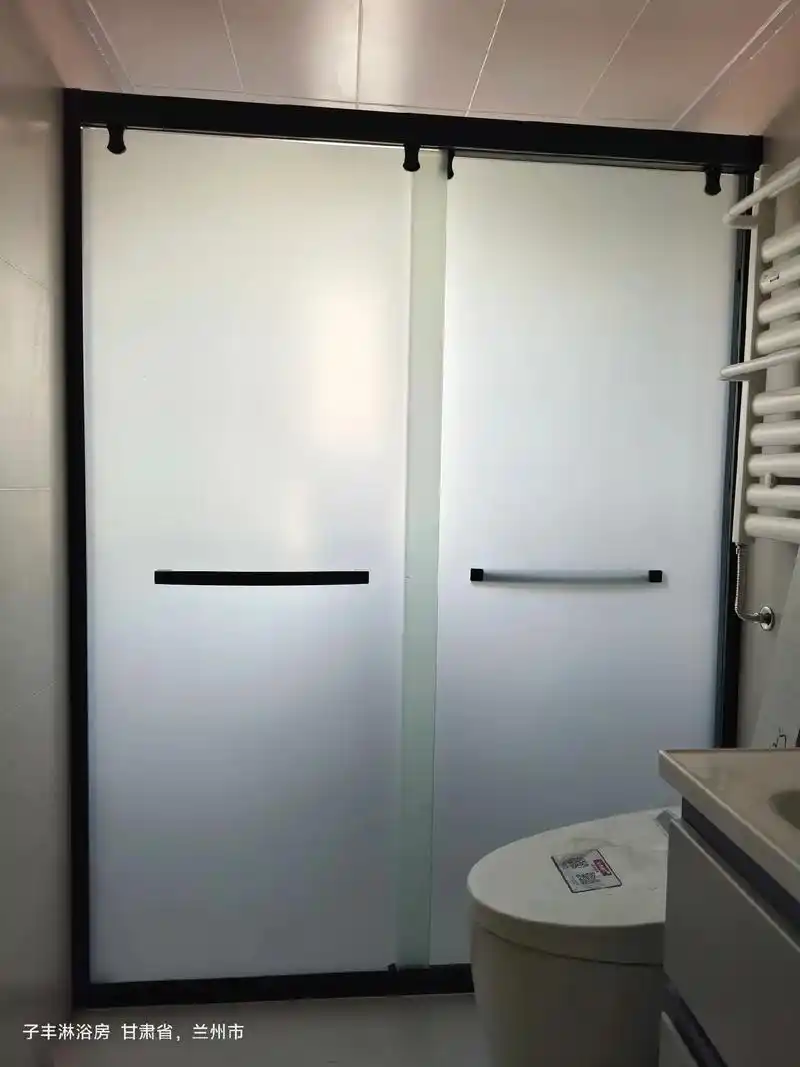
Sliding panels for apartments and hospitality bathrooms, where uniform privacy is the priority. View sliding systems →
Because Showerspace develops glass, aluminium profiles and stainless steel hardware together, panel preparation is matched to the profiles and fittings in your system rather than adapted afterwards. Read about the Showerspace system approach →
Hardware Pairings
A frosted panel is matte, which leaves two directions for the metal: contrast it, or match it. Both work; they just produce different rooms.
Frosted + Polished Chrome
The contrast route. With nothing else in the enclosure reflecting, a mirror finish becomes the only bright element — which is usually what a frosted bathroom needs.
Frosted + Brushed Brass
Warm metal against a soft white field. Suits schemes with timber and stone, and it is the pairing that stops a frosted bathroom from reading clinical.
Frosted + Gunmetal
Cool tonal, and quietly contemporary. Works well with grey-tinted frosted glass where the whole enclosure reads as one cool plane.
View available hardware finishes →
Applications
Residential
Shared family bathrooms and en-suites, where the level is set by who uses the room. View residential →
Hotels & Hospitality
Room standards with banded or gradient formats, and branding on frosted fields. View hospitality →
Apartments
Consistent privacy specification across multiple units, typically sliding or walk-in. View apartments →
Spa & Wellness
Deep frost for changing areas, treatment rooms and wet zones. View spa applications →
Commercial
Project-specific fabrication for offices, gyms, changing facilities and washrooms. View commercial →
Technical Specifications
| Glass type | Tempered safety glass; laminated construction where the application requires it |
| Thickness | 6 mm / 8 mm / 10 mm / 12 mm — subject to panel size, configuration and market requirements |
| Size | Custom, cut to drawing; maximum dimensions confirmed per project |
| Privacy levels | Light satin (ET-01) · standard (ET-02) · deep (ET-03) — see the ET grade series |
| Formats | Full panel · gradient (ET-04) · banded or zoned (ET-05) |
| Surface treatment | Acid-etched (standard) or sandblasted — see etched shower glass |
| Glass colour | Low-iron (recommended), clear, grey, bronze, custom tint |
| Edge | Flat polish, bevel and other edge finishes |
| Holes | CNC drilled to drawing |
| Notches | CNC processed to drawing |
| Processing sequence | Cutting → drilling and notching → edge work → surface treatment → tempering |
| Enclosure compatibility | Frameless, semi-frameless, framed, walk-in, hinged, sliding |
| Hardware | Aluminium profiles and stainless steel hardware, selected by configuration and finish |
| Safety glazing | Applicable requirements for the destination market agreed before production. [[CONFIRM: which standards can be supported and for which markets — use the identical wording as the ET page]] |
| Packaging | Export packaging configured for glass panels, with protection for the treated face |
Request frosted glass samples →
Getting the Level Right Before Production
Frosted glass is the one product in the range where a photograph is genuinely misleading. Satin, standard and deep frost look much closer together on screen than they do in a room, and the difference only becomes obvious once the panel is lit and in use.
- Decide by room, not by sample board. Who uses the bathroom, at what time, and is the enclosure visible from outside the room? Those three questions set the level more reliably than looking at swatches under showroom lighting.
- Approve two levels, not one. We can send panels at two grades so you can compare them in the actual room, at the actual time of day, against the actual tile.
- Check it after dark. Turn the bathroom light on with the room beyond in darkness. If the shadow is more than you are comfortable with, say so — the answer is usually one grade deeper, and it is far cheaper to change before tempering than after.
Request frosted samples → · Back to decorative shower glass →
Request Frosted Shower Glass
Tell us which room the glass is going into and who uses it, and we will recommend a level. If you already know the grade, choose it below. Drawings are welcome at this stage; they are not required to start the conversation.
Name
Business email
Company
Which room is it for?
Please select…
Shared family bathroom
En-suite / master bathroom
Hotel room standard
Accessible / assisted-use bathroom
Spa, gym or changing area
Guest cloakroom / WC
Other commercial
The single best guide to the right privacy level.
Privacy level / format
Please select…
ET-01 Light satin
ET-02 Standard frost
ET-03 Deep frost
ET-04 Gradient
ET-05 Banded / zoned
Not sure — please advise
Privacy requirement
Please select…
Low — soften the view only
Medium — outline obscured at normal distance
High — near-full obscuration
Also needed after dark
Not yet defined
Glass colour
Please select…
Low-iron (recommended for frosted)
Clear
Grey
Bronze
Other tint (please specify in notes)
Not yet decided
Thickness
Please select…
6 mm
8 mm
10 mm
12 mm
Advise me
Quantity
Shower type
Please select…
Frameless
Semi-frameless
Framed
Walk-in
Hinged door
Sliding door
Corner
Other
Hardware requirement
Please select…
Polished chrome
Brushed brass
Gunmetal
Brushed nickel / stainless
Matte black
Other finish
Glass only, no hardware
Destination country
Used to confirm applicable safety-glazing requirements before quotation.
Drawing upload (optional)
DWG, DXF, PDF, SKP, JPG or PNG. A photo of the bathroom helps when advising on a level.
Project notesRequest a Quote
We use your details to respond to this enquiry only. See our privacy policy.
Compare Two Levels in the Actual Room
Frosted levels look far more alike on a screen than they do in a bathroom. We can send panels at two grades so you can compare them under your own lighting — including after dark, which is where the difference usually shows.
Request Frosted SamplesDiscuss Your Project
© Jumbo Glass Group · Showerspace — decorative shower glass and custom shower enclosure systems