Home › Showerspace › Decorative Shower Glass › Reflective Shower Glass
Decorative Shower Glass
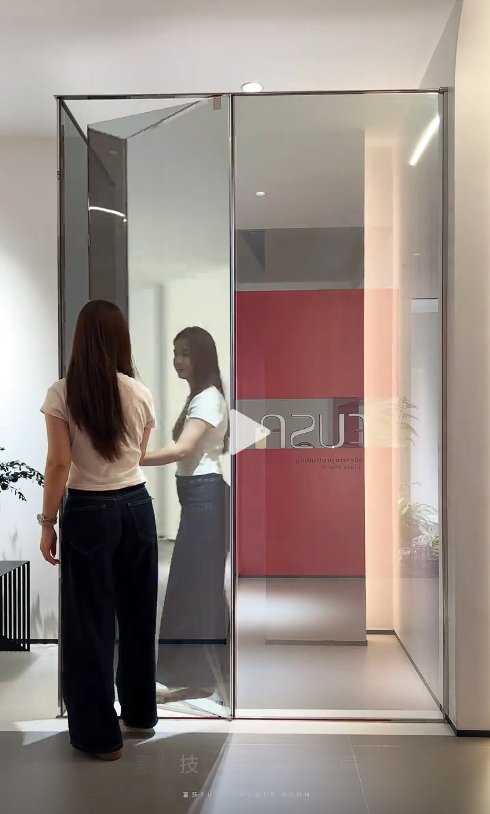
Reflective Shower Glass with 60–70% Reflectivity
Privacy That Works by Bouncing Light Back.
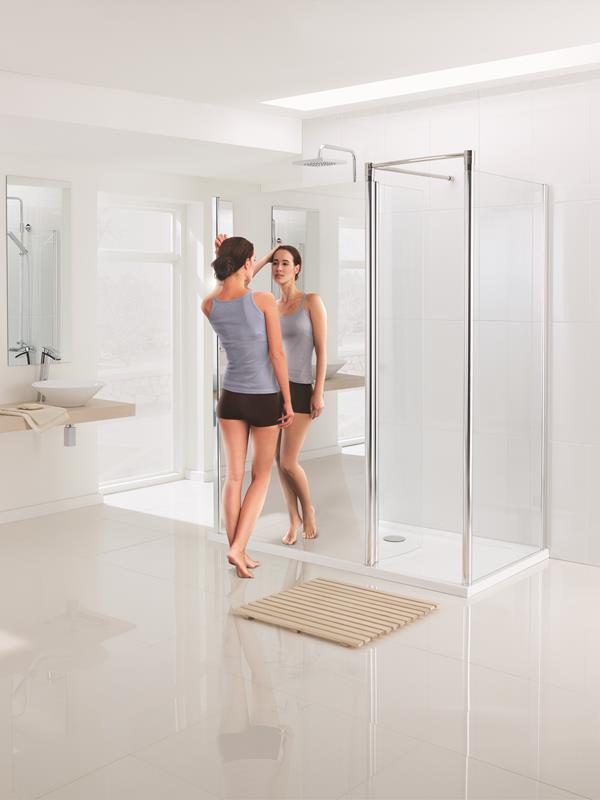
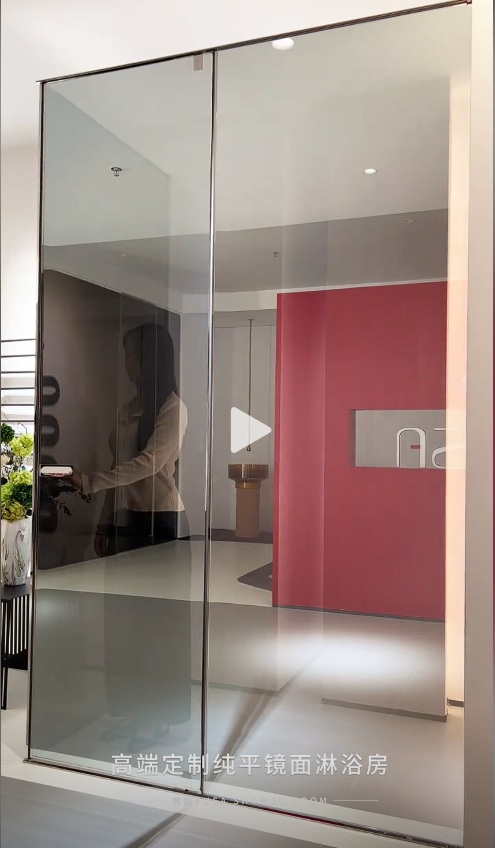
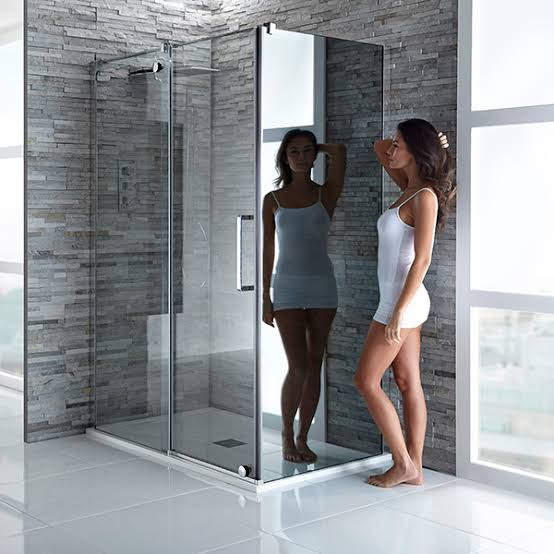
Reflective shower glass carries a sputtered metal-layer coating that reflects most of the light hitting it while still letting around a third through. It reads as a mirror from the brighter side and stays transparent from the darker one — and unlike a conventional mirror, there is no silver, copper or paint in it to break down.
How the Privacy WorksRequest a Quote
What Is Reflective Shower Glass?
Reflective shower glass is coated with an extremely thin metal layer deposited in a vacuum chamber by magnetron sputtering. The coating reflects 60–70% of the light that reaches it and transmits the rest. That balance is what makes it useful: high enough to read as a mirror from the brighter side, open enough that the shower is not a sealed dark box.
It is often called mirrored glass, a one-way mirror or a two-way mirror. Those names describe the effect rather than the product, and they are slightly misleading — a true mirror reflects 85–95% and transmits almost nothing. At 60–70% this is a semi-reflective glass, which is a different and more useful thing in a bathroom.
The distinction matters most for light. A mirror-backed panel would turn the shower into an unlit enclosure. A semi-reflective panel still passes a substantial share of the light, so the shower remains daylit while gaining privacy that no amount of frosting can provide.
Five Ways Glass Creates Privacy — Reflection Is the One Nothing Else Does
Every decorative glass in this range creates privacy by doing something different to the light. Understanding which mechanism you are specifying is usually the fastest way to the right product.
| Mechanism | What happens to light | Where it is used |
|---|
| Scattering | Transmitted, but scrambled so outlines are lost | Frosted, etched |
| Refraction | Transmitted, but bent so detail is distorted | Fluted, reeded, textured |
| Absorption | Taken up by the glass itself | Tinted |
| Reflection | Bounced back before it passes through | Reflective (this page) |
| Blocking | Stopped entirely | Colour coated |
Four of those mechanisms reduce visibility — they make it harder to see through the glass, for everyone, in both directions. Only reflection controls who can see whom, because the effect depends on which side is brighter. That is a different kind of privacy, and in the right layout it is worth a great deal more.
For the opposite requirement — maximum clarity with no privacy at all — see low-iron shower glass.
When It Works — and When It Reverses
This is the part that has to be understood before specifying, because it is not a defect and it cannot be designed away. It is how semi-reflective glass works.
The effect depends on a difference in brightness between the two sides. The brighter side sees its own reflection. The darker side sees through. That is the whole mechanism.
Room brighter than the shower
The panel reads as a mirror from the bathroom. Someone standing in the room sees themselves, not the person showering. This is the effect being bought.
Shower brighter than the room
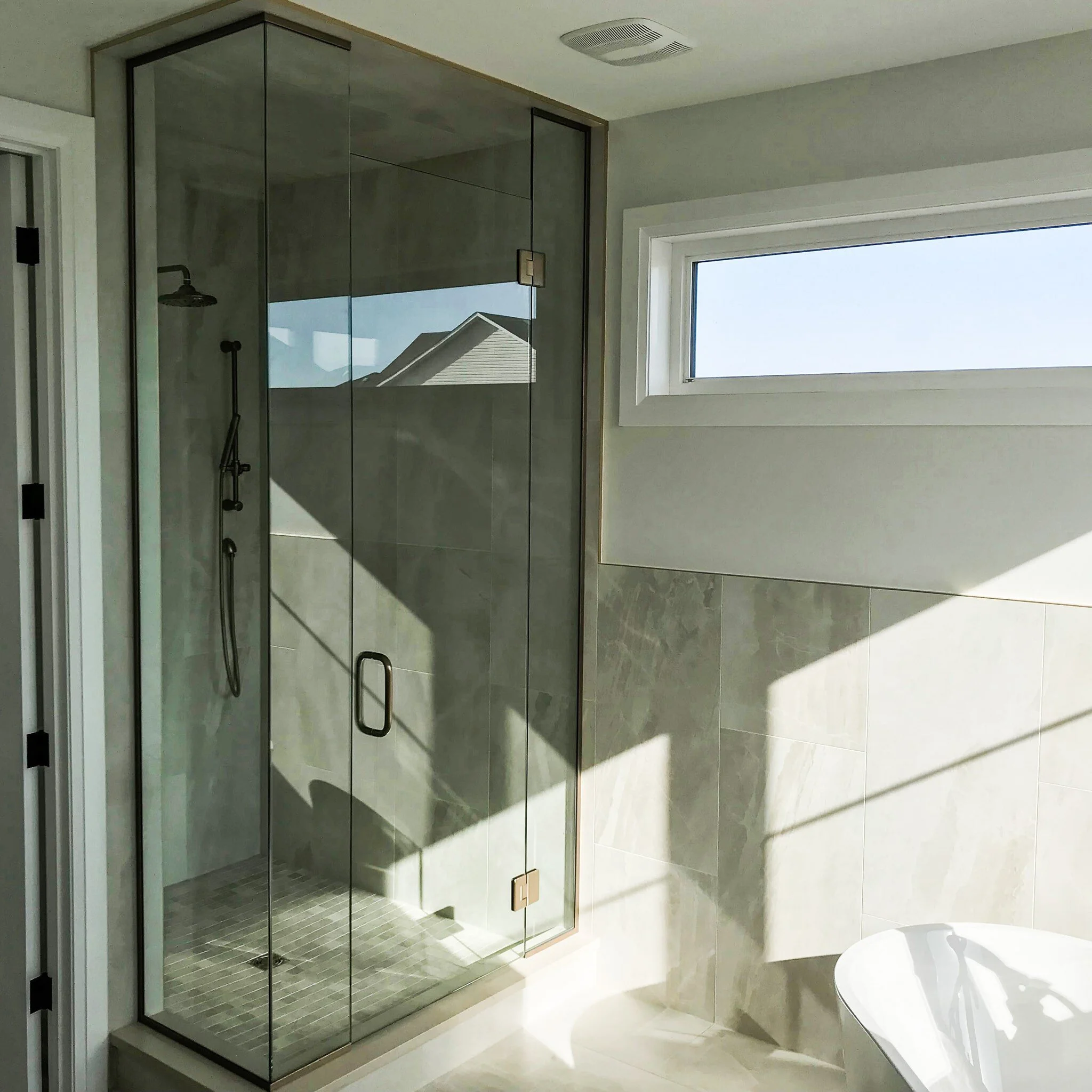
The effect reverses. With the shower light on and the room beyond in darkness, the interior becomes the mirror and the room outside can see in. This is usually an evening condition.
How this is designed around, rather than denied. A commonly used rule of thumb is that a brightness ratio in the order of ten to one gives a stable effect — but it is a rule of thumb, not a specification, and real bathrooms rarely hold a fixed ratio. The practical answers are:
- Plan the lighting. Keep the room side brighter whenever privacy matters, and avoid a scheme where the shower is the only lit volume after dark.
- Combine with a second mechanism. A frosted or textured treatment on the opposite face gives unconditional coverage that does not depend on lighting at all.
- Choose a different product. If privacy must hold regardless of lighting, reflection is the wrong mechanism — and we will say so rather than sell a panel that disappoints.
Every semi-reflective glass on the market behaves this way. The difference is that we would rather you knew it before the enclosure is installed than after.
Not a Mirror: Why There Is Nothing in It to Degrade
Conventional mirrors fail in bathrooms, and they fail in a specific, well-documented way. A traditional mirror is built from layers applied by wet chemistry: a silver nitrate reflective layer, a copper layer over it for protection, and a coat of paint on the back. Moisture reaching the edge attacks the copper, it oxidises, and the familiar black edge creeps inward from the perimeter.
Sputtered reflective glass is built differently. There is no silver, no copper and no organic paint layer. The reflective function comes from a metal alloy deposited atom by atom onto the glass in a vacuum, and it is sealed by a hard ceramic or ceramic-alloy protective layer.
| | Sputtered reflective glass | Conventional silvered mirror |
|---|
| Reflective layer | NiCrTi alloy, vacuum deposited | Silver, chemically deposited |
| Protective layer | ZrO₂ or SiZr, hard and inorganic | Copper, then organic paint |
| What degrades in moisture | No reactive metal or organic layer in the stack | Copper oxidises; paint and adhesive break down |
| Typical failure | None of the silvering type | Black edge, spreading inward from the perimeter |
| Reflectivity | 60–70%, semi-reflective | 85–95%, opaque |
| Bond to glass | Heat-fused during tempering | Adhered layers on the back surface |
Removing the reactive metal from the stack removes the failure mode. The coating is not a layer sitting on the glass waiting to be reached by moisture; it is deposited in a vacuum and then fused to the substrate by the tempering cycle.
The Coating Stack
The coating is a two-part system, and both parts matter.
Glass substrateTempered safety glass
Functional layerNiCrTi — sets reflectivity
Protective layerZrO₂ or SiZr — seals it
NiCrTi functional layer
A nickel-chromium-titanium alloy deposited by magnetron sputtering. Its composition and thickness set the reflectivity and the neutral colour of the reflection. Reflectivity is approximately 60–70%.
ZrO₂ protective layer
A zirconium oxide ceramic overcoat. Hard, chemically inert, and the layer that takes the abrasion and cleaning.
SiZr protective layer
A silicon-zirconium alternative, selected where a different balance of hardness and processing behaviour is wanted.
Deposited in vacuum
Magnetron sputtering gives a dense, uniform film with thickness controlled at the nanometre scale — the reason reflectivity is consistent across a large panel rather than drifting from edge to centre.
Why Temperable Matters
This coating is engineered to go through the tempering furnace rather than be applied after it. That single property changes both the product and the process.
The bond is heat-fused
Because the coating survives the tempering cycle, it leaves the furnace bonded to the glass at high temperature rather than resting on it. That is a fundamentally stronger interface than a layer applied to cold, finished glass.
No soft post-applied layer
Coatings that cannot be tempered must be applied after tempering, which means they sit on the surface as the last and most vulnerable step. A temperable coating is part of the manufacturing sequence, not a finishing add-on.
Production is not piece-by-piece
A temperable coating can be produced on large stock sheet and processed on demand, instead of every cut panel needing its own coating run. Faster, more consistent, and more economical at volume.
The practical consequence for a project: panels are cut, drilled, notched and edge-finished to your drawings, then coated, then tempered as safety glass. As with every product in this range, the drawing needs to be final before fabrication begins — nothing can be re-cut or re-drilled after tempering.
Reflectivity Levels
Reflectivity is set by the coating specification, and it is a genuine trade rather than a quality scale: more reflection means more privacy and less light into the shower.
60%
65%
70%
60% reflectivity
The lighter end. More light into the shower, a softer mirror effect, and the safest choice where the bathroom relies on the light passing through.
65% reflectivity
The working middle. A clear mirror read from the room while keeping the shower genuinely daylit — the usual starting point for discussion.
70% reflectivity
The stronger end. The most pronounced mirror effect and the most privacy, with the least light reaching the shower interior.
Reflectivity figures are given as a range rather than a single value: the exact figure depends on the coating specification, the glass thickness and the base glass used.
Light, Colour & What to Expect
Light still gets through
Around a third of the light passes, so the shower stays usable without dedicated lighting — the main practical advantage over any fully opaque panel.
The reflection is neutral
A metal-alloy coating gives a clean, neutral reflection rather than the warm or green cast of some coated glasses.
Tempering can shift appearance
Any temperable coating can change slightly through the furnace. We control for it, and panels from a single order are tempered together to keep them consistent.
Cut edges and holes interrupt the coating
Drilled holes and cut edges break the film, which is where moisture would reach it. Sealing approach is confirmed per configuration, and a laminated construction makes the coating fully enclosed.
Thickness & Size
Reflective shower glass is supplied in 6 mm, 8 mm, 10 mm and 12 mm thicknesses.
Thickness is determined by the application rather than chosen freely: panel dimensions, whether the panel is fixed or forms part of a moving door, the support method, the hardware specified, and the safety-glazing requirements of the destination market all bear on it. We confirm the appropriate thickness against your drawings and target market rather than leaving it to be resolved on site.
Panels are cut to size from your drawings. Maximum dimensions depend on thickness, handling constraints, coating equipment capacity and access at the installation location, and are confirmed per project.
Processing & Fabrication
Reflective shower glass is fabricated to drawing and supplied tempered as safety glass.
Cutting
Cut to size and shape from project drawings, before coating.
Edge Polishing
Flat polish, bevel and other edge finishes, completed before coating so the finished edge is clean and sealed.
Drilling
CNC-drilled holes for hinges, clamps, brackets and handles, positioned to drawing. Holes interrupt the coating and are sealed as part of the specification.
Notches
CNC notches and cut-outs for pivots, channels, stabiliser bars and wall connections, treated the same way.
Coating
Magnetron-sputtered NiCrTi functional layer with a ZrO₂ or SiZr protective layer, deposited in vacuum.
Tempering
Tempered after coating as safety glass. Requirements for the destination market are agreed before production.See tempered shower glass.
Enclosure Compatibility
Reflective glass can be specified into the following configurations. It is most often chosen for fixed panels, where the mirror effect reads as a designed surface.
Frameless
The configuration that shows fluted glass at its best: minimal framing leaves the texture as the feature. View frameless systems →
Semi-Frameless
Perimeter framing with a frameless door, a common format for mid-market ranges. View semi-frameless →
Framed
Full-profile systems where the glass panel sits within an aluminium frame. View framed systems →
Walk-In
Fixed fluted panels for open, barrier-free layouts, often combined with a clear return panel. View walk-in systems →
Hinged
Swing doors prepared for hinge and handle positions to drawing. View hinged systems →
Sliding
Sliding door panels for apartments and hospitality bathrooms. Texture direction is confirmed against the sightline and handle position. View sliding systems →
Because Showerspace develops glass, aluminium profiles and stainless steel hardware together, panel preparation is matched to the profiles and fittings in your system rather than adapted afterwards. Read about the Showerspace system approach →
Hardware Pairings
A reflective panel is already the brightest object in the room, so hardware works best when it does not compete.
Reflective + Matte Black
The strongest pairing. A dark, non-reflective frame gives the eye somewhere to rest and stops the enclosure reading as a single undifferentiated sheet of light.
Reflective + Brushed Brass
Warm metal against a neutral reflection — the pairing that keeps a highly reflective bathroom from feeling cold.
Reflective + Brushed Nickel
Quiet and tonal for schemes where the glass should dominate and the fittings should recede.
View available hardware finishes →
Applications
Residential
Master en-suites and family bathrooms where the enclosure is a design feature and the walls have been newly built or re-lined.
Hotels & Hospitality
Premium room standards, where frameless is part of the specification rather than an upgrade.
Apartments
Higher-tier units within a development, often frameless while the standard units are semi-frameless.
Spa & Wellness
Where the clean, uninterrupted sightline matters and the building is new.
Commercial
Premium fit-outs, showrooms and offices — less often high-traffic changing rooms.
Technical Specifications
| Glass type | Tempered safety glass; laminated construction available and recommended where the coating should be fully enclosed |
| Thickness | 6 mm / 8 mm / 10 mm / 12 mm — subject to panel size, configuration and market requirements |
| Size | Custom, cut to drawing; maximum dimensions confirmed per project |
| Coating process | Magnetron sputtering, vacuum deposition |
| Functional layer | NiCrTi alloy — sets reflectivity |
| Protective layer | ZrO₂ or SiZr, inorganic and hard |
| Reflectivity | 60–70%, set by coating specification |
| Opacity | Semi-reflective — transmits a substantial share of incident light, unlike an opaque mirror |
| Temperable | Yes — coating is applied before tempering and survives the furnace |
| Privacy mechanism | Reflection — conditional on which side is brighter |
| Edge | Flat polish, bevel and other edge finishes, completed before coating |
| Holes | CNC drilled before coating; sealed as part of the specification |
| Notches | CNC processed before coating; sealed as part of the specification |
| Processing sequence | Cutting → drilling and notching → edge work → coating → tempering |
| Enclosure compatibility | Frameless, semi-frameless, framed, walk-in, hinged, sliding — best suited to fixed panels |
| Hardware | Aluminium profiles and stainless steel hardware, selected by configuration and finish |
| Safety glazing | Applicable requirements for the destination market agreed before production. |
| Packaging | Export packaging configured for glass panels, with protection for the coated face |
Request reflective glass samples →
Specifying Reflective Glass Without Surprises
Three things decide whether this is the right product, and the first is not about the glass at all.
- Work out which side is brighter when it matters. If the room outside the shower is the brighter side, reflective glass gives privacy nothing else can. If the shower will be the brighter space at the times privacy matters, the effect reverses — and frosted or textured glass is the honest recommendation.
- Test the sample from both sides, at the right time of day. A reflective sample looked at on a desk tells you almost nothing. Stand where the room will be, then walk into the shower space and look back — and if you can, repeat it in the evening with the lights on.
- Fix the drawing before production. Holes, notches and edge finishes are all completed before coating and tempering. Nothing can be changed afterwards.
Request reflective samples → · Back to decorative shower glass →
Related products
Patterned Shower Glass
Fluted Shower Glass
Reeded Shower Glass
Textured Shower Glass
Frosted Shower Glass
Etched Shower Glass
Tinted Shower Glass
Low-Iron Shower Glass
Printed Shower Glass
Back-Painted Shower Glass
Reflective Shower Glass
RelatedTechnical
Shower Glass Thickness
Tempered Shower Glass
Laminated Shower Glass
How to Choose Shower Enclosure Glass
How to Care for Shower Glass
Hardware Finishes
Request a Quote
We use your details to respond to this enquiry only.
Test It From Both Sides, In Your Own Light
Reflective glass cannot be judged on a desk or from a photograph. We can send a panel and ask you to do one thing with it: stand where the room will be, then walk into the shower space and look back — and do it again after dark, with the lights on.
Request a Reflective SampleDiscuss Your Project
© Jumbo Glass Group · Showerspace — decorative shower glass and custom shower enclosure systems