Home › Showerspace › Shower Enclosure Systems › Profiles
Shower Enclosure Systems
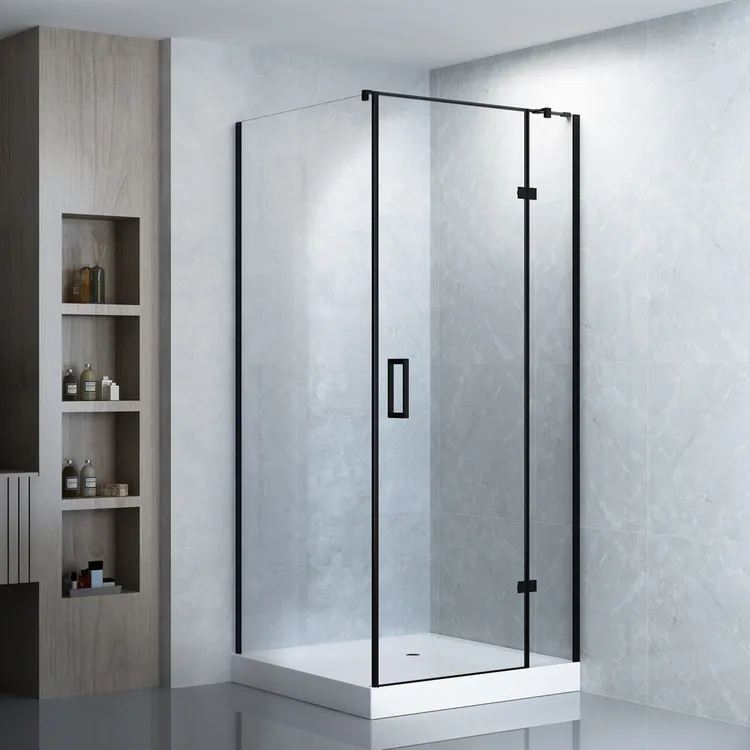
Shower Enclosure Profiles — How the Section Chooses the Glass
The metal is chosen after the glass, not before. The bore decides what fits.
Aluminium profiles are the least visible part of a shower enclosure and the most consequential. They carry the structure, absorb the tolerances the glass cannot, and hold the seals that keep water in. The section types described here are the ones available on the market, and the one that gets used is the one whose internal bore matches the glass the project has specified — which is why the glass decision comes first.
The Bore Decides the GlassSection Types
What Profiles Actually Do
Four jobs, and every one of them is structural rather than decorative. A profile is not trim.
Carry the load
On a framed or semi-frameless system, the section holds the glass. The glass does not hold itself — which is why framed systems can use thinner glass without becoming fragile.
Absorb the tolerance
Walls are not vertical and floors are not level. A profile takes up the difference along its length, so it never appears as a wedge of silicone at the edge of a panel.
Keep water in
Seals, gaskets and thresholds are profile features. This is the detail most often value-engineered out and most often regretted afterwards.
Protect the edge
A glass edge inside a channel is not exposed to knocks. On high-traffic installations — gyms, student housing, holiday lets — this matters more than appearance.
Where a system is frameless, these jobs do not disappear. They transfer to the glass, the fittings and the building itself, which is why frameless is described on its own page as less forgiving rather than simply better.
The Bore Decides the Glass
This is the single most useful thing to understand about profiles, and it reverses the order most people assume.
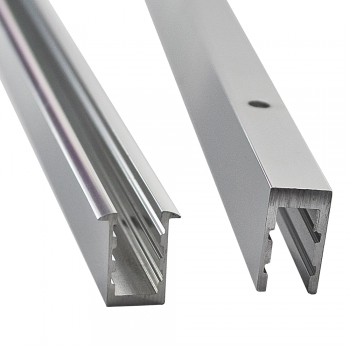
Every glazing channel has an internal clearance — the bore — into which the glass seats. That clearance is manufactured to a specific glass thickness. A section made for 8 mm will not properly accept 10 mm. It is not a tight fit; it is a panel that either cannot be glazed at all, or has been forced in and is left under permanent stress at the edge.
So the working order is glass first, metal second:
| Frame level | Glass thickness | What the section has to accept |
|---|
| Frameless | 10 / 12 mm | Heaviest panels. Where a channel is used at all, it is a minimal one; most fixing is by clamp rather than continuous section. |
| Semi-frameless | 8 / 10 mm | Sections on some runs only, so 8 mm and 10 mm can appear in the same unit — the bore has to match each run. |
| Framed | 6 / 8 mm | Continuous perimeter section throughout, and the lightest glass as a result.
|
Three practical consequences, all avoidable at drawing stage. First, a change of glass thickness late in a project is not a glass change — it is a profile change too. Second, a scheme that mixes thicknesses needs sections with matching bores on each run, which is a real specification line and not a default. Third, when replacing a panel in an existing enclosure, the new glass has to match the bore that is already on the wall, not the thickness that would be preferred today. And one for laminated panels:the bore takes the total build-up, not a single ply — so a laminated 10 mm and a monolithic 10 mm are two products that share a number.See laminated shower glass.
Section Types
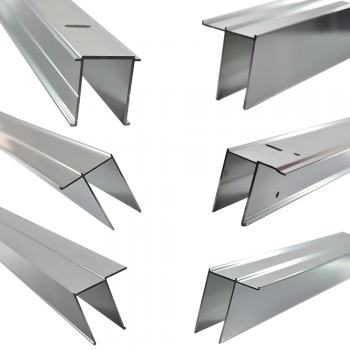
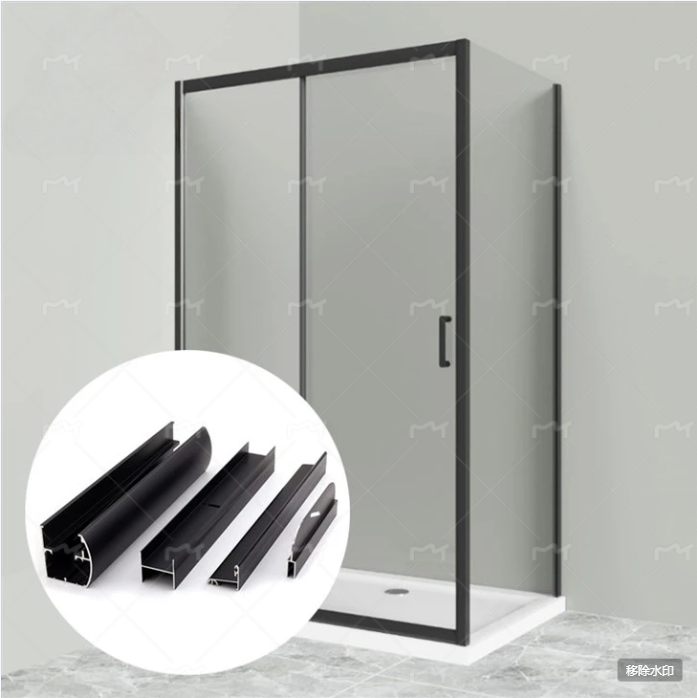
These are the section families available on the market. Each exists because it solves a specific fixing or sealing problem, and most enclosures use several at once.
Wall channels
A U-section fixed to the wall, into which the glass seats. The standard way to fix a panel to a wall where some tolerance is needed. Simple, and the bore is the whole specification.
Corner posts
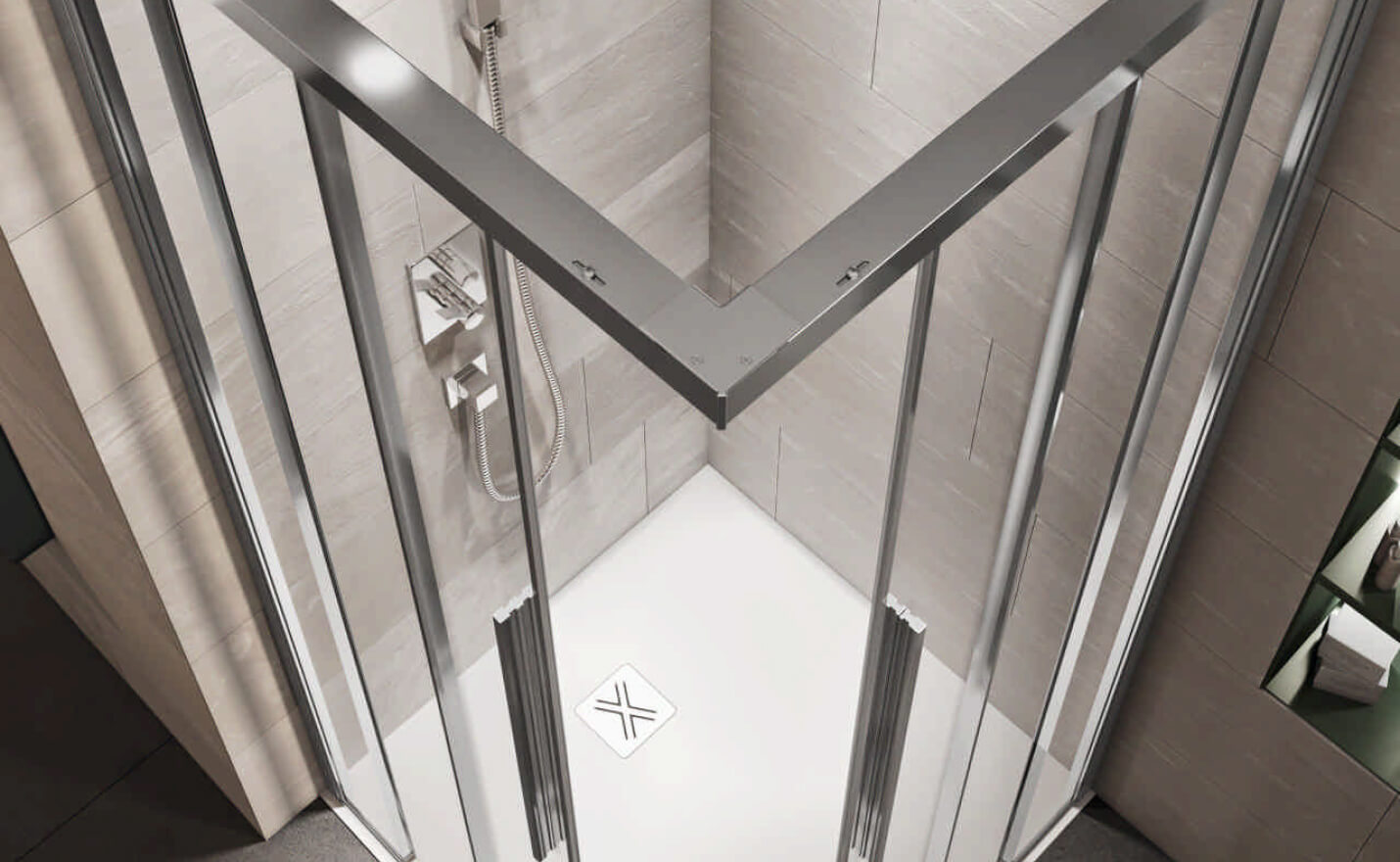
Where two panels meet at an angle, or where a panel meets a return. The post carries both panels and the seal between them — the most demanding section in the set, because it has to hold two planes at once.
Perimeter frames
The visible metal around a framed door or panel. Carries the hinges, the seals and most of the tolerance in the system. The section with the most profiles involved, and the one that decides how the enclosure reads visually.
Thresholds
The section at the base of a door opening. What stops water at floor level, and the difference between a shower that contains water and one that does not. Also the part most likely to be removed to save money.
Seals and gaskets
Not structural, and not really a “section” — but they live in the profiles, and they are the parts that wear. Finned seals, magnetic closures and wiper strips all sit in extruded housings.
Connectors and infill
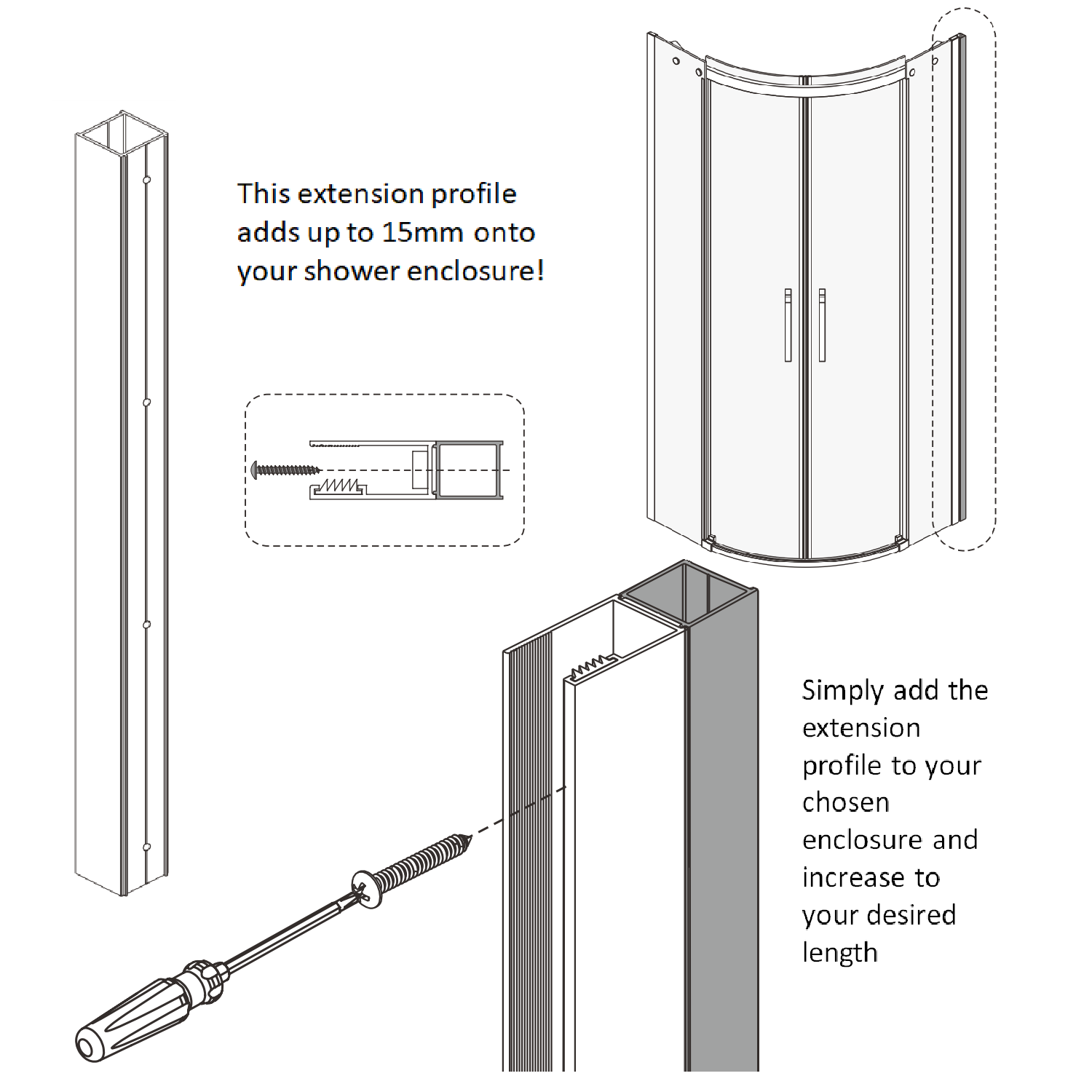
Joining pieces, end caps, corner keys and the small parts that make a run of section finish cleanly. Invisible when right, and immediately obvious when a detail has been missed.
Which of these a project needs follows from the configuration rather than from preference. A walk-in panel may need nothing more than a wall channel and a stabiliser; a framed corner unit uses almost all of them.
Wall Thickness and How a Section Behaves
Two sections can look identical in a photograph and behave completely differently. The difference is wall thickness and the internal geometry — neither of which is visible once the section is installed.
Wall thickness
A heavier wall section is stiffer and holds fixings better. It also costs more, and it is not always offered in every finish. Figures are confirmed for the section actually supplied rather than asserted here, because they differ by section.
Span and support
A channel spanning a long run needs more support than a short one. This is why a long frameless panel needs a stabiliser bar rather than simply a stronger channel.
Fixing purchase
Screws and rivets need material to bite into. A thin-walled section in a high-use door will work loose before a heavier one does.
Thermal movement
Aluminium moves with temperature more than the glass does. A long run needs that accounted for, or it will show as a gap or a bow.
What this means when comparing quotations. Two suppliers quoting “an aluminium shower profile” may be quoting sections of materially different weight. There is no way to tell from a product photograph, and there is no way to tell once it is installed. Ask for the section drawing and the weight per metre — it is a reasonable question, and a supplier who cannot answer it has not specified the section.
Finishes
A profile is finished to match the hardware, so the metal reads as one assembly rather than as parts that happen to be near each other.
Common finishes include anodised and powder-coated options, in the standard range described on the hardware finishes page — matte black, brushed brass, brushed nickel, gunmetal and polished chrome.
Anodised
The finish is integral to the metal rather than sitting on top of it. Hard-wearing, and the colour range is narrower than for coating.
Powder coated
A wider colour range, and the coating sits on the surface. Can be matched to a RAL reference, which is useful where a scheme has a defined colour.
Why the two can differ
Profiles are aluminium and hardware is stainless steel. The same finish name applied to two different metals is not the same colour — a real and unavoidable effect, described in full on the finishes page.
Cut ends
An anodised section cut on site shows a raw end. Cut ends are a genuine detailing issue and are worth planning rather than discovering.
Alloy and finish availability are confirmed for the section actually supplied. This page does not carry fixed designations, because the section is matched to each project from what the market offers rather than drawn from a fixed internal range.
How a Project Is Matched to a Section
Worth being plain about how this works, because it shapes what can be promised.
Aluminium profiles are produced by extrusion — a die is made and the section is pushed through it. The sections described on this page are the standard types the market offers, and they cover the overwhelming majority of shower work. Profiles are matched to each project from what is available, and supplied through the group's component partners.
What that means in practice:
- Selection, not development. The usual case is choosing the section whose bore, weight and finish suit the project. In this respect a profile is like a rolled glass pattern or a body tint — it is selected from what exists.
- Development is a different conversation. A genuinely new section needs a new die. That is a far smaller commitment than developing a new glass pattern, but it is not nothing, and it is handled case by case rather than assumed.
- What is guaranteed is the match, not the origin. The commitment that matters is that the section's bore matches the glass specified, the finish matches the hardware, and the whole assembly fits the opening. That is a system responsibility, and it holds regardless of which mill produced the section.
Why this is worth stating. A buyer who assumes a supplier extrudes its own profiles will eventually ask a question about the die or the alloy that reveals otherwise. Saying it first costs nothing. What is actually being offered — glass processed in-house, components coordinated to fit it, and the assembly made to match the opening — is both true and more useful than a claim of vertical integration would be.
Where Profiles Meet the Rest of the System
A profile never works alone. Three interfaces decide whether an enclosure goes together cleanly.
Profile and glass
The bore accepts a specific thickness. Everything about the glass — its weight, its edge work, and whether it has been drilled — is specified before the section is confirmed.
Profile and hardware
Hinges, clamps and rollers fix to or into the section. Their fixing pattern has to suit the section's geometry, which is why hardware selection and profile selection happen together rather than in sequence.
Profile and opening
A section can absorb only so much. Where an opening is far out of square, the answer may be a different configuration rather than a bigger section.
Profile and drain
The threshold works with the floor, not instead of it. A well-detailed threshold in a poorly drained floor still lets water out.
Read the overview of how a shower enclosure system fits together →
Specifying Profiles: The Sequence
- Fix the glass thickness first. It follows from panel size, whether the panel is fixed or moving, and how it is supported. The bore follows from it, not the other way round.
- Then choose the sections by what each run has to do. A wall run, a corner, a door opening and a threshold are different jobs.
- Confirm the finish across profiles and hardware together. Aluminium and stainless steel take the same finish name differently; agree what “matching” means before production.
- Ask for the section drawing. Wall thickness and weight per metre are the two figures that separate one quotation from another, and neither is visible in a photograph.
Technical Specifications
| Material | Aluminium. Alloy and temper confirmed for the section actually supplied |
| Section types | Wall channels, corner posts, perimeter frames, thresholds, seals and gaskets, connectors and infill |
| Bore | Determines the glass thickness that fits. Frameless 10/12 mm · semi-frameless 8/10 mm · framed 6/8 mm |
| Wall thickness | Differs by section. Confirmed for the section supplied; ask for the drawing and the weight per metre |
| Finishes | Anodised and powder-coated, in the standard range. Powder coating can be matched to a RAL reference. See hardware finishes |
| Finish matching | Profiles are aluminium and hardware is stainless steel. The same finish name on two metals is not the same colour — agreed before production |
| Sourcing | Matched to each project from the sections available on the market, supplied through the group's component partners |
| Development | A new section requires a new die. Handled case by case; not assumed |
| Interfaces | Glass thickness, hardware fixing pattern, opening tolerance, floor drainage |
| Performance figures | Load and span data confirmed per project for the section supplied, not asserted generally |
Request section samples →
Request Shower Enclosure Profiles
Tell us the glass thickness and the configuration. Those two answers determine the bore, and the bore determines everything downstream.
Name
Business email
Company
Frame level
Please select…
Frameless
Semi-frameless
Framed
Not decided — please advise
This sets the thickness band, which sets the bore.
Glass thickness
Please select…
6 mm
8 mm
10 mm
12 mm
More than one thickness in this scheme
Not decided — please advise
The bore is chosen to match this. Changing it later means changing the section too.
Which sections do you need?
Please select…
Wall channels only
Channels and corner posts
Full perimeter framing
Thresholds and seals
A complete set
Not sure — please advise
Finish required
Please select…
Matte black
Brushed brass
Brushed nickel
Gunmetal
Polished chrome
Anodised — specific finish
Powder coated to a RAL reference
Not decided — please advise
Profiles are aluminium, hardware is stainless steel. Matching is agreed before production.
Quantity
Destination country
Drawing upload (optional)
PDF, DWG, DXF, SKP, JPG or PNG. A section drawing or a site photo is useful.
Project notesRequest a Quote
We use your details to respond to this enquiry only. See our privacy policy.
Ask for the Section Drawing
Wall thickness and weight per metre are what separate one quotation from another, and neither shows in a photograph. Ask for both.
Request Section SamplesBrowse Shower Enclosure Systems
© Jumbo Glass Group · Showerspace — decorative shower glass and custom shower enclosure systems