Home › Showerspace › Hardware Finishes
Showerspace
Shower Hardware Finishes — Five Finishes, One Assembly
The finish name is the same on the profile and the hinge. The metal underneath is not.
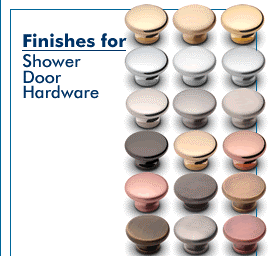
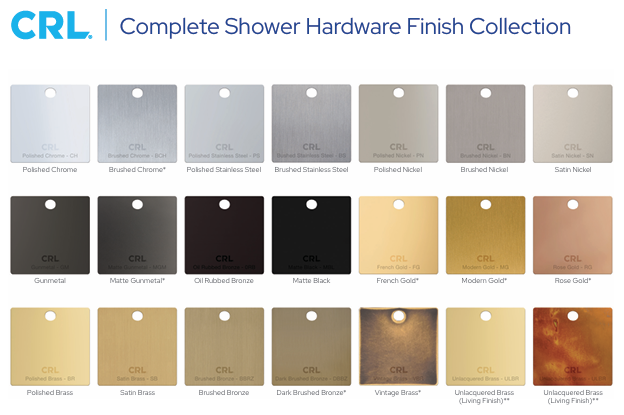
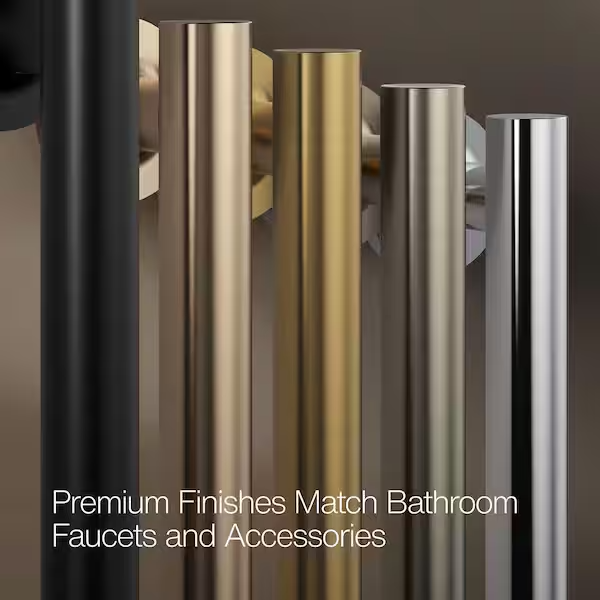
Five standard finishes — matte black, brushed brass, brushed nickel, gunmetal and polished chrome — applied across the aluminium profiles and the stainless steel fittings so the whole enclosure reads as one object. Every glass type in the range can be specified with any of the five. What takes care is not the choice of colour, but getting the different metals to agree.
Why the Metals DifferWhich Finish with Which Glass
What a Finish Has to Cover
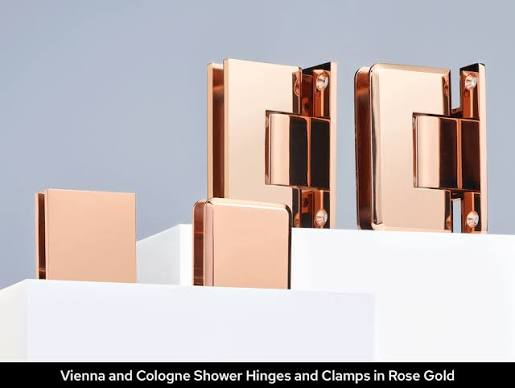
A shower enclosure is made of two kinds of metal. The aluminium profiles — channels, wall posts, frames, thresholds — hold and seal the glass. The stainless steel hardware — hinges, clamps, brackets, handles, rollers, stabiliser bars — carries the load and the movement.
The finish has to run across both, and across a long list of individual components that are made separately and assembled on site. The objective is not five matching items; it is one assembly that reads as a single, deliberate object.
Profiles
Channels, wall posts, perimeter frames, thresholds and seals — the aluminium sections.
Hinges and pivots
Glass-to-glass or glass-to-wall. The component the door swings on.
Clamps and brackets
What holds a frameless panel without a frame.
Rollers and tracks
The moving parts of a sliding system.
Handles, knobs and bars
The part the hand touches, and the part the eye goes to first.
Stabiliser bars
What stops a long panel flexing at its free corner.
The Five Standard Finishes
All five are available across profiles and hardware, and all five work with every glass type in the range.
Matte Black
A flat, non-reflective black. The highest-contrast option, and the one that gives the eye somewhere to rest.
Brushed Brass
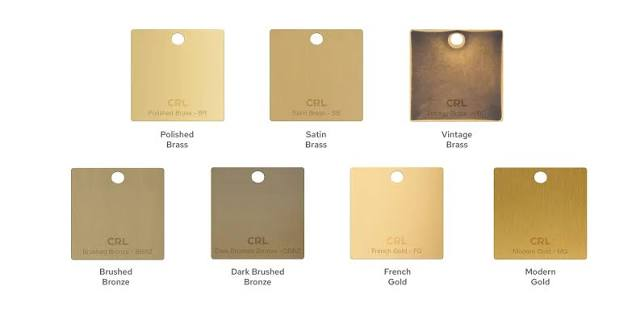
A warm, satin metal. Reads as a material rather than a colour, and brings warmth to a scheme.
Brushed Nickel
A cool, satin neutral. The quietest of the five, and the one that lets the glass carry the design.
Gunmetal
A darker, slightly cooler grey-black. Definition without the hard contrast of pure black.
Polished Chrome
Mirror-bright. The most reflective of the five, and the most demanding of the glass behind it.
These are the standard range. Where a project needs something outside it, that becomes a development question rather than a selection one — see custom design.
Why the Same Finish Name Differs Between Metals
This is the part worth understanding before specifying, because it is the most common source of disappointment on an otherwise well-made enclosure.
A channel and a hinge can both be ordered in “brushed nickel” and still not be the same colour. Three things cause that, and none of them is a defect:
- Different base metals. Aluminium and stainless steel take a finish differently. The colour of the metal underneath shows through, and the two are not the same colour to start with.
- Different processes. The finish that produces a brushed nickel on an extruded aluminium section is not the same process, or necessarily the same chemistry, as the one used on a stainless steel casting or pressing.
- Different production sources. Profiles and hardware are made in different facilities, on different equipment, under different process control. Batch-to-batch variation exists within a single facility as well as between them.
Set the expectation correctly and this stops being a problem. The achievable standard is that the assembly reads as one from normal viewing distance, under the lighting the room will actually have. It is not that every component is an identical match when held together under a lamp. Any supplier who promises the second is promising something the metals will not deliver.
Where the Difference Shows
Two things make it visible, and both are worth checking on the drawing rather than on site.
Adjacent components
The eye compares what is next to what. A hinge and a handle sit close together on a hinged door, and a mismatch there is obvious. A channel on the far side of the room is not compared in the same way.
Raking light
Daylight arriving at a low angle across a flat surface shows tone differences that overhead light hides. A sample board approved under office lighting can look different in the room.
Large flat areas
A long channel or a wide clamp face gives the eye more surface to compare. Small components are more forgiving.
Sheen as well as colour
Two components can be the same colour and still differ in gloss. Sheen differences read as colour differences at a distance.
Grain Direction on Brushed Finishes
A detail specific to the brushed finishes, and one that is easy to get wrong.
Brushed metal has a directional grain. Two components in the same finish will read differently if the grain runs vertically on one and horizontally on the other — the surfaces catch light differently even though the colour is identical. On a long run of channel meeting a clamp, or a handle meeting a hinge plate, this is visible in the same way a colour difference is.
The rule is simple and worth stating on the drawing: grain direction should run consistently across components that sit next to each other. It costs nothing to specify and cannot be corrected afterwards.
How the Difference Is Controlled
Four steps, in the order they should happen. None of them is unusual; what matters is doing them before production rather than after delivery.
- Specify the whole assembly from one source. Metal sourced piecemeal from several suppliers is where most mismatches originate. The point of specifying profiles and hardware together is that one party is responsible for them agreeing.
- Approve the samples together, not separately. Looking at a channel sample in March and a hinge sample in May is not a comparison. They need to be side by side, under the same light, before anything is approved.
- Order the project from a single production batch. Where a development or a hotel has many identical units, splitting the order across batches introduces variation that no amount of specification will prevent.
- Agree what “acceptable” means in advance. Reads-as-one at viewing distance is a workable standard. Identical-under-inspection is not, and projects that insist on it tend to be disappointed by every supplier.
Which Finish with Which Glass
Every glass type in the range works with all five finishes. These are the pairings that come up most often — each links to the glass page that explains why.
| Finish | Specified most often with | Why |
|---|
| Matte black | Fluted · textured · printed · reflective · grey tinted | The highest-contrast pairing. Black sharpens a groove shadow line, frames a printed design, and gives a reflective surface somewhere for the eye to rest. |
| Brushed brass | Low-iron · frosted · reflective · back painted · bronze tinted | Warmth against a neutral or soft field. Brass against standard clear glass can read faintly muddy; against low-iron it reads as the warm metal it is. |
| Brushed nickel | Reeded · textured · etched · printed · back painted | The quietest option. Satin metal against a satin or textured surface keeps the enclosure calm, and it lets a printed or painted surface carry the design. |
| Gunmetal | Reeded · darker schemes | A softer alternative to black — definition without hard contrast, which suits a rounded rib better than a hard-edged groove. |
| Polished chrome | Frosted · etched · low-iron | Where nothing else in the enclosure reflects, a mirror finish becomes the only bright element — and it is the most demanding pairing, because any cast in the glass shows against a mirror surface. |
Browse the full decorative glass range →
Finishes by Configuration
The components that carry a finish differ by configuration, so the specification differs too.
Little or no profile, so the finish sits almost entirely on the hardware — clamps, hinges, handles, stabiliser bars. Every component is visible.
Profile and hardware both visible, often adjacent. This is the configuration where a substrate difference is most likely to be noticed.
Profile dominant, hardware less exposed. The largest single area of one finish, and the most dependent on batch consistency.
Hinge and handle sit close together — the tightest matching requirement of any configuration.
Track and roller housings are large visible surfaces, joined by handles. Grain direction matters across the run.
Track, hinge strip housing and handles — three component types that need to agree.
The shortest component list. Channel or clamps, brackets, stabiliser bar and seals.
Corner post, clamps and fittings meeting at an angle — the place where several components converge in one view.
See all eight configurations →
Living with the Finish
Finishes differ in how they show the marks a bathroom produces. This is about appearance rather than durability, and it is worth choosing on deliberately.
Polished chrome
A mirror surface shows water spots, fingerprints and streaks more readily than any of the others. It is the brightest finish and the one that most wants drying after use.
Brushed finishes
The grain breaks up reflections, so fingerprints and light marks are far less visible than on a polished surface. The practical choice for family bathrooms and high-turnover schemes.
Matte black
Soap residue and water spotting show as a light film against the dark surface. Where it is touched repeatedly — a handle, a door edge — the surface will change with use.
Brushed brass
Whether the surface is sealed or left to change with handling is a specification question, and it changes how the finish ages.
One honest note on contact points. Any finish will show wear where it is repeatedly touched — handles, door edges, the point where a clamp meets glass. Choosing a finish is partly choosing how visible that will be. We do not publish service-life figures for finishes, because the honest answer depends on the water, the cleaning products and how the enclosure is used.
When the Standard Range Is Not Enough
Five finishes cover most projects. A scheme occasionally needs something else — a specific tone to match a brassware range, a finish to match an existing building standard, or a colour that only exists as a reference.
That is a development question rather than a selection one, and it belongs with custom design. Two practical notes before going down that route:
- Development needs a physical target. A reference sample or a defined standard gives a production route something to be measured against. A description does not.
- A custom finish has to be repeatable. The first batch matching is one question; the tenth batch matching the first is another, and for a multi-unit scheme the second is the one that matters.
Technical Specifications
| Standard finishes | Matte black · brushed brass · brushed nickel · gunmetal · polished chrome |
| Applied to | Aluminium profiles — channels, wall posts, frames, thresholds — and stainless steel hardware: hinges, clamps, brackets, handles, rollers, tracks and stabiliser bars |
| Glass compatibility | All five finishes can be specified with every glass type in the range |
| Configuration compatibility | All five available across frameless, semi-frameless, framed, hinged, sliding, walk-in, bifold and corner systems |
| Cross-substrate matching | Achieved to a reads-as-one standard. The same finish name on aluminium and on stainless steel will not be an identical match — see above. |
| Grain direction | Specified consistently across adjacent components; applies to all brushed finishes |
| Sample approval | Matched component samples approved together under the same light. |
| Batch consistency | Project orders supplied from a single production batch where the scheme requires it |
| Brushed brass | Sealed or unsealed to be confirmed at specification. |
| Beyond the standard range | Handled as a development request. See custom design → |
| Lead time and quantity | Delivery lead time: 20–25 days; minimum order: 100 sets. |
Request finish samples →
How to Specify Finishes
- Choose the finish with the glass, not after it. The two are seen together, and a finish that suits fluted glass may flatten reeded.
- Name which components have to agree. A hinge and a handle need to match closely. A channel on the opposite wall does not need the same tolerance.
- State the grain direction for brushed finishes, on the drawing, before production.
- Approve all metal samples together under lighting comparable to the finished room, and order the project as one batch.
Related products
Frameless Shower Enclosures
Semi-Frameless Shower Enclosures
Framed Shower Enclosures
Hinged Shower Enclosures
Sliding Shower Enclosures
Bifold Shower Doors
Walk-In Shower Enclosures
Corner Shower Enclosures
Shower Enclosure Profiles
Shower Enclosure Hardware
RelatedTechnical
Shower Glass Thickness
Tempered Shower Glass
Laminated Shower Glass
How to Choose Shower Enclosure Glass
How to Care for Shower Glass
Hardware Finishes
Request a Quote
We use your details to respond to this enquiry only. See our privacy policy.
See the Finishes Before You Specify
Ask for a matched set of samples — profile section and hardware in the same finish, sent together. It is the only reliable way to judge whether they read as one in your lighting.
Request Finish SamplesBrowse Decorative Glass
© Jumbo Glass Group · Showerspace — decorative shower glass and custom shower enclosure systems