Home / Resources / Glass Selection Guides /Tempered vs Laminated vs IGU Selection Guide
Tempered vs Laminated vs IGU Selection Guide
Specification guidance for architects, façade consultants, contractors and procurement teams choosing between tempered, laminated and insulating (IGU) glass. This is the decision page: it does not replace product-level detail, but gives the safety-and-performance hierarchy and a worked selection flow. Final make-up must be confirmed by the design institute/engineer, local code and approved shop drawings.
1. The Three Things Glass Must Do
Every glass specification is a trade-off between three jobs. Start here before naming a product:
- Stay safe when broken. Control the consequence of breakage—this is the tempered-vs-laminated question.
- Control heat and solar gain. This is the IGU/low-E question (U-value, SHGC, VLT).
- Carry structural load. Wind, span, deflection, edge condition and thickness.
Most projects need two or all three jobs in one make-up. That is why "tempered vs laminated vs IGU" is rarely an either/or—it is usually a build-up question.
2. The Purchasing Reality
Procurement teams commonly lose time on four avoidable errors:
- Specifying by habit. Assuming "tempered everywhere" or "laminated everywhere" instead of risk-mapping each zone.
- Confusing safety mechanisms. HST (NiS breakage) and lamination (post-breakage retention) solve different problems.
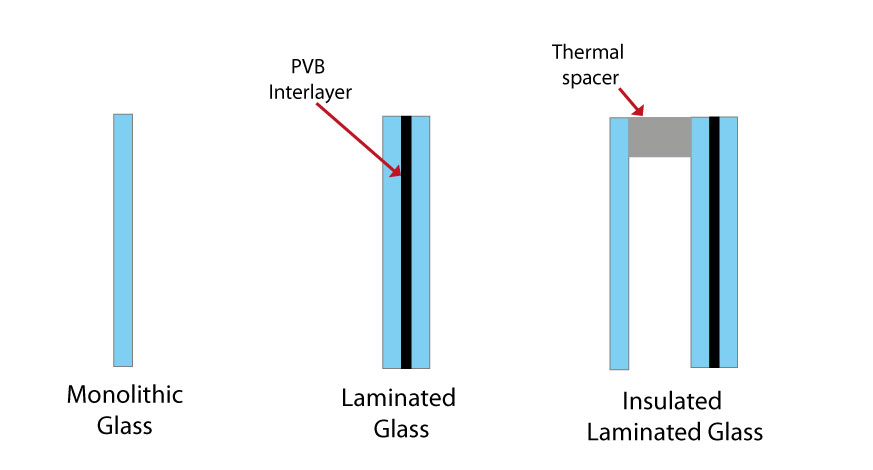
- Treating IGU as a coating. An IGU is a sealed system—cavity, gas, spacer and seal matter as much as the low-E coating.
- Forgetting make-up order. Which lite is laminated, which is tempered, and where the coating sits must be written into the schedule.
3. Decision Matrix — Tempered, Laminated or IGU?
Value note: figures are design starting points. Thickness, interlayer, coating and heat treatment must be validated against EN/ASTM, wind load, deflection and design institute approval.
| Primary need | First choice | Upgrade to… |
|---|
| Human impact / fall-through risk (balustrade, railing, overhead-adjacent) | Laminated (PVB or SGP) | Laminated + tempered or heat-strengthened lites for residual strength |
| Thermal comfort / energy (façade, window, curtain wall) | Low-E IGU (double glazing) | Triple glazing, argon/krypton, warm-edge spacer for stricter U/SHGC |
| Wind load / large panel stiffness | Tempered monolithic or tempered in IGU | Laminated (higher post-breakage stiffness) or increased thickness |
| Acoustic control (urban, traffic, airports) | Laminated with acoustic PVB/SGP | Asymmetric lites + laminated IGU to offset resonances |
| Overhead / skylight / sloped glazing | Laminated (post-breakage retention) + HST-tempered | Laminated IGU + catchment system where risk is severe |
| General vision glazing, low safety risk | Tempered monolithic or tempered IGU lite | Laminate when local code or risk review requires retention |
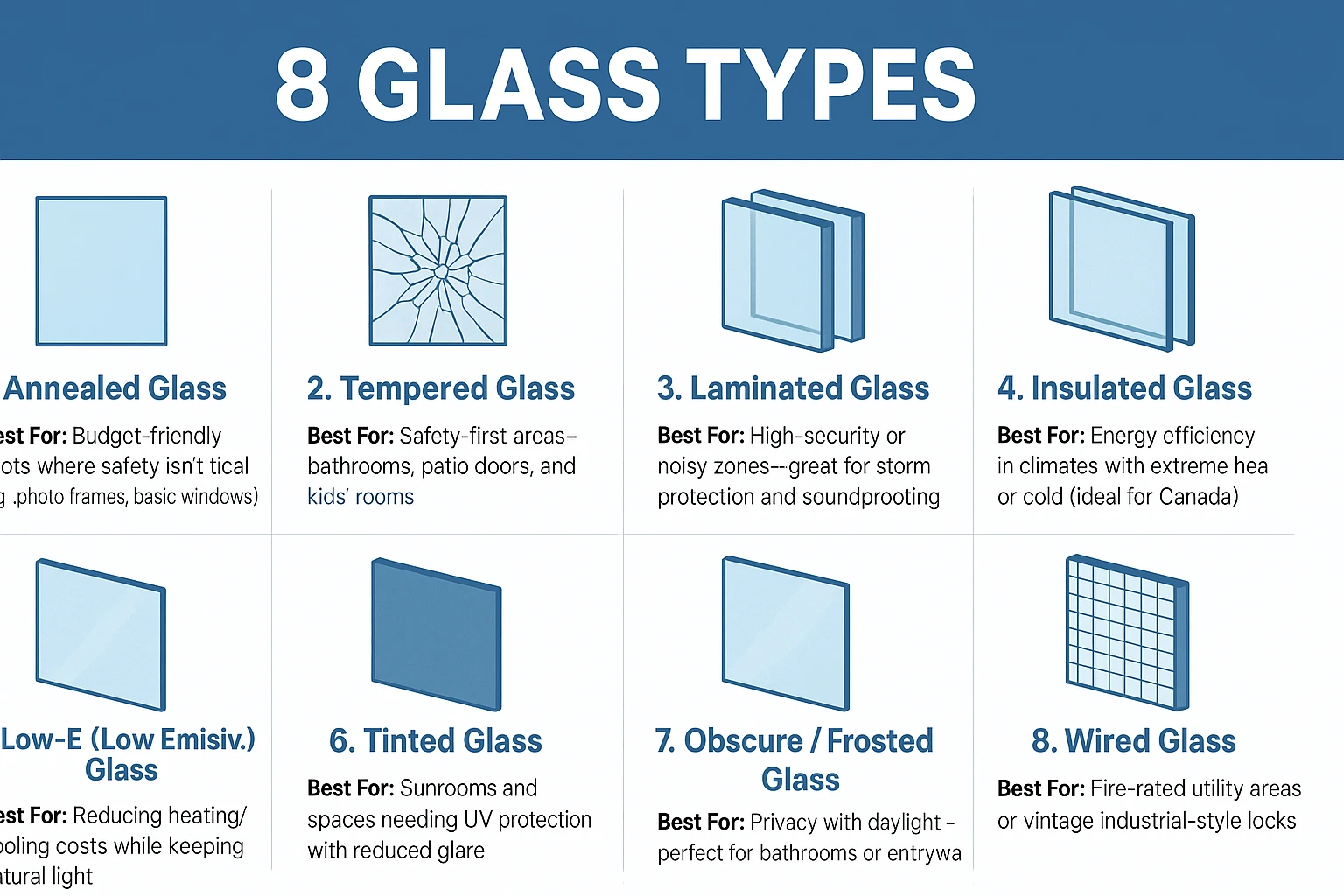
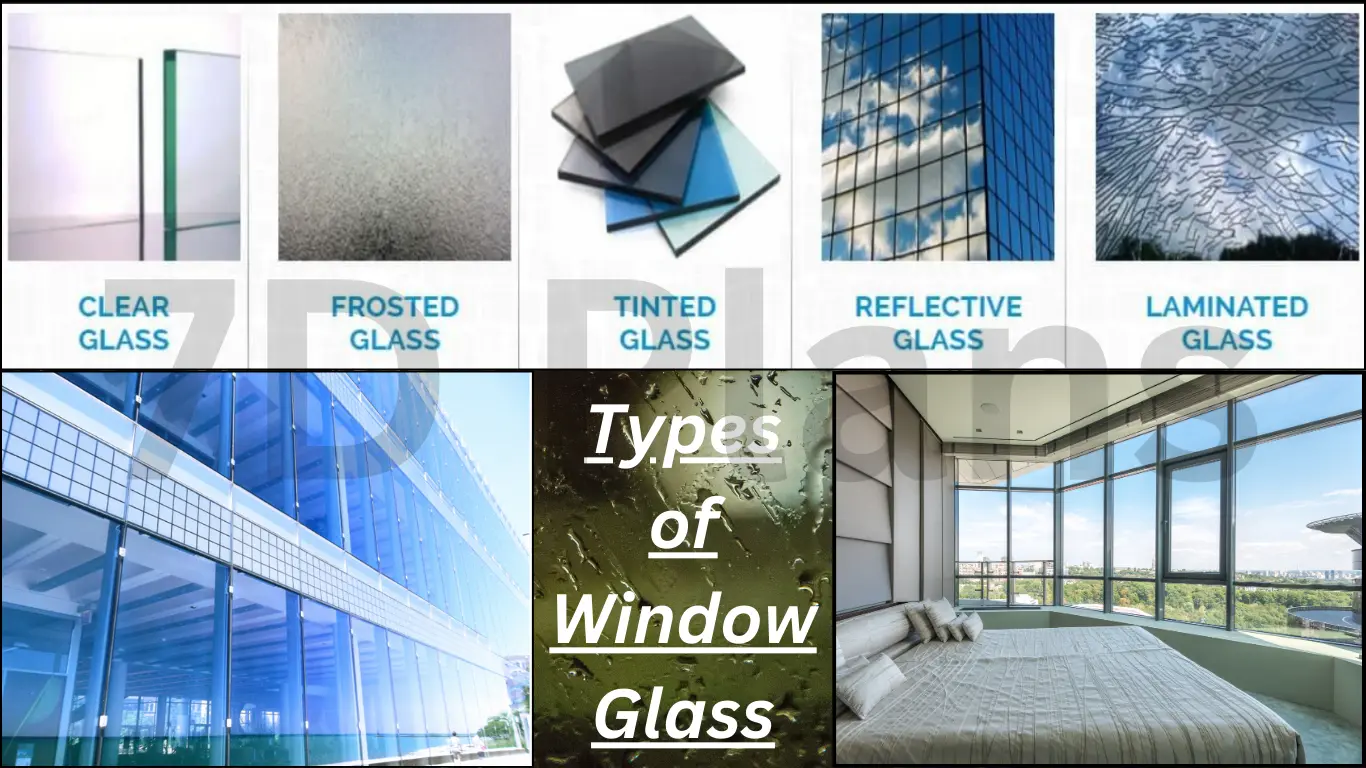
4. Tempered Glass — What It Solves
- Strength: ~4–5× stronger than annealed glass of the same thickness; surface stress ≥95 MPa process control on our lines.
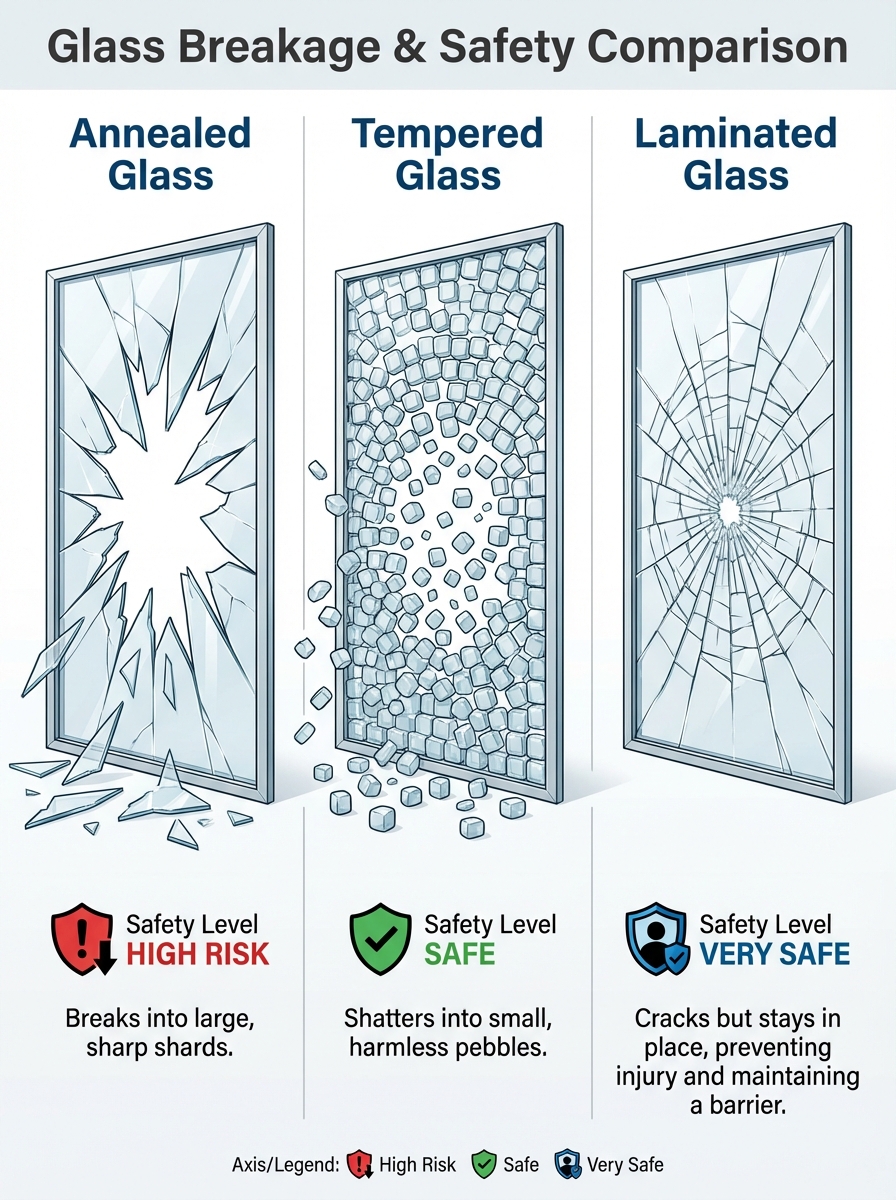
- Safe breakage pattern: fractures into small, relatively blunt granules rather than large shards.
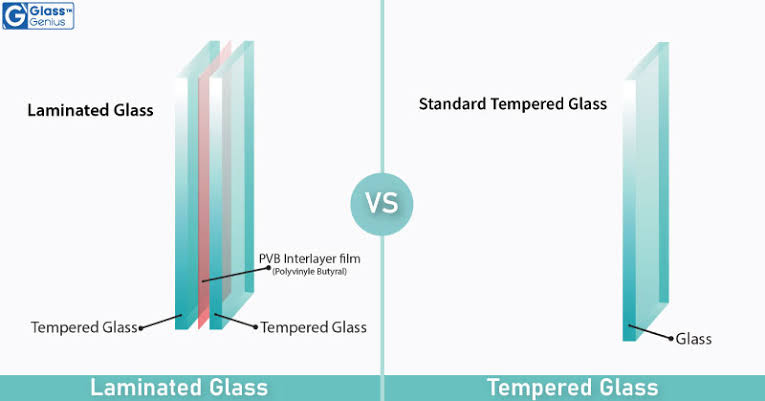
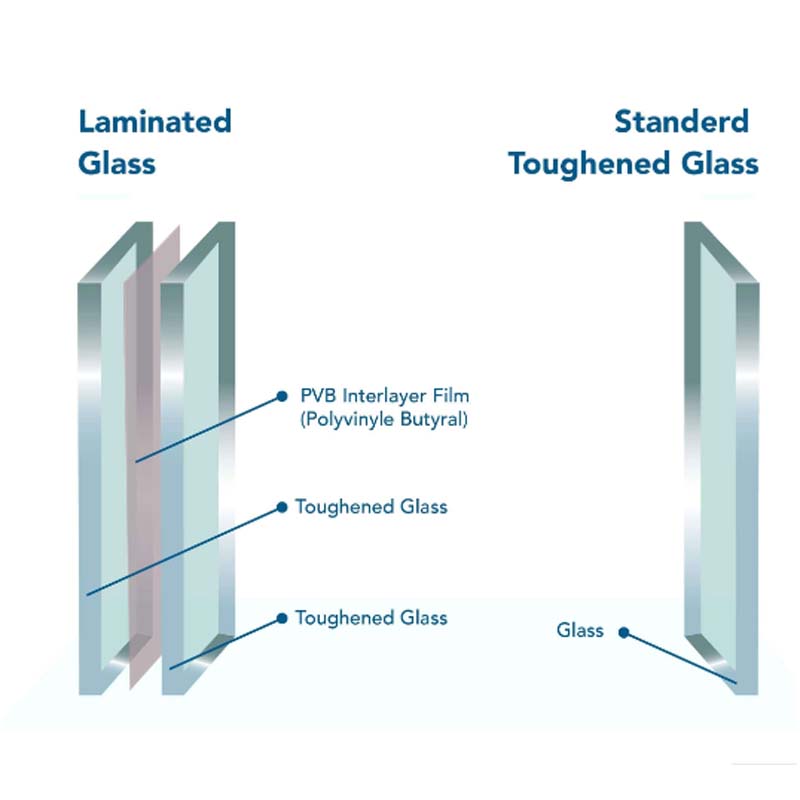
- Limit: once broken, it fully loses integrity—it does not hold together. That is why it is not enough alone for fall-through or overhead risk.
- HST (heat soak): 554°F (290°C) for 4 hours reduces NiS spontaneous breakage; breakage control <0.08% on our tempered lines.
HST addresses spontaneous breakage risk—not post-breakage retention. Do not use "HST" as a substitute for lamination.
5. Laminated Glass — What It Solves
- Post-breakage retention: PVB (0.38–2.28mm) or SGP/EVA interlayer holds broken pieces in the frame.
- Safety: impact resistance ≥900J on our laminated lines; BS EN 356:2020 P8A certified options.
- Acoustic damping, security, UV control when combined with appropriate interlayer.
- Residual strength: SGP > PVB under sustained load; choose by required residual load capacity.
- Default rule: where glass is above people—balustrades, railings, overhead, skylights, sloped glazing, and impact/security zones—laminated construction is the default, typically with tempered or heat-strengthened lites. Tempered alone is not a retention strategy.
6. IGU — What It Solves
- Thermal insulation: sealed double (or triple) glazing controls U-value; performance depends on the whole IGU system.
- Solar control: low-E coating + cavity + gas fill + warm-edge spacer control SHGC and VLT.
- Build-up example: double-silver IGU
6 + 16Ar + 6 with coating on surface #2; high-performance IGU U-value U = 1.2–1.8 (Low-E IGU with argon), SHGC 0.15–0.5. - Capacity: IGU up to 13000×3000mm; monolithic/laminated sheet up to 3300×20000mm.
The coating datasheet is not a full IGU certificate. Request the IGU calculation, gas-fill verification, seal warranty and IGCC/equivalent certification.
7. Combining Them — Common Make-ups
| Make-up | Use case | Why it works |
|---|
| Tempered IGU (e.g. 6+16Ar+6, coating on #2) | Standard vision curtain wall / window | Strength + thermal control; safety by code/risk review |
| Laminated + IGU (e.g. (8+1.52PVB+8)+12A+12) | Safety + energy (façade spandrel, overhead-adjacent) | Retention + U/SHGC in one unit |
| Heat-strengthened / HST-tempered + laminated | High safety + large panel format | Residual strength + controlled breakage |
| Triple IGU with low-E + warm edge | Cold climate / aggressive energy target | Low U with daylight and solar control |
8. Sizing & Capacity
| Format | Manufacturing capacity | Note |
|---|
| Monolithic / laminated sheet | up to 3300×20000 mm | Single sheet; handling and transport limited |
| Insulating glass unit (IGU) | up to 13000×3000 mm | Sealed unit: gas, edge seal, logistics limit |
| Real project panel (e.g. Qianhai Chuangjin Tower) | max 1800×4300 mm / 7.74 m² | Chosen by framing/system, not max capacity
Honest sizing note: Jumbo is a manufacturing capability; the panel size used on a project is a system design result (framing, wind load, deflection, logistics, approved shop drawings). |
9. Codes & Compliance
- Tempered: EN 12150 / ASTM C1048; HST records and edge quality on request.
- Laminated: EN 14449 / ASTM C1172; impact/retention to EN 356 (P8A) as applicable.
- IGU: EN 1279 / IGCC referencing practice; 20-year seal warranty where claimed.
- Structural: ASTM E1300 for thickness/load; EN 13830 and ASTM E330 for curtain wall performance.
- Energy: local code U/SHGC/VLT and whole-façade modelling (ASHRAE 90.1 / IECC / GB 50189 / EU EPBD as applicable).
10. Selection Decision Flow
- Map fall / impact / overhead risk in every zone.
- Is retention required after breakage? → laminated.
- Is thermal/solar control required? → low-E IGU.
- Does the zone need both? → laminated IGU.
- Confirm wind load, span, deflection and safety class.
- Choose interlayer (PVB vs SGP) by residual-strength need.
- Decide HST / heat-strengthened for breakage control.
- Check jumbo/oversize feasibility (IGU ≤13000×3000mm).
- Run structural calculation and energy model.
- Issue RFQ data pack and review shop drawings.
11. RFQ Data Pack
- Project location, climate zone, building height and orientation.
- Glass sizes, quantities, vision/spandrel or zone map (including risk zones).
- Safety requirement: tempered / laminated / HST / impact class (e.g. P8A).
- Performance: U-value (down to 0.7), SHGC (0.15–0.5), VLT.
- IGU details: cavity width, gas fill, warm-edge spacer, coating position (usually #2).
- Structural: wind load, allowable deflection, edge condition.
- Acoustic / security / UV requirements if any.
- Max size, packaging, delivery window and spare-panel allowance.
- Drawings, mock-up/test and certification requirements.
12. Frequently Asked Questions
Is tempered glass safer than laminated glass?
They solve different safety problems. Tempered glass is stronger and breaks into small granules, but loses all integrity on failure. Laminated glass holds broken pieces in the frame (post-breakage retention). For fall-through, overhead and impact risk, laminated is the safer default—often combined with tempered or heat-strengthened lites.
Does HST make tempered glass equivalent to laminated?
No. HST (554°F × 4 hrs) reduces the risk of spontaneous NiS breakage; it does not provide post-breakage retention. Lamination is still required wherever retention matters.
When should I specify an IGU instead of monolithic glass?
Specify an IGU when thermal insulation or solar control is part of the brief—curtain walls, windows and façades. For pure safety or structural applications without thermal demands, monolithic tempered or laminated may be sufficient.
Can an IGU also be laminated?
Yes. A laminated lite can form one side of an IGU (e.g. (8+1.52PVB+8)+12A+12). This is common where safety and energy performance are both required, such as spandrel zones or overhead-adjacent glazing.
What is the maximum IGU size?
IGU manufacturing capacity is up to 13000×3000mm; monolithic and laminated sheets can be larger, up to 3300×20000mm. The actual panel size on a project is set by framing, wind load, deflection and logistics—not capacity alone.
How do I choose between PVB and SGP interlayer?
Choose by required residual load capacity after breakage and budget: PVB covers most architectural safety needs; SGP provides higher residual strength for security, blast or heavy-duty balustrade/overhead conditions.
Need a tempered / laminated / IGU specification review?
Send your zone map, risk profile and performance targets. We will cross-check safety class, make-up, HST, jumbo limits and compliance evidence against your project specification.
Contact us / Request a quotation
Related Guides
Balustrade & Railing Glass Guide
Laminated safety, line loads, edge treatment and jumbo sizing.
IGU Selection Guide
Argon, warm edge, cavity, double vs triple and U-value.
Low-E Glass Selection Guide
Coating family, SHGC/VLT/U-value and coating position.
Continue Reading
Jumbo Glass Family
Related Products
Resources
Back to the full selection-guide index.
Glass Skylight Selection Guide →
Sloped overhead glazing taken to the extreme — atrium & skylight rules.
Glass Bridge / Deck Guide →
When your canopy becomes walkable — concentrated load rules.
Jumbo Laminated Glass →
The product page behind every PVB / SGP canopy build-up.
Jumbo Tempered Glass →
Monolithic tempered plies (pre-lamination) and material spec.
Jumbo Glass / Oversize Glass →
Size definitions, capability and engineering overview.
Source & spec basis: Jumbo Tempered Glass Group manufacturing capabilities (tempered surface stress ≥95 MPa; HST 554°F × 4 hrs; breakage control <0.08%; laminated impact ≥900J; BS EN 356:2020 P8A; PVB 0.38–2.28mm; SGP/EVA; monolithic/laminated up to 3300×20000mm; IGU up to 13000×3000mm; high-performance IGU U = 1.2–1.8 (Low-E IGU with argon), SHGC 0.15–0.5; 20-year seal warranty; EN/ISO/ASTM/IGCC referencing practice), and disclosed project data from Qianhai Chuangjin Tower façade specification. Final values must be confirmed by approved shop drawings, design institute/engineer and local authority requirements.